
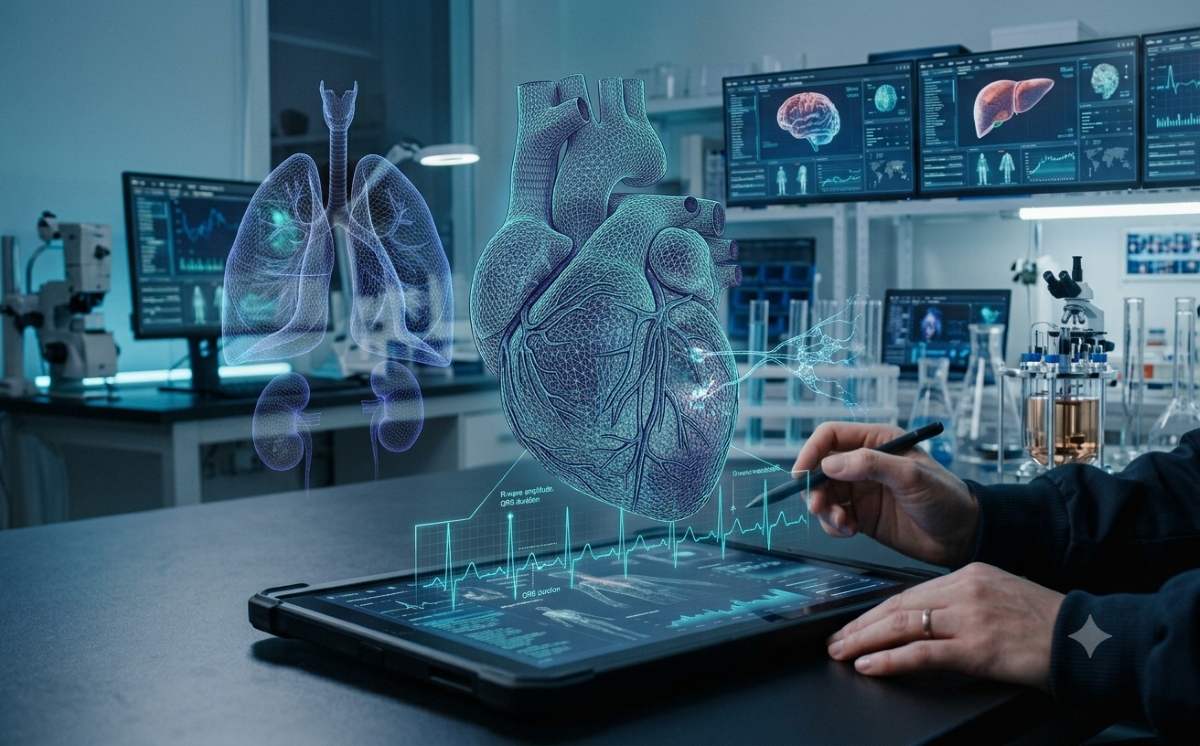
Organ digital twins have moved from mathematical curiosity to funded national priority. Imperial College London now sits close to the centre of that shift. Researchers there have built more than 3,800 anatomically accurate virtual hearts. They have also begun an NHS study that the university calls a first of its kind. In March 2026 the university joined an £11 million partnership with GSK and the University of Oxford. That centre will model the lungs, liver and kidneys. The wider programme offers a rare chance to judge what organ digital twins can already do, and what remains unproven.
What an organ digital twin is, and what it is not
The term is used loosely across health technology, so definitions matter. In computational physiology, an organ digital twin is a virtual representation of a specific organ or system. It maps one to one onto an individual patient and updates as new data arrives. That continuous link to the person is the distinguishing feature. A static simulation, a population average or a three-dimensional rendering does not qualify.
Two modelling philosophies sit behind the field. Statistical and machine learning approaches identify patterns in large datasets and predict outcomes from them. Mechanistic models instead encode the underlying physics, physiology and pharmacology. They represent cause and effect rather than correlation. Imperial’s programme leans heavily on the mechanistic tradition. The argument is simple. A model that explains its own output is easier for clinicians and regulators to trust.
Building organ digital twins at population scale
The clearest demonstration of that approach at scale arrived in May 2025. The study appeared in Nature Cardiovascular Research. It came from Imperial’s National Heart and Lung Institute, King’s College London and the Alan Turing Institute. The team generated more than 3,800 anatomically accurate digital hearts. The models drew on imaging and electrocardiogram data from UK Biobank, alongside a separate cohort of patients with heart disease. Machine learning removed much of the manual work that had confined such models to a handful of cases.
The findings were substantive rather than merely technical. The cohort comprised 3,461 twins from UK Biobank and a further 359 from an ischaemic heart disease group. Age and obesity were associated with altered myocardial conduction velocity and potassium conductance. Longer QTc intervals in obese women were attributed to greater delayed rectifier potassium conductance. The analysis also found that sex differences in QRS duration were fully explained by myocardial anatomy. Conduction velocity itself remained similar across the sexes. That distinction carries practical consequences for device programming and diagnostic thresholds.
Professor Steven Niederer was senior author on the study. He is now Chair in Biomedical Engineering at the National Heart and Lung Institute, having undertaken the research while at King’s College London. In the announcement accompanying the study, he said the potential of cardiac digital twins “goes beyond diagnostics”. In the same announcement, co-author Professor Pablo Lamata of King’s College London said the insights “will help refine treatments and identify new drug targets”. Dr Shuang Qian, first author of the paper, has identified links between heart function and genetics as the next step. Funders included the Wellcome Trust, the British Heart Foundation and the NIHR Imperial Biomedical Research Centre. The Engineering and Physical Sciences Research Council also supported the work.
Testing the technology inside the NHS
Population-scale modelling answers research questions. The harder test is whether a twin can inform decisions about an individual patient in routine care. That is the purpose of CVD-Net, an £8 million programme led by Professor Niederer. The Engineering and Physical Sciences Research Council funds it. Partners include the Alan Turing Institute and the universities of Sheffield and Nottingham.
CVD-Net focuses on pulmonary arterial hypertension, a rare condition with high mortality. Patients experience frequent episodes of clinical deterioration. Care in Great Britain is concentrated in seven designated adult centres and one paediatric centre. Assessment currently depends on episodic clinic assessments. These use six-minute walk distance, World Health Organization functional class and natriuretic peptide levels. Imaging follows at intervals of three to six months. Between appointments, clinicians have limited visibility of a patient’s trajectory.
The project builds virtual copies of participants’ hearts and circulation. Inputs include medical records, hospital scans and readings from wearable and implanted monitors. The models then update continuously. Participants are recruited through specialist centres including Imperial College Healthcare NHS Trust and Sheffield Teaching Hospitals. The NIHR Imperial Clinical Research Facility coordinates the Imperial arm. In Imperial’s announcement of the project, Professor Niederer described the study as a first, conducted “for a real patient group, at a reasonable scale”.
A 2026 review in the American Journal of Respiratory and Critical Care Medicine sets out the roadmap in detail. Professor Niederer is the corresponding author. Its central argument is that a patient twin could move care from reactive to anticipatory. The twin would work as a complementary decision-support tool alongside trial evidence, not as a substitute.
MiMeC extends the work beyond the heart
The newest strand is the Modelling-Informed Medicine Centre, announced in March 2026 and backed by £11 million from GSK. Professor Niederer leads the Imperial contribution. Professors Helen Byrne and Philip Maini lead at the University of Oxford, and Dr Anna Sher is co-director for GSK. Life Science Daily News reported the launch and funding structure at the time.
The Imperial workstream is ambitious in scope. The team intends to build patient-specific organ models representing millions of cells and the relationships between them. It will do so by simulating a proportion of the cells found in the real organ. In practice, a simple in vitro experiment on a single lung cell could be scaled computationally. The output would be a prediction about airway behaviour. In the launch announcement, Professor Niederer framed the appeal in engineering terms. Researchers, he said, “can perform virtual experiments in models of humans at great speed”.
All models are to be released on an open-source basis, with reproducibility standards and case studies alongside them. GSK expects to incorporate organ-level models into its drug development pipeline within five years. Industrial placements for centre researchers will support that goal. The centre’s remit also covers cartilage, which Imperial’s own announcement omitted. Oxford leads the modelling work on cartilage and lung disease. Imperial’s stated scope covers the lungs, liver and kidneys.
Why drug developers are paying attention
Attrition remains the central economic problem in pharmaceutical research. Candidates that perform well in laboratory and animal studies frequently fail in humans. Preclinical systems often predict human organ responses poorly. Mechanistic organ digital twins offer a route to testing hypotheses earlier. Uses include flagging likely hepatotoxicity and identifying responsive patient subgroups. Others include optimising dosing and populating in silico trials with virtual patients.
Dr Sher has described the value as a cycle. Teams move between computational modelling, prediction and experimental testing to reach decisions faster. GSK’s respiratory and inflammation portfolio maps closely onto the organs the centre has selected. The commercial logic is therefore straightforward.
Regulators are moving, cautiously
The regulatory environment has shifted in parallel. The US Food and Drug Administration published a roadmap in April 2025. It set out how new approach methodologies, including in silico models, could reduce reliance on animal testing. Monoclonal antibodies come first. A year-one progress report followed in April 2026. Draft guidance from the Center for Drug Evaluation and Research now sets out validation expectations for non-animal methods. The agency and the European Medicines Agency also published ten joint principles for artificial intelligence in January 2026.
The consistent theme across those documents is context of use. The FDA’s 2023 guidance on computational modelling in device submissions established the same risk-based framing. A model is never credible in the abstract, only for a defined decision at an assessed level of risk. That framing sets a high bar for anyone hoping to submit organ digital twins as regulatory evidence.
The limits worth stating plainly
None of this yet amounts to a validated whole-organ twin in routine clinical use. Calibration remains expensive and computationally demanding. That is a barrier the Turing digital twins cluster was set up to address. Data quality and representativeness are unresolved. UK Biobank participants are healthier and less diverse than the general population. Models built on that foundation may generalise poorly.
Governance questions follow. A self-updating twin requires a defined approach to model drift, version control and clinical accountability. Evidence that twins improve outcomes, rather than simply tracking them accurately, has still to be generated. CVD-Net is deliberately structured around iterative design cycles, with patient and clinician involvement from the outset.
What to watch next
Three markers will indicate whether organ digital twins are maturing. The first is what CVD-Net reports from its design cycles, particularly on feasibility, scalability and affordability within NHS pathways. The second is the pace and quality of the centre’s open-source releases. Those will determine whether it becomes a community resource or a bilateral collaboration with a publication record. The third is whether GSK meets its five-year target for integrating organ-level models into development decisions.
Imperial’s position is unusual. One research group combines population-scale model generation, a live NHS evaluation and an industrial partnership. Whether organ digital twins become standard infrastructure or remain a specialist tool is still open. Much depends on what that combination produces over the next three years.