

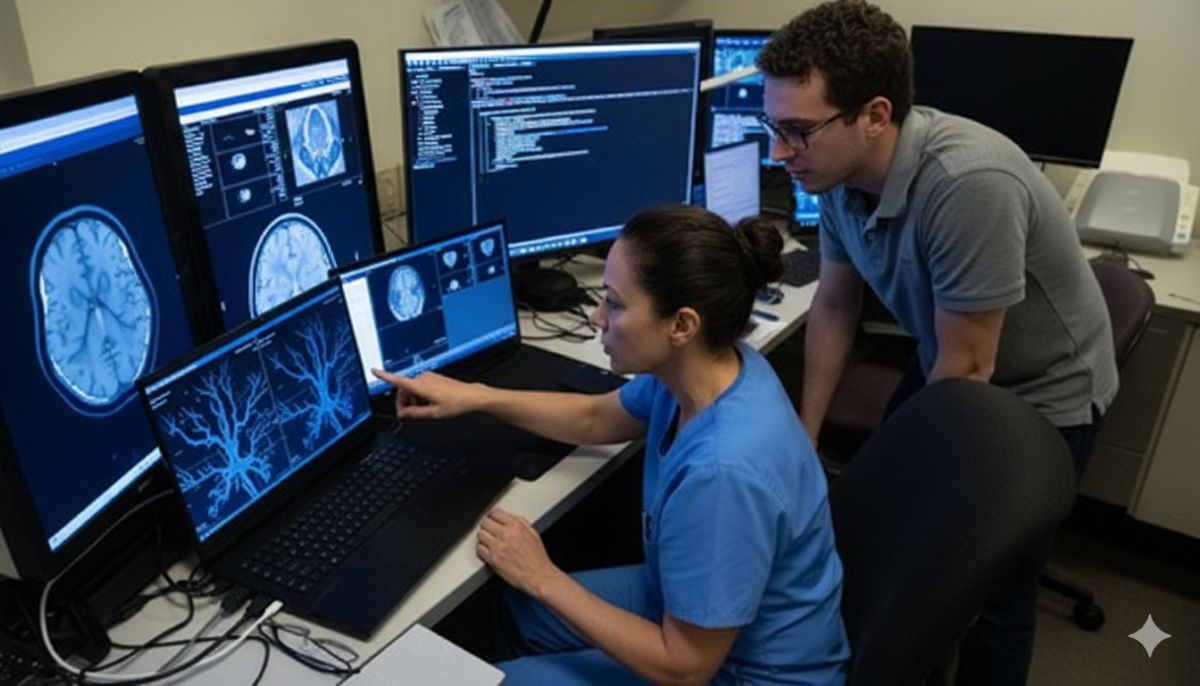
In a landmark development for stroke treatment, medical technology company Remedy Robotics has announced what it describes as the world’s first fully remote endovascular neurointerventional procedures using its N1 robotic system. The announcement, made on 6 October 2025, marks a major step toward delivering time-critical stroke care in locations lacking specialist intervention.
Remote Intervention Leveraging Endovascular Robotics
The N1 System integrates a robotically controlled catheter laboratory environment with AI-enabled software, enabling clinicians to perform endovascular procedures from a remote console. According to Remedy Robotics, the system has been used in-human for the first time during fully remote procedures conducted between hospitals within the same network in Toronto under the leadership of neurosurgeon Vitor Mendes Pereira at St Michael’s Hospital.
In a parallel demonstration, Lithuanian company Sentante reported the first transatlantic remote thrombectomy, with surgeons in Florida and Scotland guiding a clot-removal procedure on a perfused cadaver in Dundee.
Dr Pereira said:
“By successfully completing these first remote procedures in humans, we’re not just introducing a breakthrough technology, we’re taking real steps towards ensuring that every person around the world has access to the best possible endovascular care.”
Why This Matters for Stroke Patients
Acute ischaemic stroke, typically caused by a blood clot obstructing a brain artery, demands rapid intervention. The procedure known as mechanical thrombectomy is considered a gold-standard treatment, yet only a small minority of eligible patients worldwide receive it. Remedy Robotics notes fewer than 3% of patients globally currently access thrombectomy.
The introduction of a system capable of extending specialist intervention beyond the walls of major thrombectomy centres could therefore transform care in underserved or remote regions. The Sentante demonstration emphasises this potential, as in Scotland fewer than 2.2% of stroke sufferers underwent thrombectomy in 2024.
Technical and Operational Insights
Sentante’s haptic-feedback platform enables operators to sense catheter movement and vessel resistance, conveying tactile feedback that mimics conditions at the bedside. Chief Executive Edvardas Satkauskas described how the remote system gave physicians the same “hands-on” feel as conventional thrombectomy.
Latency and connectivity are critical to remote interventions. Sentante’s trial reportedly managed a transatlantic link with approximately 120 millisecond lag, which the team said did not compromise procedural safety.
Meanwhile, the N1 System from Remedy Robotics supports up to four tools, including off-the-shelf wires and microcatheters, with clinicians operating from a portable console available for use across vast distances. Reducing geographical barriers to specialist care remains the central objective.
Partnerships and Roadmap
On 27 October 2025, Remedy Robotics announced a strategic partnership with Mission Thrombectomy, a global clinician network dedicated to accelerating access to endovascular thrombectomy. Through this agreement, Remedy Robotics will become the exclusive robotics partner of Mission Thrombectomy, working toward global deployment of the N1 System.
That rollout is geared especially toward hospitals and regions where specialist thrombectomy access is limited, aligning with efforts to reduce disparity in stroke care worldwide.
Challenges and Future Directions
Despite these advances, significant hurdles remain before fully remote robotic thrombectomy becomes routine. Regulatory approval, integration into standard hospital workflows, training of remote operators, and ensuring reliable connectivity in healthcare settings are all outstanding issues. Sentante, for example, states that its remote thrombectomy platform remains in the pre-clinical phase and is targeting market entry from 2026 onward.
Equally, hospital adoption will hinge on demonstrating safety, cost-effectiveness, and clinical outcomes in real-world patients rather than cadaveric models. The availability of appropriate infrastructures such as hybrid catheter laboratories, secure tele-networks, and rapid imaging remains uneven globally.
Conclusion
The launch of remotely operated endovascular systems such as the N1 from Remedy Robotics and the haptic-enabled platform from Sentante represents a pivotal moment in stroke care. By decoupling specialist interventional expertise from physical location, these technologies hold the promise of extending life-saving thrombectomy treatments to patients who would otherwise face long transfers or no access at all. As the field advances through regulatory and clinical translation phases, the prospect of remote stroke intervention moves closer to clinical reality, with the potential to reshape how vascular emergencies are treated worldwide.