

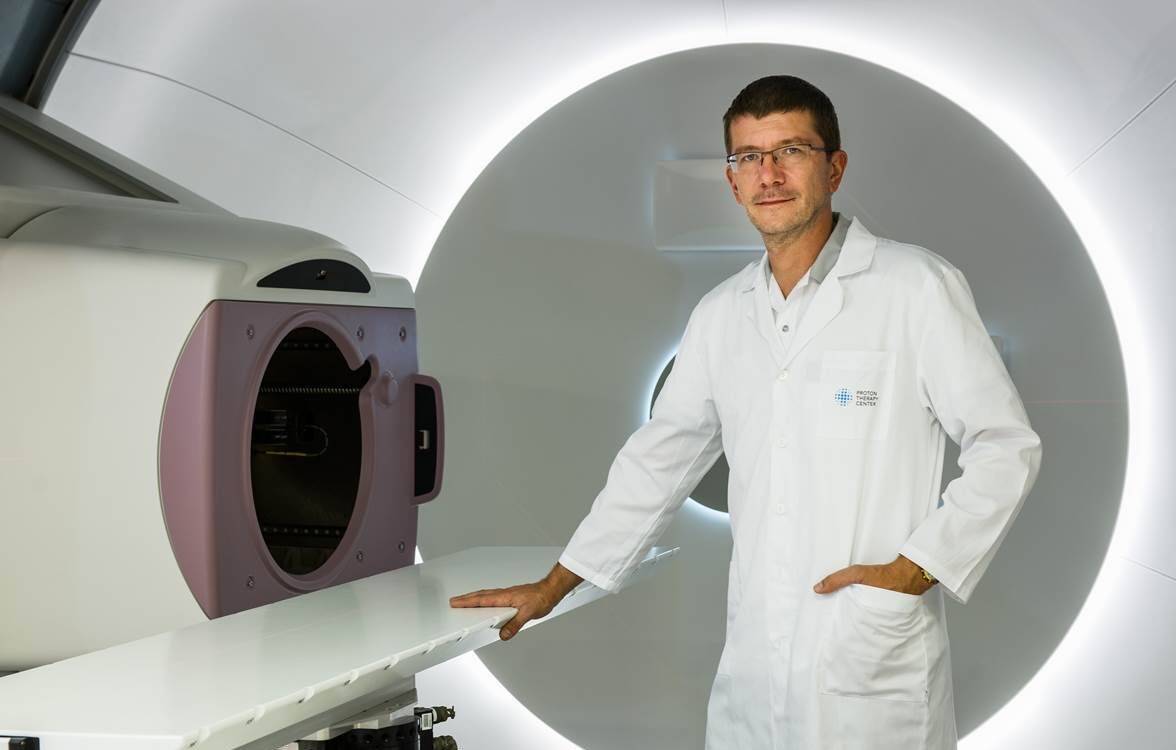
Emerging research from a team of oncologists in Prague suggests that radiotherapy — long understood as a tool for destroying cancer cells — may also play a powerful role in activating the body’s own immune defences. The implications for how we sequence and combine cancer treatments could be significant.
A new way of thinking about an established treatment
Radiotherapy has been a cornerstone of cancer treatment for decades, used to target and destroy tumour cells with high-energy radiation. But a growing body of research is beginning to reveal a second, less understood dimension to its effects: its capacity to interact with — and potentially activate — the immune system.
A team of physicians at the Proton Therapy Center in Prague, Czech Republic, has published research exploring this interaction, with findings that could reshape how clinicians think about treatment sequencing and the combination of radiotherapy with immunotherapy.

Dr Kateřina Dědečková
Lead author Dr Kateřina Dědečková frames the shift in terms that go beyond conventional oncology:
“While radiotherapy has long been known as a method to kill cancer cells, it also has the potential to activate the body’s immune system — almost like a vaccine against the tumour itself. This gives us a new way of thinking about radiotherapy. It’s not just a destructive tool but one that can help the immune system see and attack the tumour more effectively.”
The immunological case for proton therapy
Not all forms of radiotherapy interact with the immune system in the same way. The distinction between conventional photon-based radiotherapy and newer proton therapy is central to understanding the research.
Co-author Dr Jiří Kubeš, whose recent work has focused on the interaction between ionising radiation and immune function, outlines three reasons why proton therapy may offer advantages in this context.
The first relates to dose distribution. Conventional photon techniques deliver radiation across a relatively large volume of the body, exposing healthy tissue — including immune cells — to radiation beyond the primary tumour site. Proton therapy, by contrast, can deliver more precise doses, limiting exposure to surrounding tissue.
The second concerns the physical properties of the particles involved. Photons carry no mass, whereas protons are particles with weight and a substantially higher energy transfer per unit of distance. This concentrated energy transfer within cancer cells is thought to produce a different — and potentially more immunologically significant — form of cell death, releasing antigens that can stimulate an immune response.
“There are antigens that are released after particle therapy and these antigens stimulate the immune system due to the energy transfer.” — Dr Jiří Kubeš
The third factor concerns where immune responses are triggered. With proton therapy, Dr Kubeš explains, the immune reaction tends to occur in the lymph nodes nearest to the tumour — a distinction that matters because those nodes are often irradiated in cases of more advanced disease, where there is a higher probability of microscopic tumour spread.
Lymphocytes: the immune system’s most vulnerable soldiers
Central to this discussion is the effect of radiotherapy on lymphocytes — a type of white blood cell that plays a key role in the immune response to cancer, and the most radiosensitive cells in the body.
Dr Kubeš explains the clinical significance:
“Lymphocytes are the chiefs in the immune system, which is important with anti-cancer immunity, but they are also the most radiosensitive cells in the body. Modern photon techniques with modern immunotherapy will frequently mean a very low number of lymphocytes, so immunotherapy cannot work as successfully.”
The practical consequence is stark. When patients complete a course of conventional photon radiotherapy with a severely depleted lymphocyte count, the effectiveness of any subsequent immunotherapy may be significantly compromised — and recovery of lymphocyte levels can take one to two years.
These figures are indicative estimates consistent with published clinical data. The 10 per cent threshold corresponds to grade 4 lymphopenia, while 30 per cent sits at the boundary between grade 2 and grade 3. Multiple peer-reviewed studies have documented the lymphocyte-sparing advantage of proton over photon therapy across cancer types, including in non-small cell lung cancer (Kim et al., Radiotherapy and Oncology, 2021) and oesophageal cancer (Fang et al., International Journal of Particle Therapy, 2018). The research team’s observations suggest that patients completing proton radiotherapy retain approximately 30 per cent of their initial lymphocyte count, compared with fewer than 10 per cent in many patients completing standard photon treatment.
The abscopal effect: radiation’s reach beyond the tumour
One of the more striking phenomena described in the research is the abscopal effect — a systemic immune response triggered by localised radiation, capable of affecting cancer cells at sites distant from the treated tumour.
Dr Kubeš illustrates the effect with a clinical example:
“If, for example, we have a patient with three metastatic nodules in the lung and we decide to radiate one, all three could disappear. They disappear due to the radiation of the one nodule which activates the immune system and that will destroy the next two.”
The implication is that the form of radiotherapy used matters. “You can do the radiation with photons,” Dr Kubeš notes, “but if you do, you will kill more of the lymphocytes” — potentially blunting the very immune response the treatment is trying to engage.
Wider research context: an emerging field
The research sits within a broader and rapidly evolving field. Interest in the immunomodulatory effects of radiotherapy has grown significantly in recent years, with a number of studies examining how radiation-induced cell death can trigger immune activation — and how different radiation modalities may do so with varying efficacy. Grass et al. (Current Problems in Cancer, 2016) provide a detailed account of the immune mechanisms underlying the abscopal effect, while Lambin et al. (Seminars in Radiation Oncology, 2020) set out the rationale for protecting lymphocyte-rich organs when combining radiotherapy with immunotherapy — a principle central to the PTC team’s approach.
The PTC team’s findings add a clinical perspective to this discussion, particularly in relation to proton therapy’s potential to preserve immune function during treatment — a factor that may prove increasingly important as immunotherapy becomes more central to oncology practice.
Clinical implications and the future of treatment sequencing
The research also examined factors beyond particle type, including the potential relevance of the time of day at which treatment is delivered, and experimental techniques such as FLASH radiotherapy — an approach that delivers radiation in ultra-high doses over a very short timeframe, which some researchers believe may reduce damage to healthy tissue.
Dr Dědečková points to a significant potential shift in how oncologists might approach treatment planning:
“In the future we may well see radiotherapy and immunotherapy used first in treatment plans, where currently chemotherapy is thought to be the best option. Until recently that was hardly conceivable.”
She adds: “By combining radiotherapy with immunotherapy it could make the overall treatment more powerful and less toxic than chemotherapy.” The caveat, she acknowledges, is that this remains an area of active investigation — and that validation at scale is essential before such a shift could be adopted more broadly.
Study limitations and the road ahead
The research, published in the Czech science journal Vesmír, examined outcomes in four patients: three with lymphomas and one with inoperable lung cancer, each of whom had a poor prognosis. All showed more favourable outcomes when radiotherapy was combined with immunotherapy, maintaining better quality of life over extended follow-up periods.
The authors are clear-eyed about the scope of their findings. Dr Kubeš notes:
“We are still carrying out research to understand these findings and larger trials will need to be carried out.”
Looking ahead, the team’s focus is on translating these early observations into practice. Where recognised guidelines allow, they will be working to reduce irradiated volumes and shorten fractionation schedules — both confirmed strategies for maintaining higher lymphocyte counts at the end of radiotherapy. In cases where immunotherapy is already part of standard treatment, such as lung cancer, they will be closely monitoring treatment effectiveness in relation to post-radiotherapy lymphocyte levels. The priority now is collecting sufficient data to analyse which approaches prove most effective.
The small sample size and single-centre design of the study mean the findings should be interpreted as hypothesis-generating rather than definitive. Nevertheless, the mechanistic rationale is grounded in established immunology, and the team’s clinical observations offer a compelling basis for further investigation.
Conclusion
The idea that radiotherapy might serve not just as a weapon against tumour cells, but as a catalyst for the immune system’s own capacity to fight cancer, represents a meaningful evolution in oncological thinking. If larger trials confirm what early evidence suggests, the clinical consequences — particularly for patients with difficult-to-treat or treatment-resistant tumours — could be substantial.
As Dr Dědečková puts it:
“We are beginning to look at radiotherapy as a tool to help the body fight cancer from within.”
About the authors
Dr Kateřina Děděčková — Radiation Oncologist, Proton Therapy Center, Prague
Dr Jiří Kubeš — Radiation Oncologist, Proton Therapy Center, Prague
Disclaimer: Both authors are employed at the Proton Therapy Center in Prague, whose primary treatment modality is proton therapy. Readers should consider this context when evaluating the findings presented.
This article represents the views of the authors and not those of Life Science Daily News.