

It’s impossible to escape the topic of AI right now. AI hype in life sciences now dominates every boardroom, industry conference, pitch deck and earnings call. But we’ve seen this movie before. A decade ago, the topic was the cloud, and it, too, was everywhere – paving the way to the future.
Today, nearly every business and life sciences organization runs in the cloud, but few talk about it being a cloud company anymore because the cloud was never the point. It was a flexible and secure infrastructure in service of fueling business innovation, value, and scalability. AI will follow the same arc, and the organizations that understand this now will benefit the most.
What have we learned from earlier hype cycles? The danger lies in letting AI, in and of itself, become the primary mission or goal.
The shiny toy problem
For life science and other businesses, we are like kids with a shiny new toy. It’s easy to understand the excitement because the possibilities really are remarkable, from accelerating drug discovery to automating quality checks in manufacturing. But a toy we don’t yet know how to play with responsibly carries real risk. In the case of AI, these risks include exposed intellectual property, patient data privacy, security vulnerabilities and even the environmental toll of data centers drawing power and water from our patients and communities.
When AI adoption itself becomes the measure of innovation, organizations start asking the wrong question. Instead of “What problem are we solving for patients, clinicians and society?” the question becomes “How much AI are we using?” That inversion is how companies lose the plot and begin prioritizing technology for technology’s sake.
The process automation era taught us an important lesson: you can automate any process, even if it isn’t wise. Being more efficient at something that isn’t worth doing in the first place is not progress. The same holds true for AI. An algorithm layered onto a broken manual workflow, ungoverned data or vague objectives does not add value. It simply creates noise at a much faster pace and requires time and resources to go back and repair. It can also lead to false flags and poor decision-making at the highest levels, if not properly verified.
By the numbers: enthusiasm vs. impact
McKinsey research found that essentially every life sciences company has experimented with generative AI. About a third have moved to scale it, yet only 5% currently see it as a consistent competitive advantage. Despite this lack of ROI, more than two-thirds plan to significantly increase their investment.
Yes, you read that correctly: almost universal experimentation and massive investment resulting in only minimal advantage. The problem isn’t AI; it’s the fact that adoption alone doesn’t confer anything. The activating factor is pairing AI investment with quality data, disciplined governance and a clearly defined outcome.
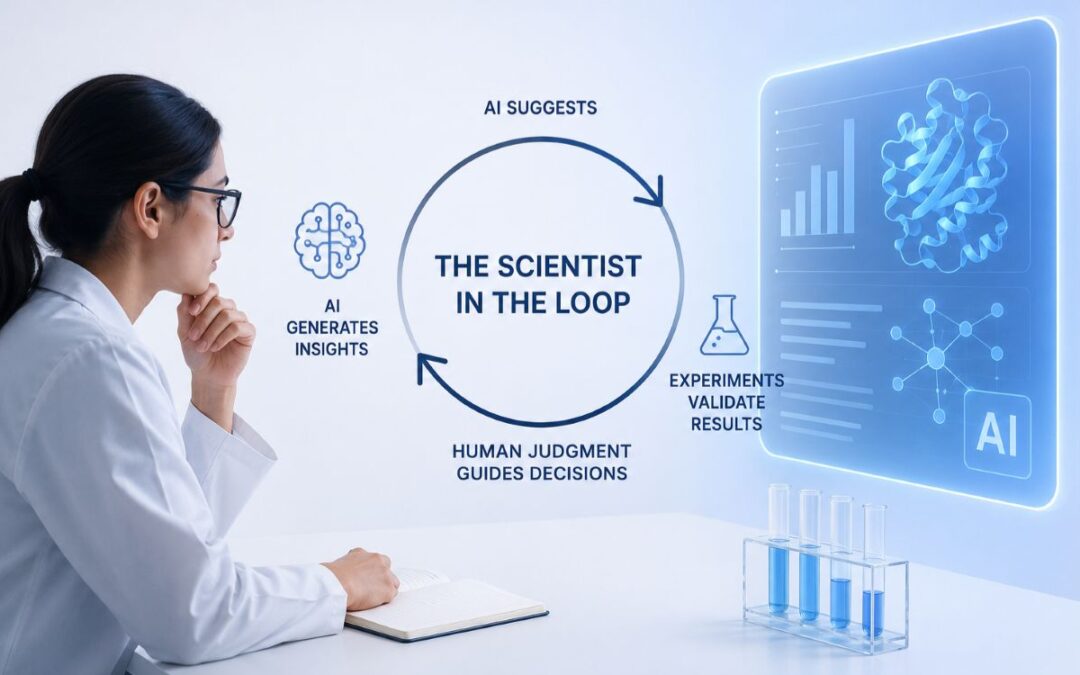
The stakes are high in life sciences, and they further justify the need for responsible AI adoption. Bringing a therapy device to market still takes 10-12 years and more than $2.6 billion. Patient outcomes and regulatory compliance hang on every decision. Critical elements like drug efficacy and patient safety cannot be handed off to AI without human judgment. AI can inform, but accountability must remain with people who can evaluate the information based on context.
The questions that still matter
The most successful life sciences organizations have always been defined by the problems they solve. The teams behind the first new type 1 diabetes therapy since insulin weren’t there for the technology; they were there to provide juvenile diabetics with an alternative treatment and result. Blockbuster medications earned their place by applying science and good clinical and manufacturing discipline to help millions of patients. The technological advances behind this drug development fueled their innovation and competitive edge when applied carefully at key points.
AI should be held to the same standard, and healthcare innovations should be driven by unmet needs and potential outcomes and value. For example, a disease without therapy, a drug trial that takes too long, supply chain gaps and traceability, and a financial close that steals days from decision-making. Start with the objective/business case and work backward to the right tool. Today, there are many opportunities to tackle those business needs with AI. AI depends on good quality data and data management, cloud agility, cybersecurity resilience, and the manufacturing compliance and flexibility that personalized medicine demands.
Digital transformation in pharmaceutical and biotech organizations is a lot broader than any single technology. Life sciences leaders need to balance AI with other initiatives that move the needle.
Governance is the difference between an asset and a liability
These realities build the case for AI governance and regulatory compliance as the foundation of any AI strategy. Governance means controlling how AI is used across the enterprise and what data it can access. Leadership needs to know which AI projects exist so it can prioritize and fund the right ones. Ungoverned AI almost guarantees an expensive reckoning down the line.
In a regulated, GxP-driven industry, good governance means:
- The data feeding the models is carefully vetted and free from bias.
- The outputs are explainable.
- There is a clear record of how every recommendation or forecast was produced.
These are the practices that make AI trustworthy enough for regulators, clinicians and scientists who are being asked to rely on it.
It’s also important to be honest about what the return really is. Too many AI business cases begin and end with headcount reduction, but that’s only a one-time savings. The people freed from reconciliations and manual checks are moved to more valuable work, such as finding the organization’s next AI solution. Balancing AI investment with patient and business impact means expecting returns that grow year after year.
Look before you leap
AI hype in life sciences will continue to pressure leaders to dive into the deep end because everyone else seems to be doing it. The wiser approach is to balance enthusiasm with diligence.
AI is an important part of the overall story and one of its most impactful chapters. But the plot is, and must remain, better outcomes for patients and society. True success in life sciences is measured by therapies reaching patients faster, trials running more safely, manufacturing that ensures quality and operations that free scientists up to meaningful work.
Author Bio