


Is Burnout More Than Workload?
Are external pressures the only drivers of burnout, or can self-perception and the manipulation of values also play a role?
Burnout, nervous system regulation, and boundaries have become increasingly familiar concepts within conversations around wellbeing, perhaps even to the point of oversimplification. Burnout is often framed as a mismatch between workload and capacity, but far less attention is often given to the role self-perception may play in driving chronic overextension, particularly in healthcare and caregiving professions where self-sacrifice can become culturally reinforced and softly rewarded.
We cannot control every external demand, societal pressure, or workplace expectation. But we can become more aware of our own capacities and create greater space for choices around our limits. So, what gets in the way of advocating for ourselves and slowing down?
Burnout discussions within healthcare and professional environments are not new. Herbert Freudenberger first described “staff burnout” in 1974 after observing emotional exhaustion, cynicism, and depletion among workers in free healthcare clinics. Later, across the 1980’s and 90’s, Christina Maslach’s work helped formalise burnout into measurable domains including emotional exhaustion, depersonalisation, and reduced professional efficacy.[1][2]
When Burnout Becomes a Self-Perception Issue
Five decades later, many healthcare, biotech, research, and caregiving professions are still grappling with remarkably similar themes: chronic workload strain, emotional burden, staffing pressures, increasing compliance demands, and systems that can unintentionally reward over-functioning, emotional suppression, and constant availability. These pressures also exist within a modern culture characterised by constant stimulation, heightened activation, and increasingly blurred boundaries between work, identity, and availability.
By highlighting self-perception, we are not moving to dismiss the importance of organisational responsibility. Workplace systems, leadership culture, staffing ratios, psychological safety, and sustainable work design are enormously important and integral to creating healthier work environments. However, if burnout is discussed solely as a systemic issue, we may overlook a key aspect that has a central role in burnout paradigms, the psychological drivers that can keep individuals repeatedly overriding their own internal limits.
Research and clinical discussions around burnout increasingly recognise the role prolonged stress, perfectionism, emotional load, and self-worth patterns can play in maintaining cycles of over-functioning.[3] But, for some individuals, burnout is not always simply about too many tasks. It can also become a self-perception issue.
A perception of being indispensable, not being good enough, a need to prove oneself, or feelings of inadequacy can quietly drive people to push beyond their emotional and physical capacities for prolonged periods of time. When paired with strong work ethic values, identities heavily tied to professional roles, achievement-based self-worth, or a deep value around showing up for others, susceptibility to overextension may increase while practical pacing diminishes in pursuit of internal stability.
The Human Reality Behind Burnout
Burnout is more than exhaustion. It is when mind and body begin to lose co-ordination. Memory can drop through the floor, attention becomes harder to sustain, and prolonged stress may influence immune functioning, increasing vulnerability to becoming unwell. Physical and psychological capacity can narrow, and recovering from even small setbacks may begin to feel disproportionately difficult.
Think about the nurse and solo mum of two with a trauma background who fears she will be punished if she disappoints people. Patients ask for extra time and support because they trust her and she cares deeply, but she struggles to say no. The shifts become longer, patient demands increase beyond capacity, and her children still need lifts, meals, emotional presence, and after-school activities. Saying no begins to feel like failure. Rest disappears. Eating properly and exercising slip away. Burnout quietly looms on the horizon.
Or the researcher desperate to prove himself after years of feeling dismissed as “the high school nerd”. Carrying a belief that his outcomes determine his worth, and deeply valuing achievement and effort, he works longer hours, takes on every additional project available, and remains constantly available to colleagues and leadership. External validation becomes addictive. Notifications remain on 24/7. The years pass and burnout slowly presses from the inside out.
The same can occur in senior clinicians and healthcare leaders. Doctors who genuinely care about patient outcomes may continue absorbing increasing workloads because they believe no one else will advocate for vulnerable patients. Compliance demands expand, staffing shortages worsen, and administrative burden escalates. Over time, the line between professional dedication and self-destruction can become increasingly blurred.
Paramedics, emergency clinicians, and frontline responders can also find themselves repeatedly exposed to moral injury, vicarious trauma, relentless callouts thanks to the rising health costs, inconsistent management advocacy, and limited recovery time between psychologically intense situations. Burnout in such contexts does not always arrive quietly. Sometimes it breaks down the door.
When people repeatedly push beyond their capabilities, understanding why they are doing it becomes important not only for accessing support in the moment, but potentially for protecting both their future wellbeing and broader workforce sustainability.
When Values Become Vulnerabilities
The problem is not strong values such as working hard, doing a quality job, or showing up for others. These are often admirable traits. The difficulty arises when strong work ethic values become fused with insecurity, fear, low self-worth, perfectionism, or imposter syndrome. These dynamics can be further intensified within dysfunctional systems, inconsistent leadership, and environments where emotional containment is poorly modelled. In these moments, slowing down can begin to feel psychologically unsafe for the worker.
But how we develop these emotional vulnerabilities is not always obvious. Over time, people can accumulate subtle injuries of influence through experiences, relationships, workplace cultures, leadership bias, and broader social messaging. These influences can shape how people see themselves and may gradually normalise overriding internal cues that signal exhaustion, distress, or depletion.
Fear is a powerful motivator, but a terrible curator. It can interfere with the kind of reflective thinking designed to protect long-term sustainability.
Internal triangulation is a process that can occur when one part of ourselves begins working against another and then becomes hijacked by our own values. For healthcare workers, this can feel like failing to meet the standards they see others maintaining around them. That emotional experience may collide with earlier experiences of rejection, instability, or low self-worth. When placed alongside increasing workplace pressure, staff shortages, and cultures that reward self-sacrifice, strong values around hard work and team commitment can become pathways into burnout.
Pressure collides with insecurity, emotional activation, fear of letting others down, and strong work ethic values. Fear, guilt, shame, and responsibility begin reinforcing one another internally, creating a spiral where doing more starts to feel like the only option. This is where psychological safety becomes more complicated than organisational slogans or brief wellness interventions alone.
Psychological Safety Is More Complex Than Gestures
Psychological safety is not created solely through systems. It is shaped through the interaction between organisational conditions, leadership capacity, and individual psychological capacity. Leaders require emotional regulation, responsiveness, awareness, and the ability to tolerate difficult conversations without defensiveness or avoidance. Organisations require sustainable systems, accessible support structures, and environments that protect human capacity rather than continuously extracting from it. Individuals also benefit from developing self-awareness, emotional regulation, communication skills, and insight into their own behavioural drivers.
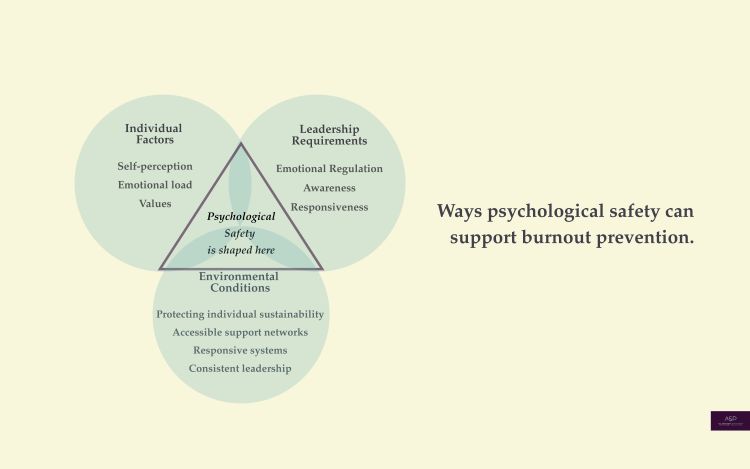
The Adaptable Sustainable Psychology Collection
Without all three elements interacting effectively, burnout can become normalised rather than recognised early.
What managing this looks like in everyday life for the individual is learning about yourself. Listening to how you speak to yourself. Observing what happens under pressure and noticing how other people influence your decisions. Do other people’s fears, insecurities, or shame activate your own, leading you into the trap of trying to manage their emotional load as well as your own? Is doing more a necessity or a way to meet an inner disturbance? Creating space to better understand yourself, your history, personality, and values may help people recognise cues from the mind and body that might otherwise be overridden.
The fields of biotech, healthcare, and research lend themselves readily to burnout, particularly for individuals with strong work ethics, high tendencies toward comparison, or vulnerabilities around self-worth. This makes maintaining a focus on healthier workplace systems and sustainable organisational design enormously important. Equally important, however, is recognising the psychological drivers that can keep people overriding their own limits despite mounting personal cost.
The Role of Organisations, Education, Leadership, and Government
Organisations can support staff by creating workloads that allow space for pausing, reflecting, and realistically assessing capacity without pressure to continually give more. Long-term access to evidence-informed mental health resources and support may also help individuals build greater self-knowledge around their own habits, vulnerabilities, and behavioural patterns.
Leadership development is also a central part of this picture. Leaders who are skilled in emotional containment, responsiveness, and consistent follow-through can help create environments where staff feel psychologically safe enough to identify, communicate, and manage factors contributing to burnout before they escalate.
This may require ongoing investment in leadership development and professional coaching that incorporates psychological insight and emotional skill-building, rather than focusing solely on productivity, engagement, team building, or retention outcomes.
Universities and training programs could also have a role to play in industries where burnout risk is high. Developing subject modules that explore emotional load, burnout risk, and encourage the adoption of adaptive and sustainable coping strategies could better prepare people entering high-pressure industries. This may also help support early leadership development and might enable reflective capacity to assist staff in recognising pathways that could lead to burnout before venturing too far down them.
Even federal and state governments can have a role to play here, and instead of offering bonuses for coming in under budgets perhaps rewarding workplace safety, staff retention and healthy workplace culture could become a way to support and encourage positive work environments from the top down.
The more people understand, and are supported to reflect on, their self-perception, values, behavioural patterns, and work environment without harsh self-judgement, the easier it becomes to make self-appropriate choices.
Burnout is more than poor work design. It is more than simply saying no or making more space for self-care. It is also about understanding why people feel compelled to do more and recognising what changes when personal resources begin to feel worthy of protection.
Author Bio

Amberley Meredith is a registered psychologist and author with over 25 years’ experience in mental health, organisational wellbeing, trauma-informed practice, and professional supervision. Her work examines burnout, emotional regulation, leadership, self-perception, and the psychological impact of modern workplace culture. She is the founder of Adaptable Sustainable Psychology and author of Self-Improvement Burnout – When to Start, When to Stop, with a particular interest in the interaction between workforce sustainability, psychological safety, and long-term emotional functioning.