
Burnout has long been viewed as a matter of individual resilience.
Individuals are advised to meditate, sleep well, optimise morning routines, cut down on screen time, show gratitude, achieve a good work-life balance, or just be better at managing time. While these measures are all well-intended, I am beginning to believe that they miss a far bigger point.
It is not the case that individuals experience burnout because they are fragile, weak, or unable to handle stress.
Individuals tend to experience burnout due to the very systems they operate within being structurally unprepared for sustainable psychological recovery from the outset.
This is of critical importance in industries such as pharmaceuticals, biotechnology, medical technology, clinical research, and health care, wherein performance-driven stress, regulation, emotional work, and operational intricacy constantly intersect.
In many high-performance settings, burnout is actually used as proof of dedication.
The issue is not simply that people work hard.
It is that many operational systems now create conditions where mental disengagement rarely happens at all.
The Life Sciences Industry Operates Under Permanent Cognitive Pressure
One of the defining features of modern life sciences work is not just workload intensity. It is sustained cognitive activation.
The people who engage in clinical research, healthcare practitioners, the regulatory group, biotech operators, and personnel from pharmaceuticals often find themselves juggling several aspects at once such as documentation, compliance, patient responsibilities, administration, and communication.
Work rarely exists in isolation anymore.
A single day can involve electronic health record documentation, regulatory reporting, internal approvals, virtual meetings, compliance reviews, project management systems, Slack messages, emails, and patient or stakeholder communication all occurring in parallel.
And unlike older working environments, these systems do not slow down naturally once the working day ends.
The psychological load simply follows people home.
This matters because the human nervous system was not designed for permanent partial attention.
Yet many professional cultures unintentionally reward exactly that behaviour.
Fast responses signal reliability. Constant availability signals dedication. Busyness signals professional value.
In many clinical and healthcare-adjacent environments, exhaustion itself quietly becomes social proof of competence.
The problem is that chronic overstimulation does not always produce immediate collapse.
It produces gradual deterioration.
Concentration weakens. Sleep quality declines. Emotional regulation becomes harder. Cynicism slowly replaces engagement. Recovery becomes incomplete even during time off because the nervous system remains mentally activated.
And because these changes happen incrementally, many highly competent professionals normalize them until the symptoms become severe.
Healthcare and Clinical Research Environments Intensify Burnout Structurally
Healthcare and life sciences environments expose this problem particularly clearly because emotional labour already exists at the centre of the work itself.
These individuals are not only handling their tasks. They are also constantly dealing with high emotional intensity within a regulated environment.
The post-pandemic workforce strain intensified this substantially.
Many healthcare workers are now operating inside environments shaped by:
- Staffing shortages
- Administrative overload
- Documentation-heavy workflows
- Increased patient complexity
- Regulatory pressure
- Recruitment challenges
- Delayed recovery from pandemic-era exhaustion
According to the 2022 World Health Organisation report, the global prevalence of anxiety and depression increased by 25% in the first year of the COVID-19 pandemic, with healthcare worker exhaustion identified as one of the key contributing factors.
What concerns me is that burnout in these industries is still often discussed reactively instead of operationally.
Support tends to appear after visible distress emerges rather than examining the structural conditions creating the distress consistently in the first place.
Offering resilience workshops inside chronically overloaded systems can sometimes feel psychologically contradictory.
It is difficult to recover meaningfully when the environment producing the stress remains fundamentally unchanged.
This is not simply a wellbeing issue either.
It eventually becomes an operational performance issue.
In clinical and life sciences environments, cognitive fatigue directly affects focus, communication quality, decision-making, documentation accuracy, collaboration, retention, and ultimately patient outcomes.
Documentation Burden Is Quietly Reshaping Mental Fatigue
One of the least discussed drivers of burnout in healthcare and clinical environments is administrative fragmentation.
Many medical professionals went into medicine to heal others, to study, to invent, or make improvements.
Rather, more and more of their time goes to working within the technological system, following compliance procedures, managing reportage processes, and completing documentation requirements.
Multiple studies have been published in medical literature over the past several years about how physicians spend significant amounts of their workday dealing with electronic health records, rather than dealing with patients.
This problem is not merely one of time management.
This problem is one of mental disintegration.
The mind does not like constant switching between attending to patients, documentation software, compliance tasks, online communication, and reportage without proper time for recovery.
Yet, productivity measures continue to be based primarily on visible results.
Wellness Has Become More Symbolic Than Structural
Modern organisations have become more comfortable talking about well-being.
There are seminars on resilience, mental health awareness programs, mindfulness subscriptions, flexibility at work, wellness budgets, and employee assistance programmes.
Some genuinely help.
But I increasingly think there is a widening gap between wellness branding and operational reality.
An organisation might publicly advocate mental health while simultaneously rewarding behaviours that undermine it internally:
- Chronic urgency
- Excessive workloads
- Permanent responsiveness
- Understaffing
- Reactive management
- Continuous escalation cultures
In many sectors, wellbeing is still treated symbolically rather than structurally.
Symbolic wellbeing focuses on visible wellness initiatives.
Structural wellbeing examines whether the actual operating environment supports sustainable psychological functioning long term.
These are very different things.
For example:
- Are employees realistically able to disconnect after hours?
- Are managers rewarded for sustainable leadership or only output volume?
- Are staffing levels realistically aligned with workload expectations?
- Are communication systems creating unnecessary cognitive overload?
- Is psychological recovery culturally respected or quietly penalised?
- Do employees feel safe admitting overwhelm without reputational consequences?
These questions often reveal far more about organisational wellbeing than wellness campaigns themselves.
Burnout Is Often a System Feedback Signal
One reason burnout conversations become so psychologically complicated is because high-performing professionals usually internalise responsibility for unrealistic systems.
They believe they simply need better routines, more discipline, or greater resilience.
Sometimes those changes help temporarily.
But eventually the operating environment catches up again.
Because burnout is often not a failure of motivation.
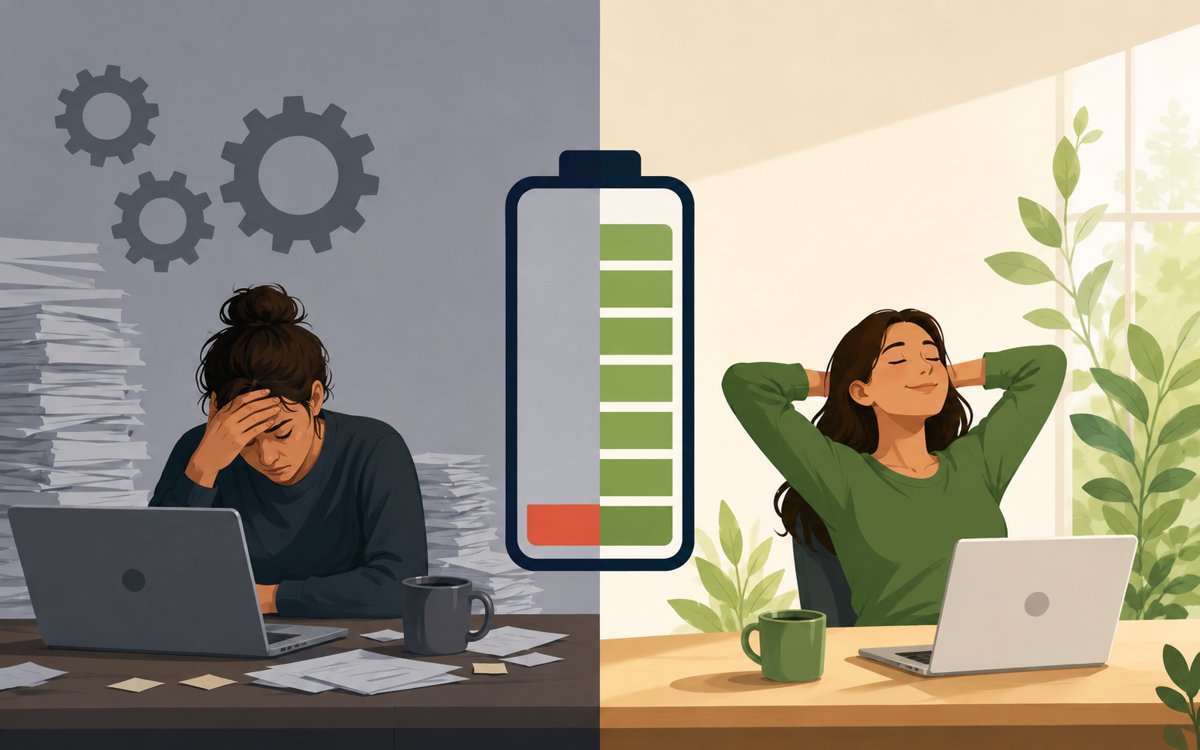
It is a mismatch between psychological demand and recovery capacity sustained over time.
When organisations continuously demand more emotional, cognitive, and mental energy than individuals can realistically recover from, burnout becomes a predictable system outcome.
Not inevitable.
But predictable.
In this sense, burnout often functions as operational feedback.
A signal that the system itself requires redesign.
The issue is that, for most organizations, measuring productivity is still far more important than measuring psychological stress, which often remains invisible to the naked eye.
Once it becomes evident via attrition, alienation, absence, errors, conflicts, and emotional exhaustion, the psychological stress has been piling up for quite some time now.
The Future of Workplace Wellbeing in Life Sciences Will Be Operational
I think that discussions around mental health in the workplace will gradually grow.
Especially in the context of the healthcare and life sciences sector where labour shortages and attrition are increasingly impacting business results.
The next step for organisational wellbeing is likely to move beyond individual optimisation toward environmental design.
This involves looking at what impact the workflow, compliance framework, leadership approach, technology, communications, and staffing has on psychological sustainability.
This does not mean eliminating accountability, ambition, or high standards.
Pressure itself is not automatically unhealthy.
Human beings are capable of extraordinary performance when recovery, autonomy, support, and meaning exist alongside the pressure.
The problem begins when stress becomes continuous while recovery becomes insufficient indefinitely.
The organisations that adapt best over the next decade will likely be the ones that understand wellbeing operationally rather than cosmetically.
Because increasingly, sustainable performance itself is becoming a competitive advantage.
Mental Health Is Not Separate From Organisational Performance
The assumption I continue to see repeatedly is that there is a separation between well-being and success within the business environment.
Actually, both of these are quite interdependent.
The stress that one experiences psychologically could affect his or her concentration, communication, leadership, emotion management, decision making, creativity, memorization, teamwork, and adaptability.
This factor becomes extremely important in situations when the surroundings include healthcare, biotechnology, and clinical settings, in which case one cannot afford any errors.
Psychologically stressed individuals might not always perform optimally on a cognitive level.
Overload creates disengagement despite commitment.
That is why mental health discussions should not be framed only as compassion initiatives.
They are operational and strategic conversations too.
Organisations that overlook psychological sustainability will experience difficulties with employee retention, motivation, hiring, adaptability, and overall workforce stability.
This is especially true for younger employees who value sustainability, flexibility, and quality of life in addition to career advancement.
Final Thought
I do not think modern healthcare and life sciences organisations need less ambition.
I think they need healthier relationships with human energy.
There is a difference between meaningful challenge and continuous depletion.
One develops people gradually.
The other drains them quietly.
The organisations that thrive long term will probably not be the ones demanding permanent intensity indefinitely.
They will be the ones that understand sustainable performance depends on protecting the psychological systems that make high performance possible in the first place.
Author Bio: Deepak Shukla, Founder, Wellness in Italy