
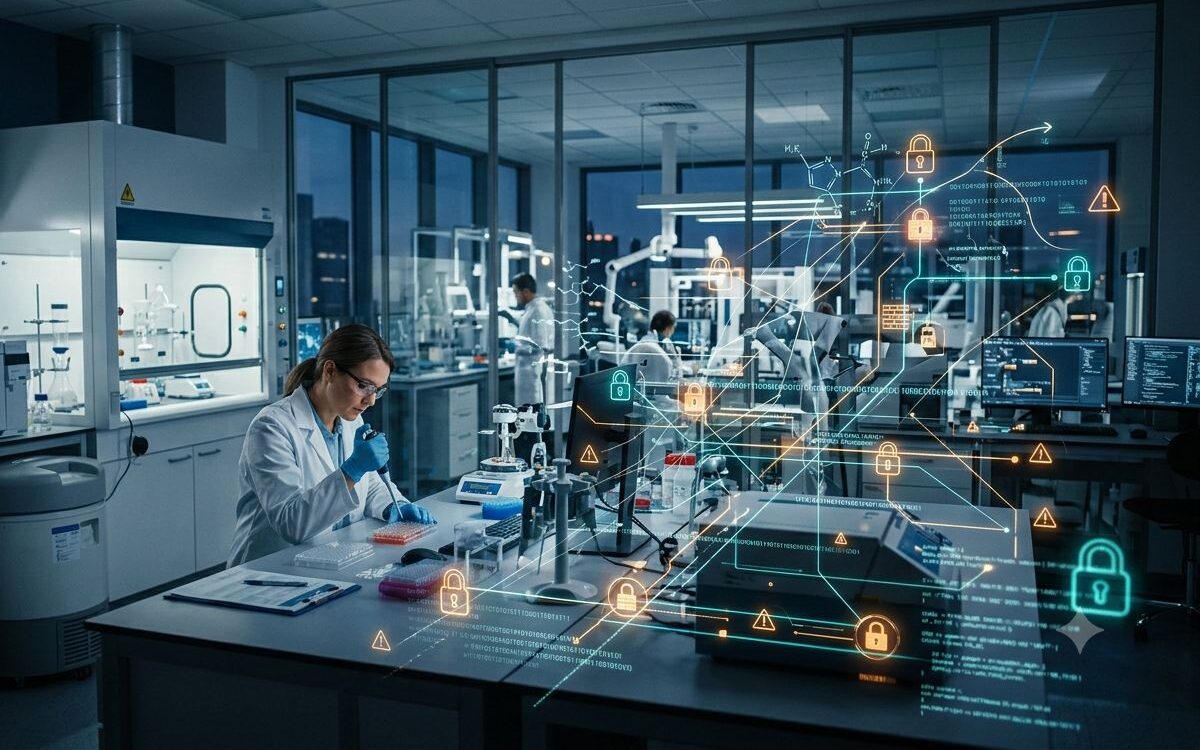
The life sciences sector is in the midst of a digital transformation that most security teams were not built to handle. AI-driven drug discovery platforms, cloud-connected lab equipment, genomic databases, and real-time patient data pipelines are creating attack surfaces that traditional pharmaceutical security models never anticipated. And the attackers have noticed.
The Scale of the Problem
Vulnerability disclosure tracking and security research activity indicate a sustained increase in attention toward biotech and healthcare infrastructure in recent years, reflecting both the sector’s rapid digitalization and its expanding attack surface. This mirrors broader industry trends: healthcare organizations continue to face significant ransomware and data security threats, with hundreds of confirmed ransomware incidents affecting the sector in 2024 alone [1][2].
The financial impact is equally stark. IBM’s 2025 Cost of a Data Breach Report continued to identify healthcare as one of the most expensive industries for data breaches, highlighting the significant financial consequences associated with the compromise of sensitive health information [3].
But these headline numbers only tell part of the story. The real risk increasingly sits in the data pipelines connecting research institutions, contract research organizations (CROs), technology providers, and pharmaceutical companies.
The CRO Connection: A Single Point of Failure
One of the most concerning trends is the targeting of data pipelines and third-party relationships between research institutions and CROs. A compromised CRO connection can potentially expose years of proprietary drug development data in a single breach.
Multiple incidents illustrate this risk. In November 2025, BioPharma Services Inc., a contract research organization based in Canada, was listed as the victim of a data breach attributed to the Qilin ransomware group [4]. The incident illustrates the potential exposure of sensitive clinical and research information managed by CROs on behalf of pharmaceutical and biotechnology companies.
In June 2026, pharmaceutical giant Novo Nordisk confirmed a cybersecurity incident involving unauthorized access to certain internal IT systems and the external copying of limited information related to patients participating in some clinical trials. The company said the potentially affected information could include patient identifiers, year of birth, sex, and health or immunogenicity data, while stating that the information was not directly linked to patients by name or other direct identifiers [5].
Separately, the cyber-extortion group FulcrumSec claimed responsibility and alleged that it had stolen more than 1.3 terabytes of data and demanded a $25 million ransom. Those claims have not been independently verified, but the incident nevertheless demonstrates how pharmaceutical companies can face simultaneous risks involving patient information, intellectual property, software infrastructure, and research environments [6][7].
Other notable incidents include the 2023 Sun Pharma ransomware attack, in which the ALPHV ransomware group claimed responsibility and alleged access to company data [8], and the 2024 Cencora breach, which involved sensitive personal information affecting more than one million individuals [9].
The common thread across these incidents is that pharmaceutical companies now operate complex digital supply chains where a single compromised vendor connection can expose sensitive information and create pathways into critical business processes.
AI, Cloud Labs, and the Expanding Attack Surface
More than 83% of pharmaceutical companies reportedly use cloud technology, making cloud infrastructure an increasingly important component of modern drug discovery and research operations [10]. AI-driven drug discovery platforms, cloud-connected laboratory equipment, and federated learning systems for genomic data analysis are becoming increasingly important. But each of these innovations introduces new security considerations.
A 2025 Censinet report highlighted concerns around sensitive data exposure to AI tools and the growing number of organizations experiencing AI-related security incidents [11]. Cloud laboratories — where researchers can conduct experiments remotely through automated robotic platforms — present a particularly challenging security environment.
RAND Corporation has called for standardized biosecurity measures in scientific cloud laboratories, warning that the convergence of AI, automation, and cloud infrastructure creates new risks that traditional security models may not adequately address [12].
The Health-ISAC 2025 Health Sector Cyber Threat Landscape report also highlights the continued escalation of cyber threats against the healthcare sector, including increasingly sophisticated ransomware and nation-state activity targeting sensitive information and intellectual property [13].
Federated Learning: A New Vector for Data Poisoning
The industry’s growing reliance on shared genomic databases and federated learning platforms for AI model training creates another important security consideration.
Federated learning is designed to protect data privacy by allowing multiple organizations to train a shared model without directly centralizing their raw datasets. However, the security assumptions behind these systems can break down if participating nodes or model updates are compromised.
Peer-reviewed and academic research has demonstrated that federated learning systems can be vulnerable to data poisoning and model poisoning attacks [14][15][16]. When an attacker compromises a node in a federated network — for example, through stolen credentials — the risk may extend beyond the individual institution. An attacker could potentially manipulate training data or model updates and attempt to influence the shared model.
Research into attacks such as DP-Poison has also demonstrated that privacy mechanisms can introduce complex security trade-offs that must be considered when designing federated learning systems [17].
This means that institutions participating in federated learning consortia should not rely exclusively on organizational trust or user credentials. Strong mechanisms for verifying node integrity, authenticating model updates, monitoring anomalous behavior, and maintaining the provenance of training contributions are increasingly important.
The 23andMe Precedent: What Genetic Data Breaches Mean
The 2023 23andMe breach demonstrated the unique sensitivity of genetic information. Attackers used credential-stuffing techniques to access customer accounts and genetic data, leading to significant regulatory and legal consequences [18].
While 23andMe is a direct-to-consumer genetic testing company, the broader lesson applies directly to life sciences: genomic data is effectively immutable. Unlike a credit card number, a genome cannot simply be reissued after a breach.
The liability, privacy implications, and reputational damage associated with a genomic data leak in a pharmaceutical research context could therefore be substantial. For organizations working with genomic datasets, cybersecurity is not simply about protecting corporate information; it is also about protecting information that may remain sensitive for an individual’s entire lifetime.
What the Fix Looks Like
The pharmaceutical industry’s current security posture combines regulatory compliance requirements, including HIPAA, GDPR, and 21 CFR Part 11, with traditional enterprise security tools. These controls remain essential, but they were not designed specifically to address every security challenge associated with AI pipelines, federated learning, or cloud-connected laboratory infrastructure.
The technical response requires multiple layers.
First, organizations should consider hardware-backed attestation for nodes participating in sensitive federated learning environments. Before a research institution’s model update is accepted into a shared model, the organization should have mechanisms to establish the integrity of the participating environment. Technologies such as TPM 2.0 can contribute to a hardware root of trust and help strengthen the verification process.
Second, model updates should be protected through cryptographic mechanisms and secure aggregation protocols where appropriate. The central server should avoid receiving unnecessary raw gradients from individual nodes and instead use privacy-preserving techniques that reduce the risk of sensitive information exposure and make unauthorized manipulation more difficult to conceal.
Third, organizations need continuous monitoring of the data supply chain.
Most pharmaceutical companies have invested heavily in perimeter security, identity management, and endpoint protection. However, they may have less visibility into how sensitive research data flows between internal systems, research institutions, CROs, cloud providers, AI platforms, and other third parties.
A data supply chain mapping exercise — identifying every point where research data crosses organizational boundaries — should be a baseline requirement for any modern life sciences security program.
The cost of these measures is potentially trivial compared with the alternative. A single undetected breach in a federated learning consortium could compromise years of drug discovery research across multiple institutions. When the stakes involve billions of dollars in R&D investment, intellectual property, and patient safety, the question is not simply whether to invest in these controls.
It is whether the industry can afford not to.
Author Bio