
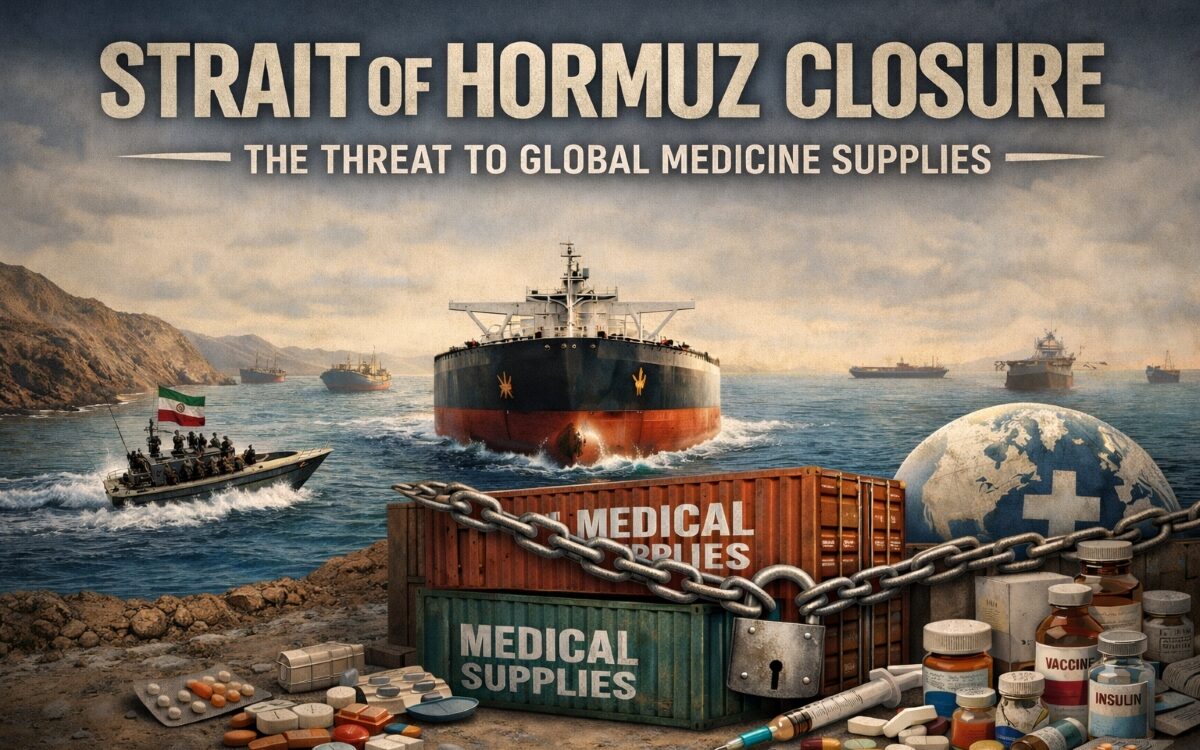
When US and Israeli military operations against Iran began on 28 February 2026, the consequences for global energy markets were immediate and predictable. What was less widely anticipated was the scale of the disruption now rippling through the life sciences sector. The closure of the Strait of Hormuz, confirmed by a senior IRGC official on 2 March 2026, has set in motion a cascade of effects across pharmaceutical supply chains, clinical research, and healthcare systems that industry experts are only beginning to fully map. The Strait of Hormuz life sciences impact is proving to be one of the most complex and far-reaching supply chain crises the sector has faced since the Covid-19 pandemic.
A Chokepoint for the World’s Medicines
The Strait of Hormuz is a narrow waterway between Iran and Oman through which approximately 20% of global petroleum and significant volumes of liquefied natural gas transit each day. Its importance to the energy sector has long been understood. Its centrality to pharmaceutical supply chains, however, has until now received far less attention.
The connection operates through several interlinked channels. The Middle East accounts for approximately 22% of global petrochemical supply, and an estimated 84% of polyethylene capacity depends on the Strait for export. Polyethylene, polypropylene, and PVC, the foundational materials for pharmaceutical packaging, delivery systems, and laboratory consumables, are now in disrupted supply following QatarEnergy’s declaration of force majeure and its halting of downstream production across all three materials. Petrochemical derivatives are not peripheral to pharmaceutical manufacturing. Analysts at Beroe Inc. note that between 90 and 99% of modern pharmaceuticals rely on petrochemicals for their synthesis, packaging, or delivery, encompassing active pharmaceutical ingredients (APIs), solvents, excipients, and reagents.
The second transmission channel runs through India. The country supplies approximately 47% of US generic prescriptions and depends on the Strait for roughly 40% of its crude oil imports. That oil feeds directly into the petrochemical inputs used throughout pharmaceutical manufacturing. As Rohit Tripathi, VP of industry strategy at supply chain software firm RELEX Solutions, has noted, American consumers may not be buying medicines directly from the Gulf, but they sit at the end of a supply chain that runs squarely through it. Similar exposure exists across major manufacturing hubs in China, Japan, and South Korea, all of which are heavily dependent on Gulf crude, LNG, and industrial feedstocks.
The Cost Cascade
The disruption is propagating through a structured cost cascade that began with energy markets and is now spreading into clinical development. APIs, excipients, and polymer-based materials were the first to see measurable price increases from March 2026 onwards, with lipid excipients, specialty chemicals, and laboratory consumables expected to follow as the disruption compounds.
Air freight has become a particular pressure point. One in five NHS medicines is transported by air, and with Middle Eastern air routes severely disrupted, capacity has fallen sharply. Air cargo rates from India have reportedly climbed between 200 and 350% on some routes. Medicines UK, which represents manufacturers of generic medicines that account for 85% of NHS prescriptions, has been direct about the implications through its Chief Executive Officer Mark Samuels. “Off-patent medicines run on high efficiency and razor thin margins,” he said. “Any prolonged crisis that drives up operating costs will disproportionately affect these manufacturers and risks leading to supply shortages or increased costs for the NHS.”
For maritime shipping, the picture is similarly strained. With the Strait of Hormuz effectively restricted, cargo is being rerouted around the Cape of Good Hope, adding up to two weeks to delivery times and significantly increasing fuel costs. Lloyd’s of London has effectively suspended insurance for international shipping through the waterway, removing the commercial viability of the route for most operators.
Warnings from the NHS and Beyond
The Strait of Hormuz life sciences impact has generated unusually blunt statements from healthcare system leaders. NHS England Chief Executive Sir Jim Mackey warned in late March 2026 that certain medical supplies could run out within days, noting that the NHS cannot simply stockpile large quantities indefinitely because many products are perishable and storage is expensive. Beyond drug shortages, Mackey identified syringes, gloves, and intravenous bags as categories at risk, given that all depend on petrochemical-derived materials now under supply pressure.
David Weeks, Director of Supply Chain Risk Management at Moody’s, characterised the situation as a convergence of stressors.
“It’s the perfect storm,” he said. “We have the conflict in the Gulf that caused the Strait of Hormuz to shut down, and India is known as the pharmacy of the world. They produce a lot of the generic drugs and APIs. With the geopolitical situation, it’s harder and harder to get those out.”
Henry Gregg, Chief Executive of the National Pharmacy Association, offered a cautionary assessment. While no medicine shortages have yet been directly linked to the conflict, he warned that price increases already appearing in the market could point to larger problems ahead.
“The NHS has driven down the price of medicines over many years, which leaves the UK vulnerable in a global market,” he said.
The Department of Health and Social Care has stated that robust measures are in place to minimise disruption to patient care, and a dedicated team has been established across the NHS to assess and manage supply chain risks.
Clinical Trials Under Pressure
Beyond the disruption to commercial pharmaceutical supply, the Strait of Hormuz life sciences impact extends directly into clinical research. Alex Guillen, global subject matter expert for life science and pharma at shipment tracking company Tive, has identified clinical trial distribution as one of the most acutely affected areas of the disruption. “As disruptions escalate around the Strait of Hormuz, the most affected shipments are often medicines for clinical trial distribution,” he said. Temperature-controlled investigational medicinal products have narrow stability windows that rerouting and delays can render void. As Guillen explained, “If you move temperature-controlled drugs and you’re late by two or three days, you might just as well throw the merchandise away, because it just goes bad.”
Data from the life sciences data company Phesi indicates that clinical trials of experimental cancer, cardiac, and other treatments in countries including Turkey, Israel, and Egypt are already being disrupted by the conflict. Unlike a delayed television delivery, a missed trial visit or spoiled investigational product cannot simply be rescheduled without consequences for protocol integrity and regulatory timelines.
Humanitarian and Global Health Dimensions
The disruption extends well beyond the pharmaceutical industries of wealthy nations. Jean Kaseya, Director-General of the Africa Centres for Disease Control and Prevention, highlighted at a press conference that the Hormuz blockage is affecting far more than direct shipments. Fuel shortages have increased the cost of transportation and the production of key health commodities including mosquito nets, which depend on polyester derived from petrochemicals.
Bob Kitchen, Vice President of Emergencies and Humanitarian Action at the International Rescue Committee, described a specific logistical failure in East Africa.
“We’ve got one shipment that was supposed to be delivered into East Africa, which is now blocked,” he said. “The humanitarian depot there that’s managed by the UN has massive stocks that are now stuck. We can’t get them to acute crisis situations like Sudan, Ethiopia and across the northeastern part of Africa.”
In Yemen, where chronic malnutrition and outbreaks of cholera, measles, and polio already place enormous strain on health systems, frontline health workers from Doctors Without Borders described situations where patients testing positive for malaria are leaving clinics without treatment because medicines are absent from pharmacy shelves.
Structural Vulnerabilities Laid Bare
What the crisis has most powerfully demonstrated is the structural fragility of a pharmaceutical supply chain built almost entirely around efficiency rather than resilience. The UK currently produces only around 25% of its medicines domestically. The US is similarly exposed through its dependence on Indian generic manufacturers. Just-in-time inventory models, which have served the sector well during stable periods, leave almost no buffer when disruptions persist beyond a matter of weeks.
Prashant Yadav, senior fellow at the Council on Foreign Relations, has noted that 10 to 20% of global pharmaceutical commerce passes through the Middle East. Even a partial, prolonged disruption at this scale is sufficient to affect the availability and pricing of medicines globally. The effects on generic drugs, with their structurally thin margins, are disproportionate. As Yadav observed,
“If you increase the cost of an input material, that shows up much more in an inexpensive medicine than for something that is $1,000 a treatment course.”
Iran has permitted limited navigation through the Strait for vessels from certain nations, including China, Russia, India, Iraq, and Pakistan, and agreed in late March to allow humanitarian and fertiliser shipments through in response to a UN request. On 17 April 2026, Iran’s Foreign Minister Abbas Araghchi announced the Strait was “completely open” for commercial vessels for the duration of a ceasefire period, and oil prices fell sharply on the news. However, significant uncertainty remains. President Trump welcomed the announcement but confirmed the US naval blockade on Iranian ports remains in full force pending a final agreement. Major shipping companies including Maersk and Hapag-Lloyd have said outstanding questions about safety and security need resolving before normal transits resume. Whether a durable resolution follows, the crisis has already exposed the depth of the life sciences sector’s dependence on a single geographic chokepoint and the inadequacy of current supply chain structures to absorb sustained geopolitical shocks.