A Neurodevelopmental Framework for Strategic Life Construction
In an era defined by rapid technological change, algorithmic persuasion, and rising rates of youth anxiety, the question is no longer whether children need education, but what kind of education is most essential. Traditional schooling equips young people with literacy, numeracy, and vocational knowledge, yet it rarely teaches them how to consciously regulate their internal states, strategically plan their lives, or prevent emotionally reactive patterns from shaping their behaviour.
If long-term psychological resilience is a societal goal, the development of conscious self-regulation and strategic life construction should be considered fundamental components of childhood education.
The Neurobiology of Emotional Reactivity
Children and adolescents are neurologically predisposed toward emotional reactivity due to the uneven maturation of brain systems. Neurodevelopmental research demonstrates that the limbic system, particularly the amygdala, which governs emotional threat detection, develops earlier than the prefrontal cortex, the region responsible for executive function, impulse control, and strategic reasoning (Casey, Jones, & Hare, 2008; Blakemore & Choudhury, 2006).
This developmental imbalance means emotionally salient stimuli can override rational decision-making during youth. Under conditions of perceived threat or social stress, limbic activation can trigger rapid emotional responses that bypass higher-order cortical processing (Davidson & McEwen, 2012). As a result, young people may respond impulsively, defensively, or avoidantly rather than through reflective reasoning.
Chronic activation of this stress-response circuitry has been associated with elevated risks of anxiety disorders, depressive symptoms, and maladaptive coping behaviours. Consequently, interventions that strengthen executive functioning and emotional regulation are increasingly viewed as essential components of preventative mental health strategies.
Conscious Self-Awareness as a Regulatory Skill
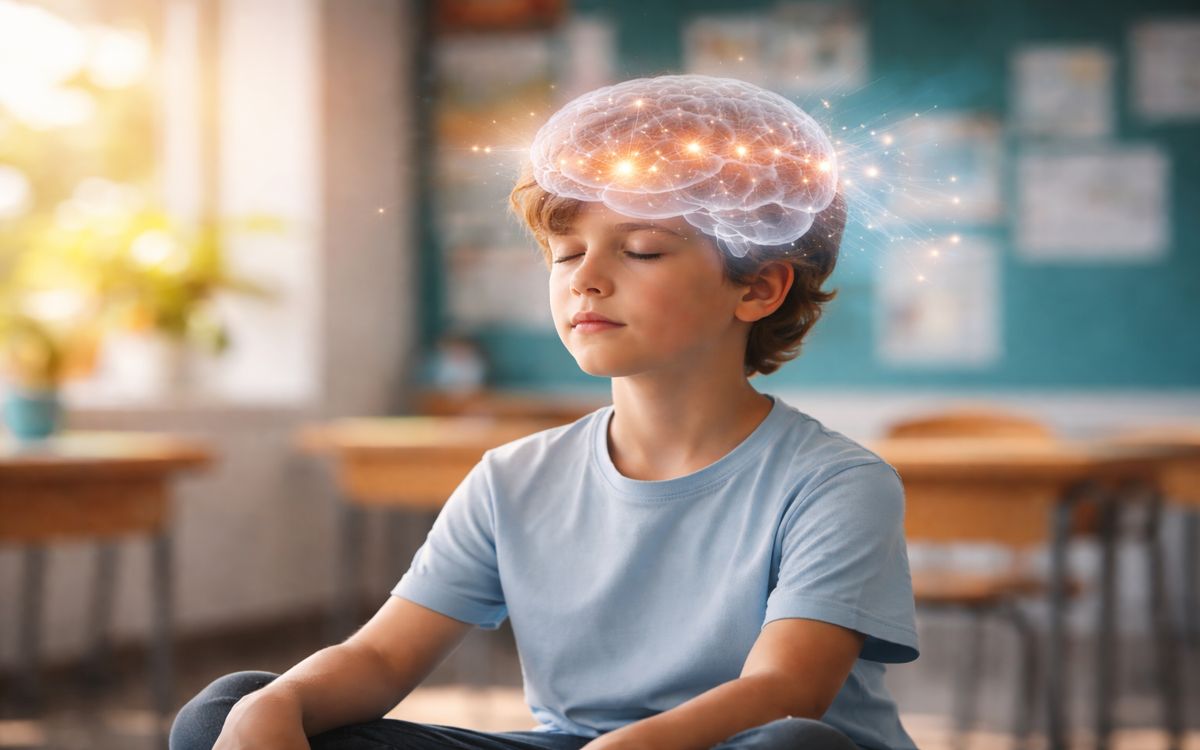
Operational self-awareness, the capacity to observe one’s own thoughts, emotions, and behavioural impulses is a key mechanism through which individuals can regulate their internal states. When young people develop metacognitive awareness, they gain the ability to pause between stimulus and response, allowing reflective decision-making to replace automatic reactivity.
Neuro Linguistic Programming (NLP) therapist and trainer Rik Schnabel has found that when children come to learn that they can control their emotions through breathing techniques and NLP anchoring, children can then calm themselves.
Research on mindfulness-based interventions has demonstrated that attentional training and present-moment awareness can improve emotional regulation, reduce stress markers, and enhance cognitive control (Tang, Hölzel, & Posner, 2015). Similarly, school-based mindfulness programs have been shown to improve wellbeing and social-emotional competence among adolescents (Schonert-Reichl & Lawlor, 2010).
From a developmental perspective, strengthening these metacognitive skills can enhance prefrontal engagement and reduce amygdala-driven reactivity. In practical terms, this means that children can be trained to recognize emotional triggers, label internal states, and intentionally shift their responses.
Strategic Life Construction and Future-Oriented Thinking
While emotional regulation provides stability, it does not automatically provide direction. Many young people experience high levels of stimulation in modern environments but lack structured frameworks for building purposeful futures.
Research on self-regulated learning suggests that individuals who can consciously set goals, monitor their progress, and adjust behaviour accordingly demonstrate higher academic performance and greater persistence (Zimmerman, 2002). Similarly, psychological studies on self-discipline indicate that behavioural self-regulation predicts educational outcomes more strongly than intelligence measures alone (Duckworth & Seligman, 2005).
Future-oriented cognition, the ability to mentally project oneself into a desired future and align present behaviour with long-term goals, also plays a significant role in life outcomes. Classic experiments on delayed gratification demonstrate that children capable of postponing immediate rewards in favour of larger future benefits tend to achieve more favourable academic, health, and behavioural outcomes later in life (Mischel, Shoda, & Rodriguez, 1989).
Teaching children to strategically construct their lives therefore involves more than motivational encouragement. It requires structured cognitive frameworks that help them understand how daily behaviours, habits, and decisions compound over time.
The Consequences of Unregulated Emotional Triggers
When emotional triggers remain unexamined, they often become entrenched behavioural patterns. Repeated avoidance of discomfort can reinforce anxiety pathways, while habitual defensive reactions can disrupt interpersonal relationships and learning environments.
The contemporary digital landscape amplifies these risks. Social media platforms frequently stimulate emotional responses through social comparison, novelty, and perceived threat signals, which can intensify limbic activation. Without adequate self-regulation skills, young people may become increasingly vulnerable to reactive emotional cycles.
For this reason, many researchers now view emotional regulation as a transdiagnostic skill, one that protects against multiple psychological disorders simultaneously.
Implications for Education and Prevention
The integration of conscious self-regulation training into education does not replace academic learning; rather, it strengthens it. Executive function skills improve concentration, emotional stability enhances classroom collaboration, and strategic thinking increases resilience in the face of failure.
Educational systems that incorporate neuroscience-informed emotional regulation, metacognitive training, and strategic thinking frameworks may significantly improve both academic and psychological outcomes.
If society expects young people to navigate increasingly complex social, technological, and economic environments, it is reasonable to equip them with the internal cognitive tools required to do so effectively.
Teaching children how to consciously regulate their minds and strategically construct their futures may ultimately represent one of the most important preventative mental health interventions available.
Author Bio:

Rik Schnabel
Rik Schnabel is an Australian-based educator, therapist, and author specialising in applied psychology, neuro-linguistic programming, and human behavioural change. He is the founder of Life Beyond Limits and has trained thousands of individuals in cognitive strategy, emotional regulation, and leadership development. Through his books and professional trainings, he focuses on equipping adults and young people with practical frameworks for mastering their internal states and strategically building fulfilling, resilient lives.