For decades, innovation in life sciences followed a familiar path: lab discovery, clinical testing, regulatory approval, market release. It was linear. Predictable. Slow.
What’s happening now feels different.
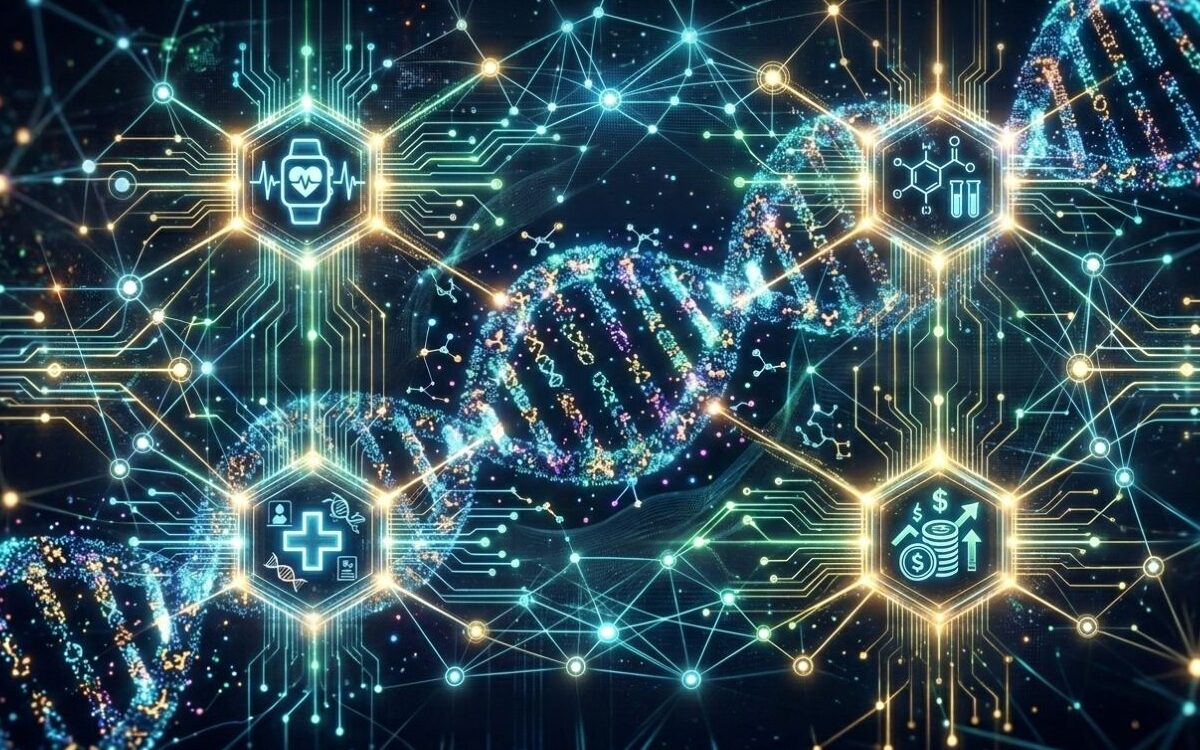
The most significant shift isn’t a single breakthrough therapy or miracle device. It’s the convergence of data science, artificial intelligence, and personalised medicine into something more like an ecosystem than a pipeline.
Life sciences is no longer just biology. It’s infrastructure.
We’re Moving Beyond Population Averages
Modern medicine has historically treated people as statistical clusters. Clinical trials establish what works “on average,” and protocols follow. That model built enormous progress but it also left blind spots.
What’s changing is the granularity.
The price of a human genome sequence has dropped from almost $100 million in 2001 to less than $1,000 today (National Human Genome Research Institute). This sharp reduction in price is more than a technological achievement. It changes the world of possibilities.
Add to the list of wearable biometrics, longitudinal medical records, and machine learning algorithms capable of analyzing millions of variables, the ability to sequence genomes, and the point of equilibrium changes. We move from reactive treatment toward earlier detection and risk modelling.
That doesn’t mean we suddenly understand everything. It means we’re finally building systems that can recognise complexity instead of averaging it away.
Drug Discovery Is Quietly Being Rewritten
If you talk to people inside biotech, the most radical changes aren’t happening in glossy press releases, they’re happening upstream.
AI systems are helping researchers narrow down viable molecular candidates far earlier in the drug discovery process. DeepMind’s AlphaFold, for example, mapped predicted structures for nearly all known proteins. That’s not incremental progress. That’s a reference library humanity didn’t have before.
Does that mean drugs appear overnight? Of course not.
But it does mean the early-stage filtering process, historically expensive and slow, is becoming more computational and less brute-force.
Adaptive clinical trials are another shift. Instead of rigid trial designs that remain fixed for years, parameters can now adjust based on interim data. It’s more flexible, more responsive, and in many cases more ethical.
The timeline compression is real. But it’s uneven. And regulators are still adapting.
The Real Transformation Is Operational
The scientific advances get headlines. Equal consideration should be given to the operational changes.
Collaboration between biotech companies, hospitals, and research institutions is now supported by cloud infrastructure. Previously siloed data can now be shared, examined, and put through stress tests across networks.
When interoperable, electronic health records enable real-world data to inform research more quickly than was previously possible with traditional retrospective studies.
But interoperability is still inconsistent. The World Health Organization has pointed out that fragmented data systems remain a major barrier to equitable digital health progress.
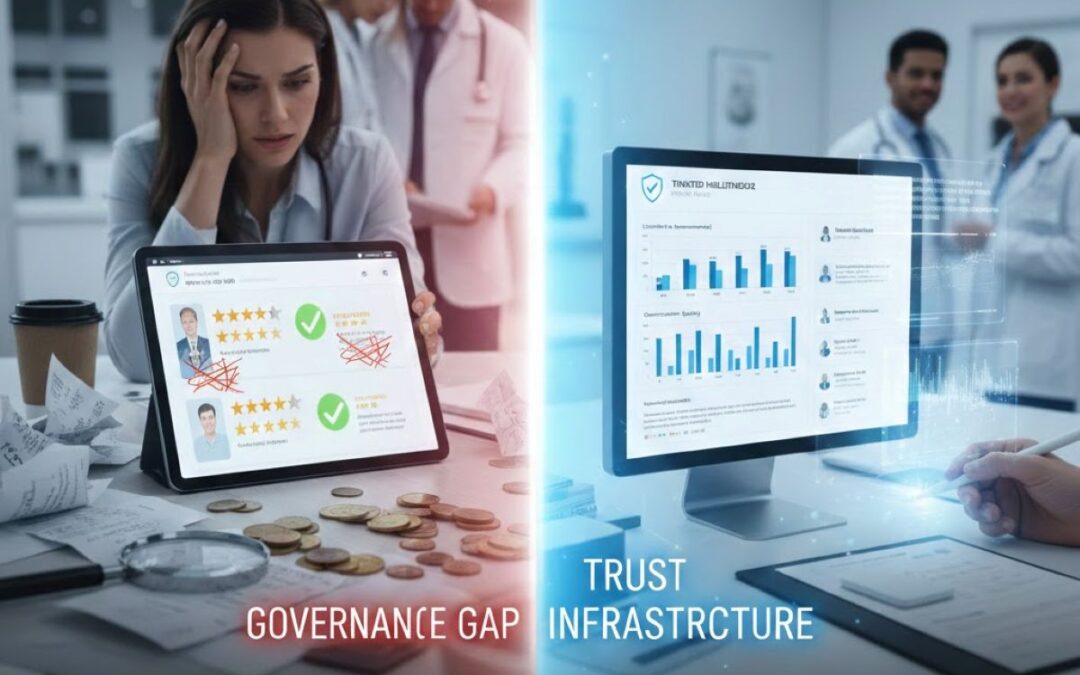
Technology is accelerating. Coordination is lagging.
That gap matters.
Regulation Is the Pressure Point
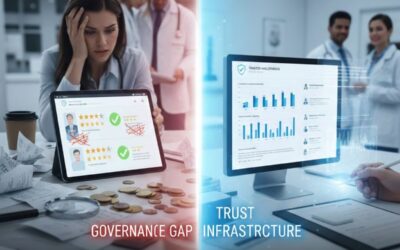
Every technological leap creates a governance lag.
AI-driven medical tools don’t sit comfortably inside regulatory frameworks built for static products. Machine learning models evolve. They retrain. They adapt. Traditional approval systems don’t.
The FDA and EMA are actively developing guidance for AI-based medical software, but the tension remains: how do you regulate something that changes?
Then there’s data privacy. Genomic information isn’t just sensitive, it’s uniquely identifiable. You can’t “reset” a genome like you can a password.
Add cross-border data flows and GDPR compliance into the mix, and innovation quickly intersects with geopolitics.
The scientific problems are complex. The regulatory ones might be harder.
The Equity Question Isn’t Secondary
Precision medicine sounds empowering, and it is.
But there’s a structural risk. Advanced diagnostics and personalised therapies often emerge first in well-funded systems. If infrastructure isn’t designed deliberately, innovation can widen disparities rather than close them.
Access isn’t a downstream issue. It’s architectural.
If convergence only benefits certain populations, the system will face both political and ethical resistance.
The Economics Are Compelling With Caveats
A huge amount of the world’s healthcare budget is spent on chronic diseases. Predictive analytics and early intervention strategies could cut costs dramatically. McKinsey suggests that AI applications in the healthcare sector could create as much as $110 billion in value each year.
That projection is meaningful.
But the savings aren’t automatic. Upfront investment in data architecture, compliance frameworks, and validation systems is substantial. The ROI unfolds over time, and only if implementation is disciplined.
There’s a difference between technological possibility and operational maturity.
Innovation Is Now Distributed
What’s perhaps most striking is who participates in life sciences today.
It’s no longer just pharmaceutical companies and academic labs. Along the innovation chain are cybersecurity teams, wearable device manufacturers, cloud providers, and AI engineers.
Innovations are taking place at the nexus of molecular science and computational biology, real-time data feedback loops, and algorithmic pattern recognition.
The lab is still critical. But it’s no longer isolated.
Life sciences has become a networked system.
So What Actually Changes?
Several changes appear likely over the next ten years:
- Clinical decision-making tools with AI support are becoming commonplace in workflow.
- Decentralized and flexible clinical trials are becoming more widely accepted.
- Persistent conflict over cross-border governance and data ownership
- Growing discussion about fair access to precision medicine
The capability to transform healthcare outcomes is expanding. The constraint is no longer raw discovery capacity, it’s coordination.
That’s the quiet truth.
These days, innovation in the life sciences isn’t limited to molecules. It involves creating robust data systems, agile governance models, and infrastructures that convert knowledge into advantages for the entire population.
There is no speculation in the era of convergence. It has already arrived.
Whether we can responsibly design the ecosystem is the question at hand, not whether it will evolve.
Author Bio

Deepak Shukla, Founder & CEO, Pearl Lemon
Deepak Shukla: LinkedIn Profile