

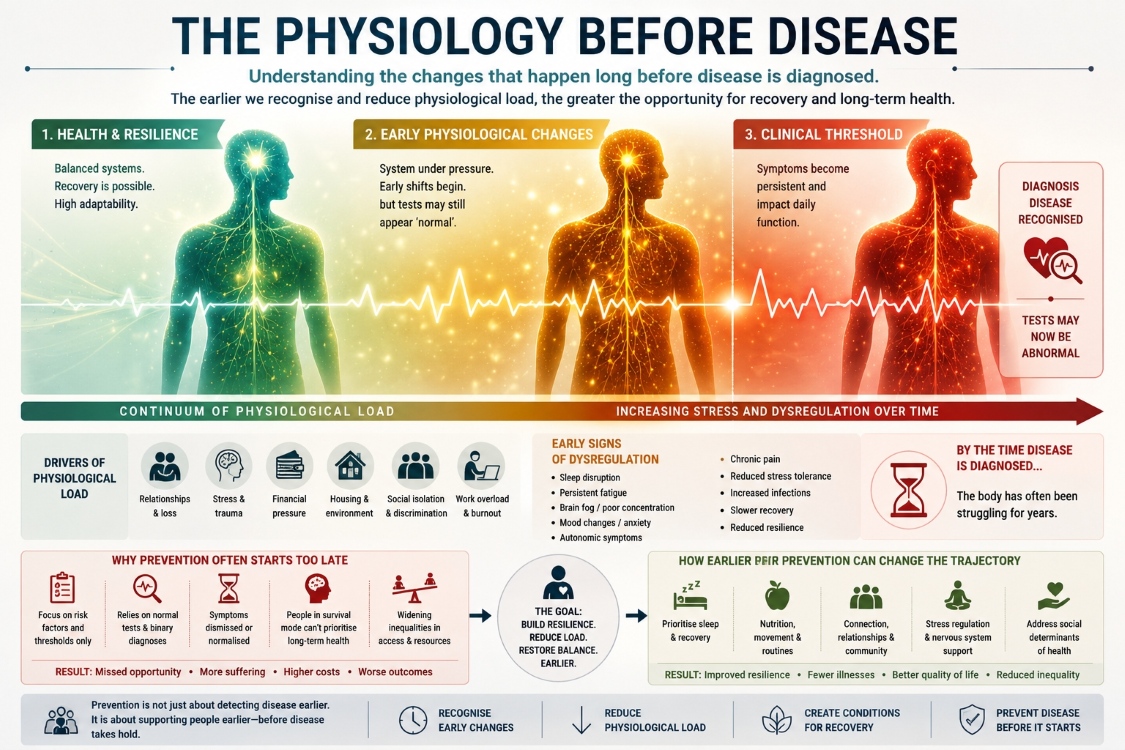
Most diseases do not begin the day a diagnosis is made. The body often goes through a series of changes long before medicine has a name for what is happening, and the period between apparent health and confirmed disease is something we still don’t fully understand.¹
Modern prevention strategies have traditionally focused on identifiable risk factors and established disease pathways: smoking, obesity, hypertension, diabetes, cardiovascular risk, and cancer screening. These approaches have improved outcomes enormously and remain central to public health.
Yet many current models of prevention still operate around measurable thresholds and binary diagnostic frameworks. Patients are often categorised as either well or unwell, low risk or high risk, normal or abnormal. Human physiology rarely behaves in such neat categories.
In clinical practice, many people present in subthreshold states long before disease becomes formally diagnosable. Sleep disruption, persistent fatigue, cognitive dysfunction, autonomic symptoms, chronic pain, anxiety, altered stress and immune responses, and reduced resilience may all emerge while investigations remain within “normal” ranges.² ³
Having experienced both sides of medicine, as a clinician and a patient, I have become increasingly aware of how the body often moves through recognisable phases of dysregulation long before illness is formally defined. Physiology is shaped continuously by the conditions in which people live. Caregiving, burnout, bereavement, trauma, financial pressure, loneliness, relationship breakdown, insecure housing, chronic uncertainty, discrimination, and prolonged psychological stress all place demands on the body’s regulatory systems over time. Cortisol patterns shift. Inflammatory pathways become activated. Energy regulation becomes disrupted. Concentration deteriorates.¹ ⁴
These shifts rarely occur in isolation from the realities of everyday life.
Prevention becomes far more difficult when someone is already firefighting their way through daily life. For a person living on the brink, struggling with financial insecurity, caring responsibilities, trauma, exhaustion, or chronic instability, health decisions are rarely made from a place of calm, stability, or long-term planning. The immediate priority becomes getting through the day.
This state of constant firefighting is not confined to society’s extremes. For many people, modern life itself can become a prolonged process of managing pressure, uncertainty, overload, and competing demands while recovery time steadily disappears.
In these circumstances, the body often shifts towards short-term survival rather than long-term repair. Stress systems remain activated. Nutrition becomes inconsistent. Concentration deteriorates. Recovery becomes more difficult.⁴ ⁵
Telling people simply to “make healthier choices” without recognising the conditions surrounding those choices risks overlooking the wider physiological picture.⁵
Prevention should ideally start with recognising and reducing physiological load and recalibrating the nervous system where possible: creating opportunities for recovery, stabilising routines, increasing movement, strengthening social connection, and helping people move out of constant firefighting mode.
Earlier prevention requires people to feel more empowered to recognise physiological changes sooner and to better understand how the body responds to chronic load, recovery, stress, environment, and lived experience over time.
Sleep itself reflects the complexity of these regulatory systems. Deep sleep and REM sleep play important roles in neurological recovery, emotional regulation, memory processing, immune function, hormonal balance, and metabolic repair. When these restorative stages become repeatedly disrupted through chronic stress, overload, trauma, or instability, the effects often extend far beyond tiredness alone.
Changes in concentration, emotional regulation, stress tolerance, energy, pain, physical resilience, and recovery are often dismissed until they become far more difficult to reverse. Recognising these earlier shifts may create greater opportunity for intervention before more prolonged states of dysregulation become established.
This also raises wider questions for healthcare systems and public policy. If physiological deterioration frequently begins before disease reaches diagnostic thresholds, prevention may need to evolve beyond episodic illness detection and screening towards earlier recognition of strain, dysregulation, and reduced resilience. Primary care pathways, digital health tools, behavioural data, and population health strategies all play roles in supporting earlier intervention and identifying patterns of decline before pathology becomes fully established.6
At the same time, prevention cannot be separated from the wider conditions in which people live. Earlier recognition alone is unlikely to improve outcomes if people remain trapped within chronic instability, insecurity, poor housing, financial strain, social isolation, or limited access to support. Expanding preventive approaches without addressing these wider realities risks deepening existing health inequalities, particularly if preventive tools and resources remain concentrated among already advantaged groups. 5, 6
Medicine has become increasingly sophisticated at detecting established disease. The next challenge lies in recognising the earlier physiological changes that emerge long before pathology becomes fully visible within conventional models of diagnosis, and in creating healthcare systems, public health strategies, and social environments capable of responding before the body reaches crisis.
Author Bio

Dr Jasmin Tzortzakakis Malik GP | Health Inclusion and Trauma-Informed Specialist | Author | Preventive Health Educator Founder of Your Health Comes First
Dr Jasmin Tzortzakakis Malik is a UK-based General Practitioner and senior clinical leader with over 20 years’ experience across primary care, mental health, and inclusion health. She is currently GP Clinical Lead for Health Inclusion in North Central London, working to improve access, safety, and outcomes for underserved populations. She is the founder of Your Health Comes First, a medically grounded wellbeing platform focused on prevention, stress physiology, and sustainable health in high-demand environments, and the author of When the Body Whispers and The Human Cost of Long COVID. In 2025, she was recognised as Best Preventive Health Educator in the UK at the Evergreen Awards. She speaks regularly across NHS systems, academic institutions, and international platforms.