
Every regulatory professional has experienced the same moment. After months, and sometimes years, of preparing a Chemistry, Manufacturing, and Controls (CMC) submission, the application is finally submitted to a health authority. At that point, the questions begin.
Some questions are relatively minor and easy to address. Others can highlight missing data, inconsistencies within the submission, or aspects of the filing that require stronger scientific justification. When that happens, teams may need to perform additional work, prepare further documentation, and respond through multiple review cycles, adding time and complexity to the development process.
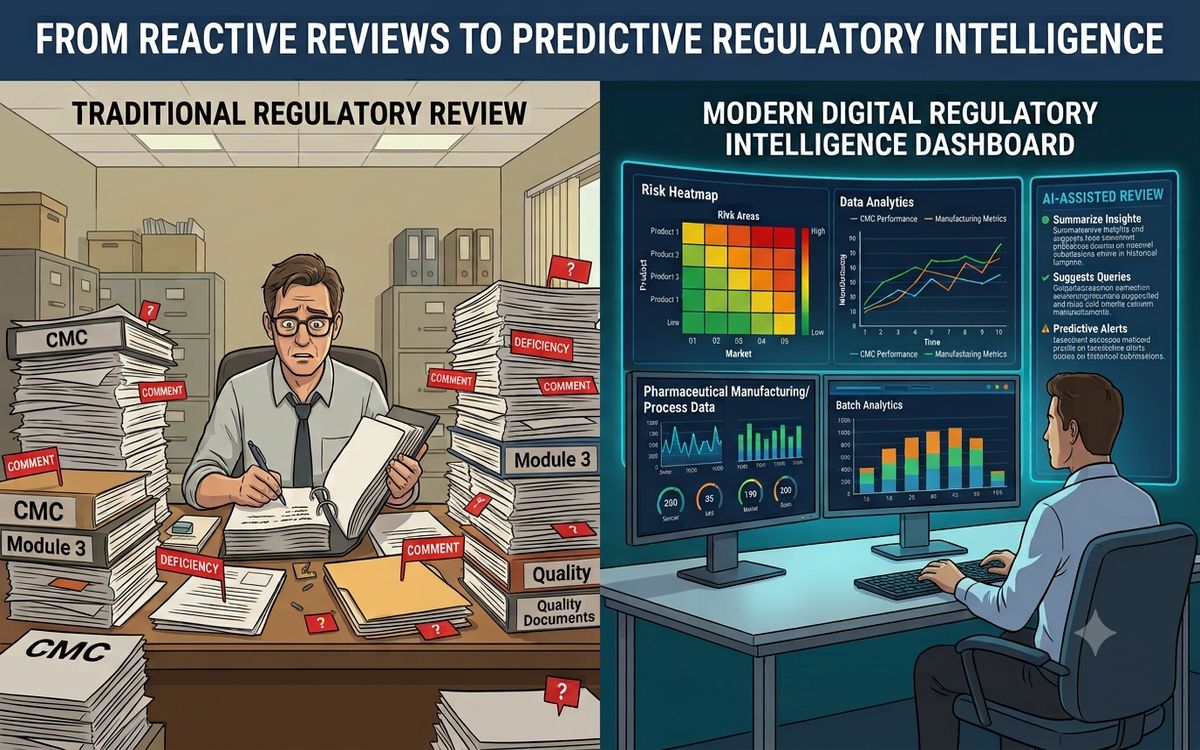
This process has protected public health for decades by ensuring that medicines meet rigorous standards for quality, safety, and effectiveness. Yet it remains largely reactive. Regulators identify issues after a submission is received, and sponsors respond afterward.
As artificial intelligence (AI) becomes increasingly integrated into healthcare and pharmaceutical development, an important question is emerging:
Can we identify many of those issues before a submission ever reaches a regulator?
The answer is yes. AI will not replace scientific judgment. Instead, it is likely to become another tool to help organizations identify regulatory risks earlier in the development process. In this article, predictive regulatory intelligence refers to the use of AI, machine learning, and natural language processing to identify potential regulatory risks before a submission is filed.
Regulatory Intelligence Is Evolving
Regulatory intelligence has long played an important role in pharmaceutical development. Companies continuously monitor guidance documents, inspection findings, deficiency trends, enforcement actions, and regulatory precedents to understand evolving expectations and support compliant product development.
Traditionally, however, regulatory intelligence has been retrospective. It makes it easier to explain what regulators have required in the past, but it offers limited ability to anticipate how future submissions may be reviewed.
Artificial intelligence offers an opportunity to move beyond collecting regulatory information and begin identifying recurring patterns that may facilitate anticipation of future regulatory concerns. Instead of asking, “What deficiencies have regulators identified previously?” organizations may eventually ask, “Based on what is known today, where is this submission most likely to receive questions?”¹⁻⁴
This reflects a broader shift already taking place across healthcare, where predictive analytics are increasingly being used to improve decision-making, manage risk, and support more efficient operations.²⁻⁴
Why CMC Is an Ideal Starting Point
Among all sections of a pharmaceutical submission, CMC may be one of the most suitable areas for predictive analytics.
Modern CMC dossiers contain enormous amounts of scientific information describing pharmaceutical development, manufacturing processes, analytical methods, specifications, stability studies, impurity control strategies, process validation, packaging systems, and lifecycle management activities. Some information is highly structured, while much of it exists within lengthy narrative reports that require careful scientific interpretation.
Experienced reviewers rarely evaluate one document in isolation. They move continuously between Module 2 summaries, Module 3 reports, analytical methods, stability protocols, validation reports, and manufacturing descriptions. Even when the underlying science is sound, inconsistencies between these documents can generate regulatory questions.
Many regulatory observations also follow familiar themes. Stability data may be incomplete. Specifications may lack sufficient scientific justification. Process validation documentation may require additional clarification. Analytical methods may need stronger validation support. Impurity qualification strategies may not fully align with current regulatory expectations.¹
These observations are product-specific, but they are not entirely random. Over time, regulators have accumulated extensive experience evaluating similar scientific issues across many products and submission types.
That ability to recognize recurring patterns is where AI may provide meaningful support.
What Predictive Regulatory Intelligence Could Look Like
Imagine preparing a CMC submission with the assistance of an AI-based review system.
Rather than simply confirming that required documents are present, the system reviews the scientific content itself.
It identifies that the stability commitment described in Module 2 does not fully align with supporting data presented elsewhere in the submission.
It detects that an impurity specification includes acceptance limits but lacks sufficient scientific justification.
None of these observations replaces regulatory review. Instead, they identify areas that deserve closer scientific attention before submission.
Recent advances in natural language processing and large language models have significantly improved AI systems’ ability to interpret scientific documents, summarize technical information, identify inconsistencies, and extract relevant knowledge from large collections of unstructured text.²⁻⁴
When combined with well-developed machine learning models and carefully curated regulatory datasets, these technologies can provide probability-based assessments to help organizations prioritize their review activities.
In this way, AI can function as an intelligent assistant rather than an automated regulator.
Supporting Experts Rather Than Replacing Them
Whenever AI is discussed, one question almost always follows.
Will it replace regulatory professionals?
For pharmaceutical CMC, the answer is almost certainly no.
Preparing and reviewing regulatory submissions requires scientific judgment, product knowledge, regulatory experience, and an understanding of manufacturing science that extend well beyond pattern recognition. Every product presents unique formulation, analytical, manufacturing, and quality considerations that require experienced professionals to interpret.
AI should therefore be viewed as another tool within the regulatory toolbox.
Its value lies in helping reviewers identify areas that deserve closer attention, allowing experts to spend less time searching for potential issues and more time evaluating their scientific significance.
The final responsibility for regulatory decisions will remain where it belongs: with experienced scientists and regulatory professionals.
Opportunities Beyond Submission Readiness
If predictive regulatory intelligence is developed responsibly, its value could extend well beyond identifying potential deficiencies before submission.
Predictive systems could strengthen organizational learning. Regulatory knowledge is often built over many years and resides within individual experts or project teams. Capturing lessons learned from previous submissions and making them accessible through AI-supported knowledge systems could help organizations apply that experience more consistently across future development programs.
Another important advantage is efficiency. For example, instead of manually comparing dozens of stability reports against Module 2 summaries, reviewers could begin with AI-generated observations and then focus their attention on scientific interpretation. None of these capabilities eliminate the need for human review. Instead, they support better preparation before regulatory assessment begins.
The Challenges Are Just as Important as the Opportunities
As promising as predictive regulatory intelligence appears, significant challenges remain before it can become part of routine regulatory practice. One of the greatest challenges is access to high-quality data.
Effective machine learning models depend on access to large, well-curated, and representative datasets. Much of the most valuable regulatory information remains confidential, proprietary, or dispersed across different organizations. Building datasets that accurately represent regulatory expectations while protecting confidential information will require collaboration, appropriate governance, and careful data stewardship.¹
Data quality is equally important. AI systems learn from the information used to train them. If historical datasets are incomplete, inconsistent, or biased, predictions may be unreliable. Poor-quality data can produce false confidence just as easily as poor-quality science.
Another important consideration is explainability.
Regulatory decisions require scientific rationale. If an AI system identifies a possible risk, reviewers need to understand why that conclusion was reached. There is also the risk of overreliance. False-positive predictions could create unnecessary work, while false negatives could provide false reassurance. For this reason, AI should complement existing review processes rather than replace them.
Human oversight will remain essential.
Organizations implementing AI-enabled regulatory tools will also need strong governance frameworks covering data integrity, cybersecurity, validation, auditability, change control, and ongoing performance monitoring. Principles outlined in ICH Q9(R1), Quality Risk Management, and ICH Q10, Pharmaceutical Quality System, provide important foundations for approaching these challenges in a structured and scientifically justified manner.5˒6
Looking Ahead
Interest in predictive regulatory intelligence is already emerging.
One recent example is a peer-reviewed technical report that described a conceptual framework for integrating machine learning, natural language processing, and historical regulatory knowledge to identify potential CMC deficiency risks prior to submission.¹ The publication makes it clear that the framework is conceptual, has not been validated using real regulatory submissions, and should be viewed as a research direction rather than an operational system.
These concepts are also reflected in a U.S. provisional patent application describing a computer-implemented approach for predictive assessment of regulatory deficiencies in pharmaceutical CMC submissions.
Regulatory science has continually evolved alongside advances in pharmaceutical development. Paper submissions became electronic dossiers. Quality by Design introduced more systematic approaches to product development. Risk-based quality management became an integral part of pharmaceutical lifecycle management.
Predictive regulatory intelligence may represent the next step in that evolution.
If implemented responsibly, AI has the potential to improve submission quality, reduce avoidable review cycles, and support more efficient regulatory assessments. Those benefits extend beyond pharmaceutical companies. If such systems prove reliable and appropriately validated, they could allow both sponsors and regulators to focus more of their effort on complex scientific questions rather than avoidable documentation issues.
AI is unlikely to define the future of regulatory science by replacing scientific reviewers.
It may define the future by helping organizations submit better science in the first place.
Author Bio