Misaligned incentives, the wrong unit of work, and a probabilistic model where the process demands a reproducible one A draft annex to European GMP guidance, out for consultation until October 2025, contains the bluntest sentence yet written about AI in regulated...
New Approach Methodologies: What Regulators Now Accept
New approach methodologies have moved from the margins of preclinical science to the centre of regulatory policy. Since publishing its Roadmap to Reducing Animal Testing in Preclinical Safety Studies in April 2025, the United States Food and Drug Administration has...
CSRD Reporting: What Has Changed for European Biotech
The European Union has rewritten its sustainability disclosure rules. The consequences for the life sciences sector are substantial. CSRD reporting was once expected to capture tens of thousands of companies across the bloc. It now applies to a far smaller group of...
FDA PreCheck Program: Seven Companies Chosen to Reshape US Manufacturing
The United States Food and Drug Administration has selected seven pharmaceutical and biotechnology companies for its FDA PreCheck Program, a pilot initiative designed to accelerate the establishment of new domestic drug manufacturing facilities. Announced on 7 August...
Retatrutide Phase 3 Data: Record Weight Loss, Unanswered Questions
Retatrutide, Eli Lilly’s investigational triple hormone receptor agonist, has now reported positive results across five Phase 3 trials. In the pivotal TRIUMPH-1 obesity study, participants on the highest dose lost an average of 28.3% of their body weight at 80 weeks,...
FDA Drug Approval Decisions
Last updated 31 July 2026. Covering target action dates from August to December 2026. The closing stretch of the third quarter has become the busiest regulatory window of 2026. Between early August and the end of September, the US Food and Drug Administration faces...
FDA Drug Approval Decisions
Last updated 31 July 2026. Covering target action dates from August to December 2026. The closing stretch of the third quarter has become the busiest regulatory window of 2026. Between early August and the end of September, the US Food and Drug Administration faces...
Want the FDA to Make Peptides More Accessible?
As the FDA considers reclassifying seven popular peptides, experts say the decision could change how patients access these compounds. As the FDA evaluates whether several commonly used peptides should become eligible for pharmacy compounding, the outcome could...
Compliant on Paper, Exposed in Practice
A pharmaceutical manufacturer completes a technology transfer. The validation protocols have been approved. Training records are complete, documentation has been reviewed, and every required signature has been collected. The project passes its milestones and moves...
From Reactive Reviews to Predictive Regulatory Intelligence
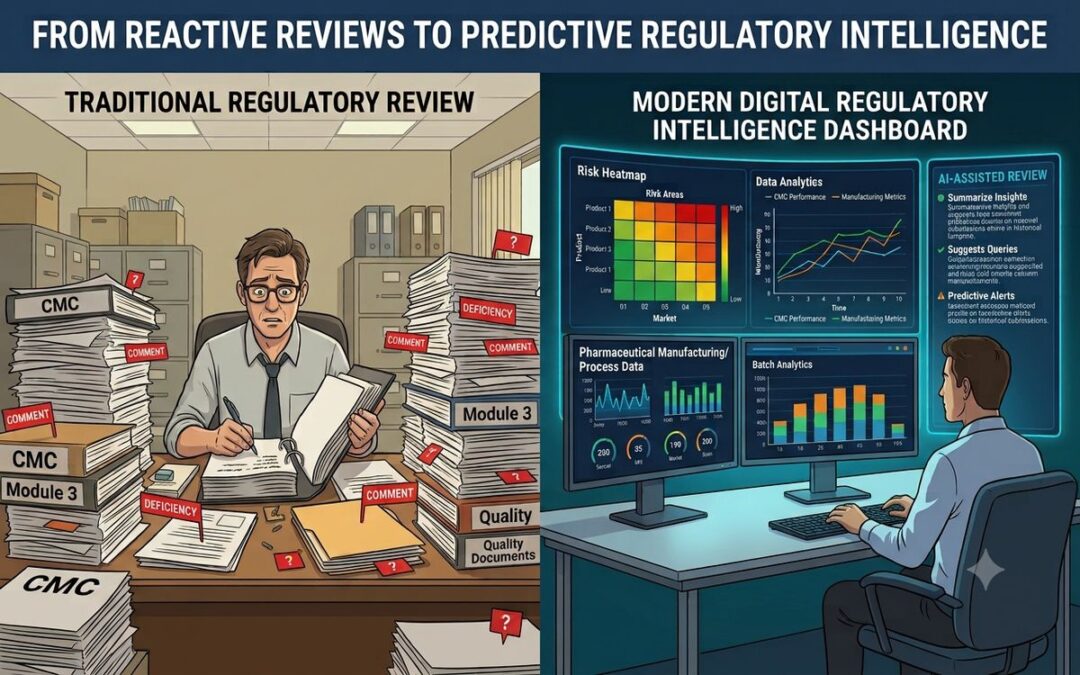
Every regulatory professional has experienced the same moment. After months, and sometimes years, of preparing a Chemistry, Manufacturing, and Controls (CMC) submission, the application is finally submitted to a health authority. At that point, the questions begin....
Why AI in Life Sciences Lives or Dies on its Data Foundations
AI has moved quickly in the life sciences making exciting breakthroughs and reframing how we think about healthcare. But beneath these breakthroughs, work is happening in places that rarely make headlines, data catalogues, validation plans, audit trails, integration...
CagriSema FDA Review: Novo Nordisk NDA Timeline Explained
The CagriSema FDA review has become one of the most closely watched regulatory processes in metabolic medicine. Novo Nordisk filed a New Drug Application for its once-weekly obesity combination in December 2025, and a decision is widely expected in the final quarter...
Daraxonrasib FDA Filing: What Happens Next for Pancreatic Cancer Patients?
The daraxonrasib FDA filing is nearing completion, marking a pivotal regulatory moment for patients with metastatic pancreatic ductal adenocarcinoma (PDAC). Revolution Medicines announced on 7 July 2026 that its rolling submission of a New Drug Application (NDA) to...
FDA Drug Approval Decisions to Watch: July and August 2026
The second half of 2026 is shaping up to be one of the most consequential periods for FDA drug approval decisions in recent memory. Between mid-July and late August, the US Food and Drug Administration faces a succession of Prescription Drug User Fee Act target action...
Atacicept FDA Approval: Trutakna Cleared for IgAN
The atacicept FDA approval that the nephrology community had been anticipating since January arrived on schedule on 7 July 2026, when the US Food and Drug Administration granted accelerated approval to Vera Therapeutics' atacicept-vymj, to be marketed as Trutakna, for...
CE Marking Is Not Enough: Three Layers for Connected Medical Devices
If your device connects to a network and runs AI, CE marking under MDR or IVDR is only the first layer for connected medical devices. Two further EU frameworks, the AI Act and the Cyber Resilience Act, can also apply, each with obligations that go beyond what MDR...
Atacicept IgA Nephropathy: FDA Decision Due 7 July
Four days from now, the US Food and Drug Administration is due to hand down its atacicept IgA nephropathy decision, ruling on whether the experimental Vera Therapeutics drug becomes the first therapy to target both BAFF and APRIL in adults with the disease. The...
FDA Accelerated Approval: How the Fast-Track Pathway Works
FDA accelerated approval is one of the agency's most powerful and most debated regulatory tools. Designed to speed access to treatments for patients with serious or life-threatening conditions, it has delivered transformative therapies to those with no other options....