
Merck and Moderna have reported what they describe as the first positive Phase 3 result for an individualised cancer therapy. Intismeran autogene, given with pembrolizumab, met its primary endpoint in resected melanoma. The companies announced the outcome on 19 August 2026. For the life science industry, the scientific question has narrowed sharply. The operational question has just opened up.
The result lands after more than a decade of disappointing cancer vaccine programmes. Earlier attempts targeted single shared antigens in patients with advanced disease. This programme instead builds a bespoke product from each patient’s own tumour. That difference now has late-stage evidence behind it.
What the INTerpath-001 trial reported
INTerpath-001 is a randomised, double-blind, global Phase 3 study. It is registered as NCT05933577. The trial enrolled 1,137 patients with completely resected stage IIB to IV cutaneous melanoma. None had received prior systemic therapy for their disease. Patients were randomised 2:1 to the combination or to pembrolizumab alone.
The dosing schedule ran for roughly one year. Patients received intismeran autogene at 1 mg every three weeks, for up to nine doses. Pembrolizumab was given at 400 mg every six weeks, for up to nine cycles. The trial used both placebo and active comparator controls.
In their joint announcement, Merck and Moderna said the trial met its primary endpoint of recurrence-free survival. It also met distant metastasis-free survival, a key secondary endpoint. Both results were described as statistically significant. The companies reported no new safety signals for either agent.
Crucially, no hazard ratios, confidence intervals or p-values were released. The announcement came from a preplanned interim analysis. The study continues, and overall survival remains under assessment. Full data will be presented at an international medical meeting.
Professor Georgina Long is the study principal investigator. She is Medical Director of Melanoma Institute Australia. She also chairs Melanoma Medical Oncology and Translational Research at the University of Sydney. “Today’s results represent a landmark moment for adjuvant melanoma treatment,” she said in the companies’ statement.
Why the intismeran autogene result matters beyond melanoma
Merck and Moderna describe this as a first for the field. No earlier Phase 3 study, on their account, has shown benefit for such a therapy. The design is built around each patient’s own tumour mutations. That framing uses the companies’ own language. No peer-reviewed publication yet supports it. Even so, the read-across is significant.
Each dose encodes up to 34 neoantigens as synthetic messenger RNA. Sequencing identifies mutations unique to the individual tumour. Software then selects the targets most likely to provoke an immune response. Manufacturing follows for that single patient. The companies avoid the word vaccine, preferring individualised neoantigen therapy, on the basis that the product treats existing disease rather than preventing it.
The wider INTerpath programme now runs nine Phase 2 and Phase 3 studies. Indications span melanoma, non-small cell lung cancer, bladder cancer and renal cell carcinoma. The renal cell carcinoma study, INTerpath-004, is a randomised Phase 2 trial and is fully enrolled, with primary completion currently estimated for January 2028. A positive melanoma readout improves the outlook for each of those programmes.
For Merck, the timing is commercially useful. Pembrolizumab faces loss of exclusivity before the end of the decade. An adjuvant combination extends the franchise into earlier disease. For Moderna, the result offers a pipeline narrative beyond respiratory vaccines. Moderna’s share price more than doubled on the day of the announcement.
The adjuvant setting has become the sector’s most contested ground. Several recent readouts have pushed therapy earlier in the disease course. Our round-up of the ASCO 2026 cancer trial results covered five plenary readouts across five tumour types. Intismeran autogene now joins the same pattern.
The evidence base underneath the headline
Context matters here, and timepoints matter more. The Phase 2b KEYNOTE-942 study, registered as NCT03897881, provided the earlier signal. Its primary analysis was published in The Lancet in 2024. That analysis reported a hazard ratio of 0.561 for recurrence-free survival, with a 95 per cent confidence interval of 0.309 to 1.017 and a two-sided p-value of 0.053. That equates to a 44 per cent reduction in recurrence or death, a figure reported at AACR in 2023 against the trial’s prespecified one-sided threshold.
Merck’s August 2026 statement cites five-year follow-up from the same Phase 2b study, presented at ASCO in June 2026. On that follow-up, the companies describe a 49 per cent reduction in recurrence or death, with a hazard ratio of 0.51 and a 95 per cent confidence interval of 0.294 to 0.887. They also cite a 59 per cent reduction in distant metastasis or death, with a hazard ratio of 0.411 and a 95 per cent confidence interval of 0.200 to 0.843. Readers should note that these figures belong to KEYNOTE-942, not to INTerpath-001.
Regulators have engaged with the programme for some years. The FDA granted breakthrough therapy designation in February 2023. The European Medicines Agency awarded PRIME scheme designation on 6 April 2023. Neither designation guarantees approval. Neither shortens the evidence bar either.
Manufacturing becomes the rate-limiting step
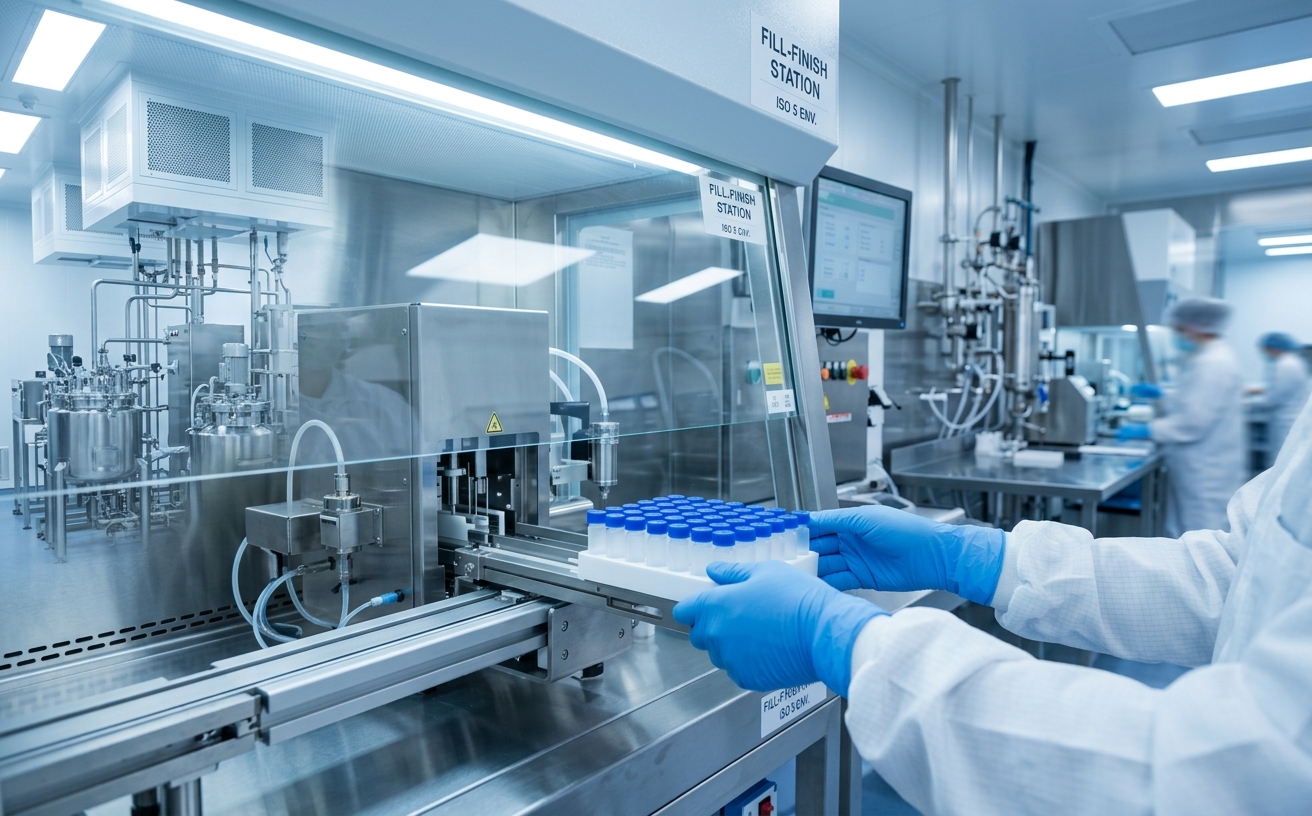
Here the story turns operational. A batch-manufactured biologic can be made once and shipped widely. An individualised neoantigen therapy cannot. Every patient requires sequencing, target selection, synthesis, fill and release testing.
Adjuvant melanoma is not a small population. Cancer Research UK recorded more than 20,000 melanoma cases in the UK in 2022. The charity projects roughly 26,500 cases a year by 2040. Only a subset would qualify for adjuvant therapy. The numbers still remain material.
Scale therefore depends on turnaround time and on capacity. Moderna has built out mRNA capability in several markets. That includes a manufacturing and research facility at Harwell Campus in Oxfordshire. Whether such sites can serve individualised oncology products remains an open commercial question. Contract manufacturers and sequencing providers will watch that question closely.
Neither company has disclosed a vein-to-vein turnaround time for intismeran autogene. That omission matters for adjuvant planning, and it should be pressed at the data presentation.
Cost of goods is the second constraint. Personalised production carries a higher unit cost than conventional biologics. Payers will test that cost against recurrence avoided. Health technology assessment bodies will want durable outcome data, not interim endpoints alone.
Competitors now face a moved benchmark
Merck and Moderna are not alone in this field. BioNTech is developing autogene cevumeran, also known as BNT122, with Genentech. That candidate uses a comparable individualised mRNA approach. It has run Phase 2 studies in adjuvant colorectal cancer and in pancreatic cancer.
A Phase 3 success at a rival changes the calculus for those programmes. Investors will expect similar rigour and similar endpoints. Partners will reassess timelines and capital allocation. Suppliers of sequencing, synthesis and cold chain services should expect demand signals to firm up.
A regulatory framework written for batches
Existing medicines regulation assumes a defined, reproducible product. Individualised therapies challenge that assumption directly. Each dose differs in sequence, though the platform and process stay constant.
Regulators have handled similar problems in cell therapy. Autologous CAR-T products already move through per-patient manufacturing and release. Those precedents help, but they do not resolve everything. Comparability, potency assays and site inspection all require adaptation.
Chain of identity is a further practical burden. A mislabelled batch cannot simply be replaced from stock. Quality systems must therefore track each product from biopsy to infusion. Digital traceability becomes a compliance requirement, not a convenience.
The companies have said they will engage regulators on filings for intismeran autogene. No submission has yet been made. UK readers should expect the MHRA to consider its own route, alongside any European or US decision.
The UK and European access question
The NHS has already positioned itself as a recruitment route for this field. The NHS Cancer Vaccine Launch Pad refers eligible patients into personalised cancer vaccine trials, with recruitment to date running through BioNTech studies rather than the INTerpath programme. That infrastructure still gives the UK an unusual head start on delivery pathways.
Delivery is not the same as reimbursement, however. NICE will assess clinical and cost effectiveness in the usual way. Interim recurrence-free survival data may not satisfy that assessment alone. Overall survival results are likely to carry more weight.
European systems face a similar sequencing problem. Adjuvant therapy must begin reasonably soon after surgery. A long manufacturing turnaround would compress that window. Health systems will need to plan laboratory capacity as well as budget.
What to watch next for intismeran autogene
Three things should shape the next six months. First, the full INTerpath-001 dataset at a medical meeting, including hazard ratios and subgroup detail. Second, progress across the renal cell carcinoma and non-small cell lung cancer arms of the INTerpath programme. Third, the timing and scope of regulatory submissions.
Until the detailed data appear, effect size remains unknown. The companies have confirmed direction, not magnitude. That distinction is worth holding onto.
What has changed is the burden of proof. Individualised neoantigen therapy no longer needs to establish that it can work. It now needs to show that it can be made, released and paid for at scale.