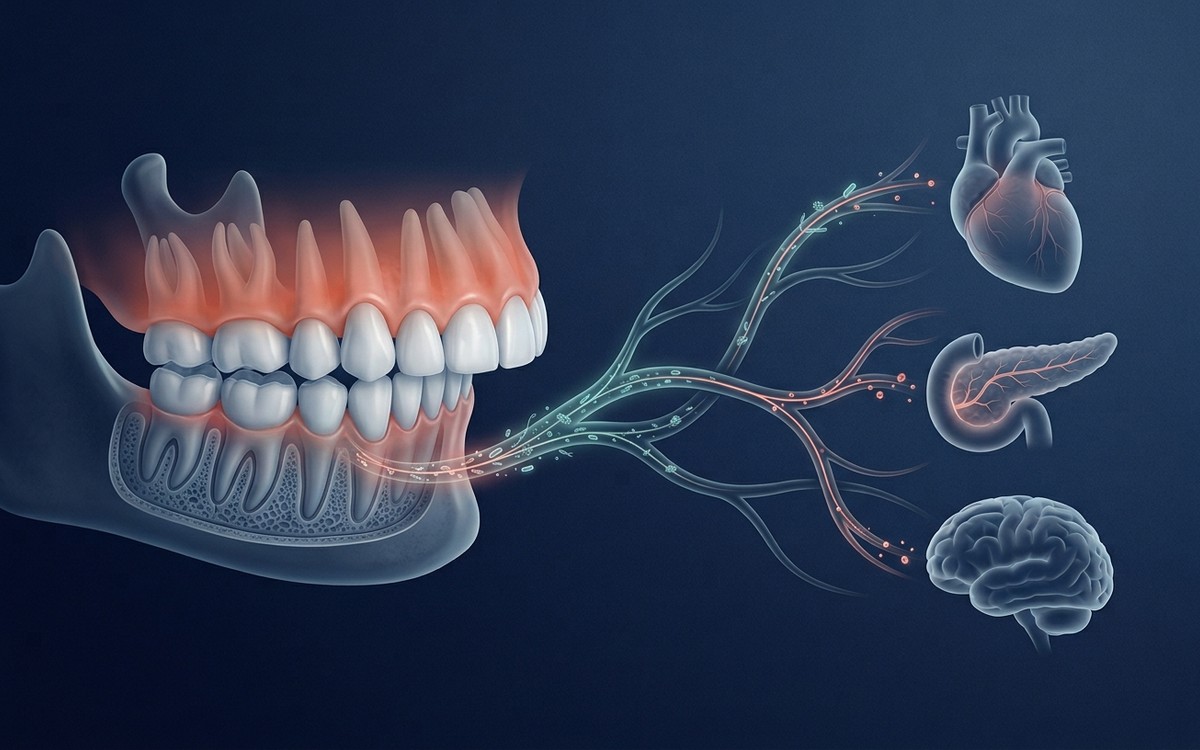
In brief: Periodontitis, the advanced form of gum disease, is consistently linked with cardiovascular disease, type 2 diabetes and adverse pregnancy outcomes. Only the diabetes link is supported by treatment trials, in which periodontal therapy lowers HbA1c by about 0.4 percentage points. No adequately powered trial has shown that treating gum disease prevents heart attacks, strokes or preterm birth. For research and drug development, the mouth is a strong signal and, so far, a weak proof.
Key takeaways
- Severe periodontal disease affects more than 1 billion people worldwide, and around 30% of Australian adults have moderate or severe periodontitis [1,2].
- The American Heart Association’s December 2025 scientific statement confirms an independent association between periodontal disease and atherosclerotic cardiovascular disease, but states that a cause-and-effect relationship has not been confirmed and that there is no direct evidence that periodontal treatment prevents cardiovascular disease [4].
- The diabetes link runs both ways and is the best supported. Periodontal treatment lowers HbA1c by 0.43 percentage points at three to four months, based on moderate-certainty evidence from 30 trials [6,7].
- Treating periodontitis during pregnancy is safe, but the major randomised trials did not reduce preterm birth [9,10].
- Microbiome findings on Porphyromonas gingivalis and Fusobacterium nucleatum are promising research leads, not established causes [13,14,15].
Why the mouth keeps appearing in systemic research
Periodontitis is one of the most common chronic inflammatory conditions in the world. The World Health Organisation estimates that severe periodontal disease affects more than 1 billion people [1], and Australia’s most recent national adult oral health survey found that around 30% of adults aged 15 and over had moderate or severe periodontitis, rising to 59% in people aged 65 and over [2]. Its systemic effects have drawn steady interest from researchers outside dentistry.
The mouth offers a rare live window into chronic infection and host inflammation in the same patient across years. Gum pockets can be measured, sampled and treated, and the body’s inflammatory response can be tracked in blood. For anyone in drug development or clinical research, this makes it both useful and underused.
Which systemic conditions are linked to periodontitis?
Three links have accumulated the most data, and each sits at a different point on the evidence scale.
- Cardiovascular disease. Large observational studies show that periodontitis tracks with atherosclerotic cardiovascular disease after adjusting for shared risk factors such as smoking and diabetes. The American Heart Association (AHA) reviewed this in 2012 and found a consistent association but no proof of causation [3]. Its updated scientific statement, published in December 2025, reaches the same conclusion with more data behind it: the association is independent of shared risk factors, a cause-and-effect relationship has not been confirmed, and there is no direct evidence that periodontal treatment prevents cardiovascular disease [4]. The 2020 consensus of the European Federation of Periodontology (EFP) and the World Heart Federation describes the epidemiological evidence as strong and consistent, covering coronary heart disease, stroke, peripheral artery disease, and cardiovascular mortality [5].
- Type 2 diabetes. This is the most convincing relationship, and it runs both ways. Poor blood sugar control makes periodontitis more likely and more severe, and periodontal inflammation appears to worsen insulin resistance and glycaemic control, according to the joint consensus of the International Diabetes Federation and the EFP [6]. Treatment produces modest but consistent improvements. A 2022 Cochrane review of 30 trials found that periodontal treatment lowered HbA1c (a three-month average measure of blood sugar) by 0.43 percentage points at three to four months, for example, from 7.43% to 7.0%, with moderate-certainty evidence [7].
- Adverse pregnancy outcomes. Observational studies link maternal periodontitis with preterm birth, low birth weight and pre-eclampsia, although the strength of the association varies between populations [8]. Treating periodontitis during pregnancy is safe, but the major randomised trials, including the 823-woman Obstetrics and Periodontal Therapy trial, did not lower preterm birth rates [9]. A 2017 Cochrane review of 15 trials found no clear effect on preterm birth, with only low-quality evidence of a possible reduction in low birth weight [10].
Does treating gum disease improve systemic outcomes?
The gap between association and cause is where this field earns its caveats. Periodontal treatment reduces systemic inflammatory markers, such as C-reactive protein and interleukin-6, and improves endothelial function (how well blood vessels relax), but it has not been shown to reduce heart attacks or strokes. No randomised trial has tested periodontal treatment for the primary prevention of cardiovascular events, and the secondary-prevention trials to date have been inconclusive. The PAVE pilot study found no statistically significant difference in events, and the 280-patient PREMIERS trial in people who had recently had a stroke or transient ischaemic attack found fewer events with intensive than with standard periodontal treatment, but the difference was not statistically significant [4,5].
The diabetes signal is the exception worth taking seriously. The glycaemic improvement after treatment has held up across multiple reviews, even after a large negative trial tempered expectations. The Diabetes and Periodontal Therapy Trial, with 514 participants, found no change in HbA1c at six months [11], yet the pooled evidence still favours a clinically meaningful effect [7].
Is the link causal? What Mendelian randomisation shows
Mendelian randomisation uses genetic variants that predispose people to a condition as a natural experiment, which reduces the confounding that limits observational studies. Applied to periodontitis, these studies have so far produced mixed results and have not confirmed a causal effect on coronary artery disease or stroke [4,12]. A 2020 analysis found no robust evidence of a causal relationship and suggested that the associations seen in observational studies may partly reflect confounding [12].
That does not close the question. The genetic instruments for periodontitis are weak, and the method carries its own limits around instrument strength and pleiotropy (genes that influence more than one trait). For a research or regulatory reader, the practical takeaway is to treat oral-systemic claims as hypotheses that still need clear causal evidence.
The oral microbiome as a research frontier
The tissue-level story is now being rewritten at the oral microbiome level. Specific species have been linked to conditions well beyond the mouth, and some findings suggest plausible drug targets and biomarkers. Two examples have drawn the most attention.
- Porphyromonas gingivalis and Alzheimer’s disease. A 2019 study reported the presence of gingipains (protein-cutting enzymes produced by P. gingivalis) and P. gingivalis DNA in the brains of people who had died with Alzheimer’s disease, and proposed the bacterium as a contributor [13]. The follow-on GAIN trial of the gingipain inhibitor atuzaginstat, with 643 participants, did not meet its co-primary cognitive and functional endpoints in the overall population. A prespecified subgroup with markers of P. gingivalis infection showed slower decline, which keeps the idea firmly in the hypothesis-generating column [14].
- Fusobacterium nucleatum and colorectal cancer. This oral organism is enriched in colorectal tumours, and a 2024 study in Nature narrowed the link to a specific subspecies clade, Fna C2, that dominates the tumour niche [15]. The mechanistic and diagnostic implications are under active study.
For pharma and biotech, the appeal is concrete. Salivary and subgingival (below the gum line) sampling is inexpensive and repeatable, which suits biomarker discovery and companion diagnostics. Host-modulation therapy, which targets the inflammatory response rather than the bacteria alone, is an established concept in periodontology and remains an active area of research.
What this means for clinical research and drug development
I see this from both sides, in the literature and in the chair. Severe, untreated oral infection does not remain confined to the mouth and remains a common reason patients present for urgent dental care.
The clearest near-term value lies in how trials are designed and read. Periodontal status is a modifiable inflammatory variable that often goes unmeasured, and it can confound studies of cardiometabolic and inflammatory endpoints. Capturing it at baseline is cheap insurance against a hidden source of variance.
There is also a shared-risk story that matters for whole-patient care. Periodontitis, type 2 diabetes and cardiovascular disease cluster in the same patients through common drivers such as smoking and metabolic dysfunction. The EFP and World Heart Federation recommend that dentists inform patients with periodontitis of their increased cardiovascular risk, and that physicians ask about gum health and refer patients for periodontal assessment as part of cardiovascular care [5]. Managing the mouth as part of that cluster provides clinical teams with another modifiable factor to measure, without promising systemic benefits that trials have not yet demonstrated.
Where the evidence is still thin
A few honest limits should travel with any oral-systemic claim:
- Causation remains unproven for most systemic links outside diabetes, and intervention trials for cardiovascular and pregnancy outcomes have been negative or inconclusive [4,10].
- Effect sizes, where they exist, tend to be modest and can shrink under well-controlled conditions.
- Microbiome findings remain largely associative, and single-organism theories have so far struggled once tested in human trials.
The direction of travel is still worth watching. Better causal methods, larger microbiome cohorts and salivary diagnostics are the areas most likely to move this from correlation toward something a trialist or regulator can use. Until then, the mouth is a strong signal and a weak proof, and it deserves to be measured more often than it is.
Frequently asked questions
Does gum disease cause heart disease? Not proven. Periodontitis is independently associated with cardiovascular disease, but the AHA’s 2025 statement says a cause-and-effect relationship has not been confirmed, and genetic studies have not shown a causal effect [4,12].
Can treating gum disease lower blood sugar? Yes, modestly. In people with diabetes and periodontitis, periodontal treatment lowers HbA1c by about 0.43 percentage points at three to four months (moderate-certainty evidence). It complements, and does not replace, medical diabetes care [7].
Is it safe to treat gum disease during pregnancy? Yes. Non-surgical periodontal treatment during pregnancy is safe, but trials have not shown that it lowers the rate of preterm birth [9,10].
Should clinical trials record periodontal status? It is worth considering for trials with inflammatory or cardiometabolic endpoints. Periodontitis is common, modifiable and rarely measured, so it can act as a hidden confounder.
Author Bio