

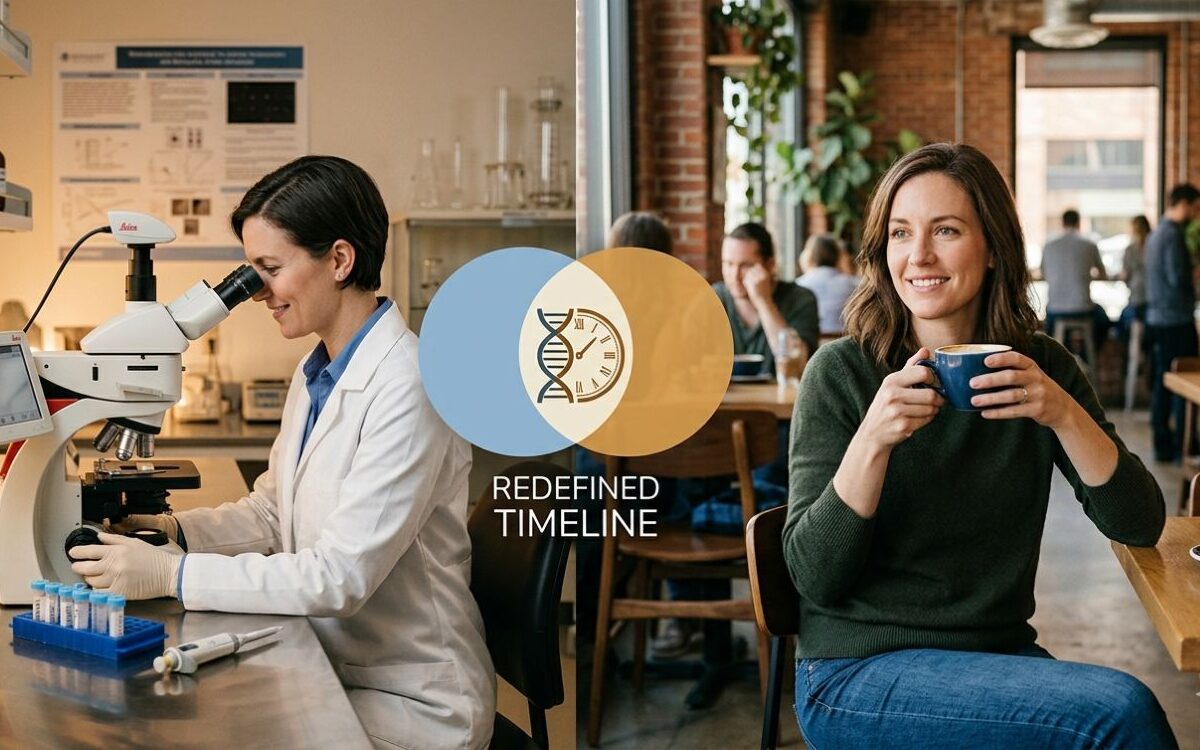
For many modern women, the concept of fertility is something to consider later, when life feels steady and the timing feels right. Now more than ever, trends that encourage delaying partnership, questioning traditional paths, or seeking information earlier are changing the conversation around reproductive health. At the center of this shift are two core perspectives: clinical clarity and cultural reality.
Dr. Roohi Jeelani guides her patients through infertility, fertility preservation, and reproductive health assessments and has a wealth of knowledge to share with women from her medical perspective. Hayley Spitaleri, a mom who had children later in life, explores this often-unspoken topic on her podcast A Splash More. Together, they offer a thoughtfully nuanced look at what it truly means to “redefine the timeline.”
One of the biggest misconceptions Dr. Jeelani sees is the belief that infertility is primarily a woman’s issue. “In reality,” she explains, “male factor contributes to infertility in about 40–50% of cases.” While delayed parenthood can impact both partners, culturally, the burden of concern is often placed solely on women.
A common misconception is that outward health is a direct indicator of fertility. Dr. Jeelani emphasizes that while overall health absolutely matters, ovarian reserve and egg quality are influenced strongly by both age and genetics, not just lifestyle.
There is also a widespread myth about when fertility decline actually begins. “Fertility doesn’t suddenly drop at 40,” she says. “It gradually changes beginning in the early 30s, with egg quality declining before many women feel any outward signs.” Egg quality cannot be seen or felt, which is why testing can be empowering for women.
For Dr. Jeelani, one of the most important shifts is helping women understand that fertility is not just something to consider when trying to conceive.
“I wish every woman understood that fertility is a vital sign of overall health,” she says. “Your menstrual cycle, hormone patterns, and ovarian reserve can offer early clues about metabolic health, endocrine disorders, and even long-term wellness risks.”
Proactive fertility assessment, she adds, isn’t only for people actively trying to get pregnant. Hormone testing, ovarian reserve markers, and cycle tracking can provide valuable information years before pregnancy is even on the radar.
“Reproductive education is not about pressure or fear,” she says. “It’s about agency. When you understand your biology early, you can make informed decisions that align with your goals, your timeline, and your life, not someone else’s expectations.”
Beyond biology, Dr. Jeelani sees the emotional weight fertility uncertainty carries.
“From a clinical perspective, fertility uncertainty can be one of the most psychologically taxing experiences a woman faces,” she says. It combines three powerful stressors: lack of control, time pressure, and identity vulnerability. Unlike many medical conditions with clear timelines or treatment paths, fertility often exists in a space of waiting without answers. That prolonged uncertainty can heighten anxiety and emotional distress.
Dr. Jeelani works with patients who are high-functioning, successful, and resilient in every other area of their lives, but fertility uncertainty can make them feel powerless. “That emotional shift is profound,” she says. Many describe cycles of hope and disappointment month after month, mirroring patterns seen in chronic stress.
There is also a grief component. Even before a formal diagnosis, patients may grieve the future they imagined. Because fertility struggles are often private, women may feel isolated, as though everyone else is moving forward while they’re standing still.
Clinically, she notes, prolonged uncertainty can increase risks of anxiety, depression, sleep disruption, and relationship strain. Yet she also observes something else: when patients are given clear information, a plan, and support, stress levels often improve, even if treatment hasn’t started.
“It’s not just infertility that affects mental health,” she says. “It’s the uncertainty. And one of the most therapeutic things we can offer patients is clarity.”
While Dr. Jeelani sees the medical and psychological effects firsthand, Hayley hears the cultural undercurrents in conversation after conversation. “The biggest theme that comes up around fertility is pressure,” Hayley says. “Pressure to be ready. Pressure to want motherhood. Pressure for it to happen easily.”
Women talk to her about how overwhelming it feels to know they want to be a mother someday, but not yet. Others share how isolating it feels to not want that path at all. And many speak about the heartbreak of coming face-to-face with fertility when it doesn’t unfold according to plan.
“There’s still a quiet narrative that if you’re a woman, motherhood is inevitable and that the process should be natural and seamless,” she says. “That narrative is dangerous.”
When motherhood doesn’t happen easily, or doesn’t happen by choice, women are often left carrying the weight in silence, questioning themselves instead of questioning the expectation. Another recurring theme Hayley hears is the fear of being “behind.”
How do women reconcile ambition, career growth, partnership timing, and biology without constantly feeling late? “Honestly, this is an inside job,” she says. Society still pushes the idea of a “right” timeline, and trying to align ambition, partnership, and biology in a perfectly sequenced way can feel exhausting and unrealistic.
What’s changing, though, is conversation. Women are sharing their stories and finding community. “Feeling ‘behind’ is usually a comparison trap, not a fact,” she says. Vulnerability and honesty about where you actually are in life, she believes, is a superpower. “We shouldn’t have to reconcile who we are with someone else’s timeline,” she says. “We should be free to live fully on our own.”
When asked what “redefining the timeline” means, Hayley is clear that the science belongs to Dr. Jeelani. Emotionally, however, it’s about releasing the idea that there is one correct sequence for a woman’s life.
For decades, expectations around marriage and motherhood were clear and narrow. But women’s roles have shifted dramatically, particularly as participation in the workforce has increased. That shift alone changes how timing works.
“Redefining the timeline emotionally means giving ourselves permission to want what we want, or not want it, without shame,” she says. It also means recognizing that growth takes time and cultural narratives take time to catch up.
“The timeline shifts when women stop measuring themselves against an inherited script,” Hayley says, “and start living in alignment with their own.”
In both the exam room and the podcast studio, one theme echoes: clarity over pressure, agency over assumption.
Fertility is deeply personal, sometimes uncertain, and often misunderstood. Redefining the timeline does not mean ignoring reality anyway. It simply means understanding it and choosing how to move forward with intention, informed, and empowered.
About the Authors

Hayley Spitaleri
Hayley Spitaleri: Hayley Spitaleri is a purpose-driven entrepreneur, advocate, and community builder dedicated to amplifying women’s voices and fostering authentic connection. Raised in a big Italian family outside Boston, she learned early that being seen and heard does not always come naturally. Her confidence and leadership skills grew at Notre Dame Academy, an all-girls Catholic school that encouraged young women to lead boldly and own their strengths, a foundation that continues to shape her life today.
After years in corporate marketing and a transformative service trip to Haiti, where she lived and worked in a remote health clinic, Hayley founded A Labor of Love, an e-commerce and community platform rooted in sustainability, collaboration, and empowerment. That mission later evolved into co-founding A Splash More, a podcast dedicated to celebrating women’s stories and creating spaces where authenticity and leadership thrive. Hayley’s work is also shaped by her experiences as a mother, a music industry professional with a platinum album credit, and an advocate who leads with integrity, empathy, and purpose.

Dr. Roohi Jeelani
Roohi Jeelani: Roohi Jeelani, MD, FACOG, is a double board-certified Reproductive Endocrinology and Infertility (REI) specialist, nationally recognized for her leadership in fertility care and women’s health innovation. As both a physician and former fertility patient living with PCOS, Dr. Jeelani brings a rare combination of clinical expertise, scientific insight and personal understanding to every aspect of patient care.
Dr. Jeelani takes a proactive, patient-centered approach that integrates personalized care with evidence-based medicine. She views fertility as a critical indicator of overall health, which enables her to identify and address factors that influence well-being across the lifespan. Her focus is on delivering exceptional fertility outcomes while supporting long-term health.
As Founder and CEO of Onto Health, Dr. Jeelani is committed to expanding access to high-quality health care, building innovative clinical programs and ensuring every patient feels informed, supported and empowered on their path to parenthood.