

Thesis
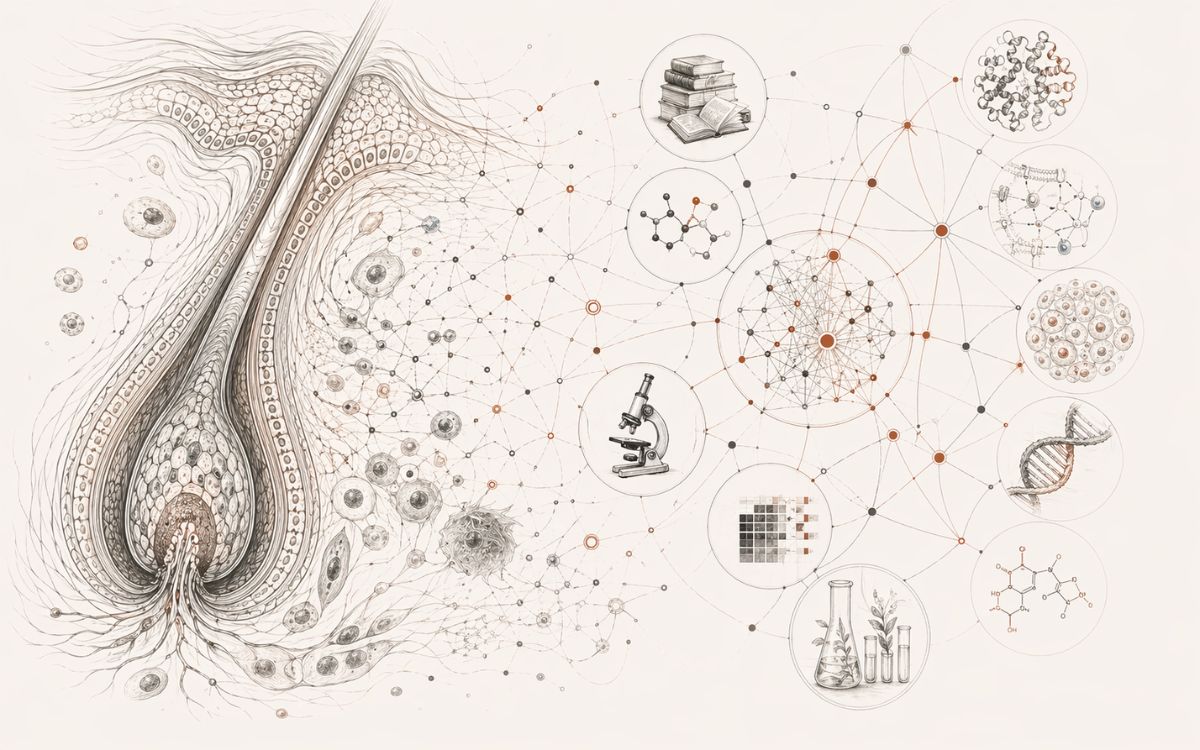
Early-stage life science development is increasingly constrained not by lack of data, but by fragmented, multi-scale evidence that resists straightforward interpretation. AI systems can assist in structuring this complexity – through literature triage, mechanism mapping, and contradiction analysis – but translating evidence into formulation logic still requires explicit frameworks, scientific judgement, and experimental validation.
Introduction: The Bottleneck Is No Longer Information
Over the past two decades, the volume of life science literature has expanded to a point where access is no longer the limiting factor. Researchers and early-stage development teams can readily retrieve hundreds of papers on a given biological process, spanning molecular mechanisms, animal models, and human observations.
Yet this abundance introduces a different constraint: fragmentation. Evidence is distributed across disciplines, experimental systems, and levels of abstraction. Findings that are individually valid do not automatically cohere into a usable model when considered together.
In many early-stage settings, the default workflow remains largely unchanged: assembling literature, identifying promising mechanisms, and constructing interventions from selected findings. This process is often described as evidence-based. In practice, it is frequently evidence-selected – a filtering process that favours coherence over completeness. The result is not a structured hypothesis about system behaviour, but an aggregation of plausible signals.
The challenge, therefore, is not access to evidence, but the ability to impose structure on it.
Why Single-Mechanism Reasoning Breaks Down
Most biological phenomena of practical interest are not governed by single pathways. They emerge from interacting systems with overlapping dependencies, compensatory mechanisms, and context sensitivity.
Hair pigmentation provides a useful illustration. It depends on stem cell dynamics, signalling pathways, metabolic inputs, oxidative balance, and structural integration within the follicle. These processes do not operate independently – they constrain and reinforce one another. Disruption in one domain may propagate across the system, but no single mechanism fully explains the outcome.
This type of architecture is common across biological domains. However, early-stage intervention logic often simplifies it. A compound is selected because it modulates a pathway of interest; multiple compounds are then combined with the expectation that their effects will aggregate.
That expectation is rarely made explicit. Interactions between pathways, bottlenecks in system dynamics, and dependencies between inputs are often under-specified. As a result, interventions may be mechanistically motivated, but structurally incomplete.
AI as Infrastructure for Evidence Structuring
Recent advances in AI – particularly in large-scale language models and embedding-based retrieval – offer a way to manage this fragmentation. Their value lies not in generating new scientific knowledge, but in reorganising existing knowledge into more tractable forms.
Several functions are particularly relevant in early-stage contexts:
Literature triage
AI systems can cluster research by mechanism, not just topic, enabling structured exploration beyond keyword search.
Mechanism mapping
Relationships between pathways, molecules, and phenotypes can be extracted and represented as networks, making dependencies explicit.
Contradiction detection
Divergent findings – often distributed across studies – can be surfaced and compared, particularly where effects are context-dependent.
Signal prioritisation
Evidence can be stratified by type, consistency, and relevance, reducing reliance on isolated or weakly supported findings.
Hypothesis organisation
Rather than producing lists of candidate mechanisms, AI-assisted workflows can organise them into structured models of system behaviour.
Used in this way, AI does not generate conclusions. It makes the structure of the evidence visible. This distinction is critical. AI organises information; it does not validate it. Used well, it increases clarity. Used poorly, it accelerates poorly structured thinking.
From Literature to Formulation Logic
Even when evidence is well organised, the transition from literature synthesis to formulation logic is not automatic. It requires an explicit structuring step – one that translates biological insight into a coherent intervention model.
A useful approach can be understood as a sequence of constraints:
Defining system boundaries
Clarity about the biological system and the outcomes of interest determines what evidence is relevant. Without this, synthesis remains descriptive rather than directional.
Identifying interacting pathways
The objective is not to prioritise individual mechanisms, but to identify the set of pathways that collectively govern system behaviour. This shifts the focus from prominence to coverage.
Mapping constraints and dependencies
Rate-limiting steps, co-factor dependencies, and feedback loops define how the system responds to intervention. Making these explicit allows the model to move beyond surface associations.
Evaluating interaction logic
Interventions operate in combination. Their effects depend on how they interact:
- complementarity vs redundancy
- potential interference
- diminishing returns across overlapping mechanisms
Translating into intervention structure
At this stage, combinations and configurations can be defined – not as solutions, but as structured hypotheses grounded in system behaviour.
A formulation, in this sense, is not a collection of components. It is an encoded hypothesis about how a biological system may respond under a defined set of constraints. Well-structured models do not eliminate uncertainty. They determine where uncertainty meaningfully remains.
Mechanistic Plausibility and Its Role
There is a recurring tendency in early-stage work to treat the distinction between mechanism and efficacy as a disclaimer – something to acknowledge before moving on. This understates its role.
A well-structured mechanistic model does something specific: it constrains the space of plausible interventions. It defines what is worth testing and, equally importantly, what is not. This is not the same as predicting outcomes, but it is not incidental.
The greater risk is not overconfidence in such models. It is the absence of them – where interventions are assembled from isolated findings and described as “evidence-based” without an underlying system logic.
Translation gaps, dose-response variability, and untested interactions are not simply limitations. They are the parameters that define rigorous early-stage work. Making them explicit allows hypotheses to be formed with greater precision, even in the absence of definitive outcomes.
Where AI Meaningfully Changes Early-Stage Work
For small, science-led teams, the practical impact of AI lies in enabling a more systematic approach under constraint.
AI can:
- expand the breadth of literature considered without proportional increases in time
- structure evidence into mechanisms, relationships, and dependencies
- support iterative refinement of hypotheses as new data emerges
- surface assumptions that would otherwise remain implicit
This shifts the role of the researcher. Less time is spent on retrieval and aggregation; more is spent on interpretation and model construction.
AI does not resolve biological uncertainty. It makes that uncertainty more visible, and therefore more tractable. Used in this way, it does not replace scientific judgement – it increases the surface area on which it can be applied.
Broader Relevance Across Life Science Domains
The dynamics described here are not specific to any one biological system. They emerge wherever processes are multifactorial and evidence is distributed across scales.
This applies across preventive health, longevity science, dermatology, metabolic regulation, and other life science-adjacent areas. In each case, the underlying challenge is similar: translating fragmented evidence into structured, system-aware hypotheses.
As the volume of available data continues to increase, this challenge becomes more pronounced. The ability to impose structure on that data – rather than simply access it – becomes a defining capability.
Conclusion: Toward Structured Early-Stage Science
The limiting factor in early-stage life science development is no longer access to information, but the structure imposed on it.
AI tools offer a way to organise and interrogate complex bodies of evidence more effectively. However, their value depends on the frameworks within which they are used. Without explicit approaches to mapping systems, identifying constraints, and evaluating interactions, the output remains a collection of signals rather than a coherent hypothesis.
A shift is therefore required – from assembling evidence to structuring it, and from selecting mechanisms to modelling systems.
The translation from literature to intervention remains a scientific act.