
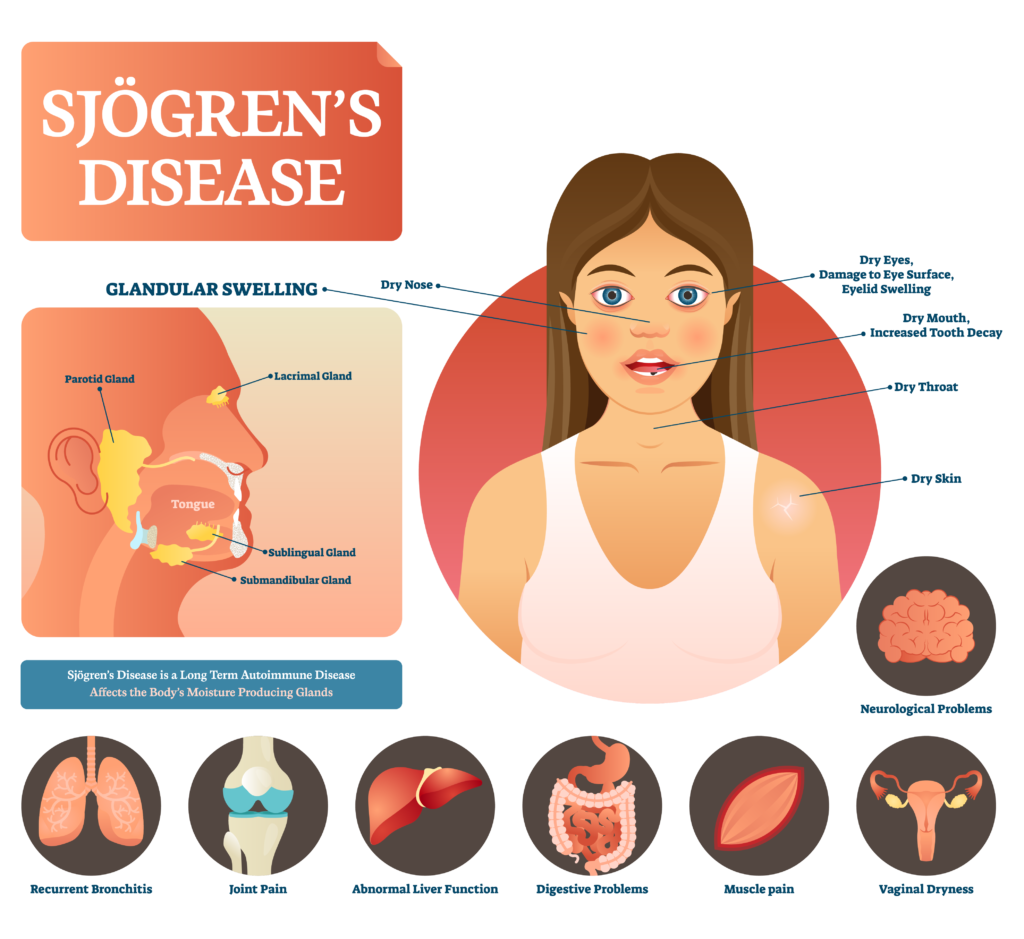
Autoantibody testing is a central part of autoimmune disease diagnosis, including Sjögren’s disease (SjD). The American College of Rheumatology and European Alliance of Associations of Rheumatology (ACR/EULAR) classification criteria for SjD incorporate ocular and oral symptoms and anti-SSA/SSB (anti-Ro/La) antibody testing to assign a diagnosis. Providers rely on this combination of clinical features to distinguish SjD from other autoimmune diseases.
However, a considerable proportion of patients present with profiles that do not align with established criteria. Variability in symptom expressions and biomarker signatures across suspected cases complicates diagnosis, reflecting a broader challenge seen across autoimmune diseases. Further, seronegative patients with high clinical suspicion of SjD may require invasive salivary labial biopsy procedures to confirm a diagnosis. These diagnostic limitations highlight the need for additional non-invasive approaches to support diagnostic accuracy.
SjD patients are often misdiagnosed with rheumatoid arthritis (RA), systemic lupus erythematosus (SLE), or systemic sclerosis (SS) due to overlapping clinical and serological features. Sicca symptoms are hallmarks for SjD; however, these symptoms are also observed in RA, SLE, and scleroderma. Additionally, positivity for biomarkers that typically point to other diseases, namely rheumatoid factor, can be quite common in SjD patients.
(Deroo et al, 2022). Meaning one third of patients test negative for these biomarkers highlighting a need for supplementary biomarkers to differentiate SjD from other autoimmune diseases. Patients with SjD face an average diagnostic delay of nearly six years, during which misdiagnosis can contribute to delays in treatment initiation, prolonged disease activity, and progression that may increase the risk of long-term organ or tissue damage (Meinecke et al, 2024).
Antibodies against subcomponents of the SSA complex, anti-Ro52 and anti-Ro60, have gained interest as additional biomarkers to help differentiate SjD. Further, recent data report differential diagnostic and clinical implications with positivity for each antibody individually and collectively. Indicating a need for differentiation of anti-Ro52 and anti-Ro60 antibodies (Robbins et al, 2019).
Together, Ro52 and Ro60 come together to form the Ro component of the Ro/La ribonuclear complex. However, both proteins show distinct functions outside of complex-specific activities. Ro52 is a 52 kDa protein often referred to as TRIM21, which participates in intracellular immune regulation and ubiquitination pathways. Typically, cytoplasmic Ro52 is an E3 ligase contributing to ubiquitination and subsequent degradation of proteins. In proinflammatory environments, Ro52 is translocated to the nuclear compartment where it upregulates transcription factors that promote interferon and cytokine production (Oke et al, 2012).
By contrast, Ro60 is a 60 kDa RNA-binding protein involved in mediating stabilization and degradation of misfolded noncoding RNA. Ro60 also mediates macrophage activation in response to cellular apoptosis (Mahla et al, 2024).
In the context of autoimmune disease, anti-Ro52 and anti-Ro60 show discrete differences in prognostic and diagnostic value. First, anti-Ro52 associates with a broad spectrum of autoimmune diseases including systemic sclerosis and myositis, often signaling overlapping phenotypes or increased disease severity. Specifically, anti-Ro52 positivity is associated with myositis- or systemic sclerosis-associated interstitial lung disease suggesting signaling for more severe or progressive pulmonary involvement, even in the absence of myositis-specific antibodies.
On the other hand, anti-Ro60 antibodies are strongly linked to Sjögren’s disease and SLE, often correlating with classic features such as sicca symptoms, photosensitivity, and cutaneous manifestations. In SLE, anti-Ro60 is associated with subacute cutaneous lupus and neonatal lupus risk when present in pregnant patients (Gryka-Marton et al, 2021).
The distinction between these antibodies carries important clinical implications to refine diagnosis, stratify patients by risk level, and classify overlapping syndromes (based on Robbins et al, 2019).
- Refined diagnosis: Isolated anti-Ro60 positivity supports classification of Sjögren’s disease or SLE, while isolated anti-Ro52 positivity associates with myositis or systemic sclerosis.
- Risk stratification: Anti-Ro52 positivity in myositis patients may warrant closer pulmonary monitoring due to its association with ILD (Shi et al, 2023).
- Clarifying overlap syndromes: Dual positivity (anti-Ro52 and anti-Ro60) may indicate Sjögren’s disease or SLE, which suggests broader immune dysregulation requiring further evaluation.
Not only do these biomarkers provide additional diagnostic information, but they can also guide more targeted clinical decision-making and enhance patient management. For instance, a patient who presents mild myalgias and isolated anti-Ro52 positivity may benefit from early pulmonary evaluation, even before overt respiratory symptoms develop. Anti-Ro60 positivity in a patient with dry eye and dry mouth symptoms reinforces the need for comprehensive Sjögren’s disease assessment. Identifying anti-Ro60 positivity (with or without anti-Ro52 positivity) remains critical in pregnant patients due to the risk of neonatal lupus and congenital heart block (Tonello et al, 2016), underscoring the value of comprehensive antibody characterization.
Advanced testing using more specific antibodies enhances the clinical picture in diagnosing autoimmune disease and provides more complete information to support clinical decisions. With promising targeted therapies for SjD advancing through regulatory review, it is imperative that providers can diagnose patients accurately and early, so that eligible patients are positioned to benefit promptly upon approval. Recently, the FDA assigned the “Breakthrough Therapy” designation to ianalumab for SjD based on favorable efficacy and safety outcomes in recent clinical trials (Dörner et al, 2025). As targeted treatment options for SjD become available on the market, advanced diagnostic approaches can support earlier and more definitive diagnoses to ensure patients receive targeted therapies.
The AVISE® CTD test, developed by Exagen, Inc., incorporates anti-Ro52 and anti-Ro60 as part of a comprehensive autoimmune testing approach. By evaluating these antibodies within a broader biomarker framework, AVISE® CTD provides clinicians with additional objective information to support assessment of SjD and overlapping connective tissue diseases.
Author Bio’s

Tyler Alexander, PhD
Tyler Alexander is a medical affairs writer at Exagen Inc., a life sciences company focused on improving the diagnostic journey and management of patients with autoimmune diseases. With more than five years of medical writing experience across academic, pharmaceutical, and diagnostic laboratory settings, he specializes in translating complex healthcare topics into clear, scientifically accurate, and compelling evidence-based communications. Tyler earned his Ph.D. in Biological Sciences from University of Arkansas for Medical Sciences and holds a bachelor’s degree in Biology from Morehouse College.

Brittany Partain, PhD
Brittany Partain, PhD is the Associate Director of Clinical Affairs and Physician Education at Exagen, where she leverages her scientific and medical expertise to support healthcare providers in the use of advanced diagnostic tools for the accurate diagnosis, prognosis, and monitoring of autoimmune diseases. Her work focuses on translating complex clinical and scientific data into actionable insights that support informed clinical decision-making and improved patient outcomes.
Brittany joined Exagen in May 2021 from the University of Florida, where she was a Postdoctoral Fellow. She holds a PhD in Biomedical Engineering from the University of Florida and brings over a decade of cross-disciplinary research experience spanning biomedical engineering, translational research, and diagnostics.