The Silent Clock in Your Arteries: Why Vascular Aging Is the Heart Health Crisis We’re Missing
We are living in an era of extraordinary innovation in heart health. Precision diagnostics. AI-guided therapies. Wearables that track everything from rhythm to recovery. And yet, cardiovascular mortality is rising again for the first time in decades. From where I sit, both as a researcher and a builder, the missing piece is clear. We are overlooking one of the most powerful, predictive indicators of future cardiovascular risk: vascular aging.
Vascular aging reflects how old your arteries behave, regardless of your actual age. We recognize aging in our skin and joints, but not in the arteries, where it matters most. The wear and tear is happening quietly, without obvious signs, as rising pressure and stiffening vessels begin to strain the organs they supply.
Over time, this process contributes directly to disease. It increases the risk of heart attacks and heart failure, damages the brain’s small vessels leading to stroke and cognitive decline, and impairs blood flow to the kidneys and other organs. What begins as a subtle mechanical change in the arteries ultimately shapes some of the most serious and costly conditions we face.
This is increasingly reflected in science. Research on vascular aging has expanded rapidly, with new studies emerging every few days and a growing recognition that arterial stiffness plays a central role in heart failure, stroke, and reduced longevity.
The blind spot in how we measure heart health
People often think of arteries as simple tubes that carry blood from the heart to the rest of the body. But healthy arteries do far more than that. They expand and contract with each heartbeat, cushioning the force of circulation and regulating flow. This flexibility protects the heart from strain and shields organs from damage.
As we age, that flexibility fades. The arteries stiffen, and the heart has to work harder to push blood forward. That added effort raises pressure throughout the system. It’s like switching from a garden hose to a pressure washer. The same volume becomes more forceful and more damaging. Over time, that extra pressure reaches the body’s smallest, most delicate blood vessels, gradually damaging organs like the brain and kidneys.
What begins as a gradual loss of elasticity eventually becomes measurable strain. This is the process of vascular aging: the slow breakdown of the system’s ability to manage pressure and flow. In fact, in the Framingham Heart Study, nearly two-thirds of adults aged 50 to 59 already showed signs of early vascular aging, and they had two to three times higher cardiovascular risk. Yet this remains largely unrecognised by both patients and clinicians.
Why? Because the tools we rely on don’t capture what matters most. Take blood pressure. It’s measured at the arm, where arteries are smaller and farther from the heart. But that number, whether it’s 120 over 80 or not, doesn’t reflect the pressure the heart is actually working against.
The signal hidden in plain sight
Every time the heart beats, it sends a wave of pressure through the arteries. That wave carries important clues about how flexible or stiff those vessels are.
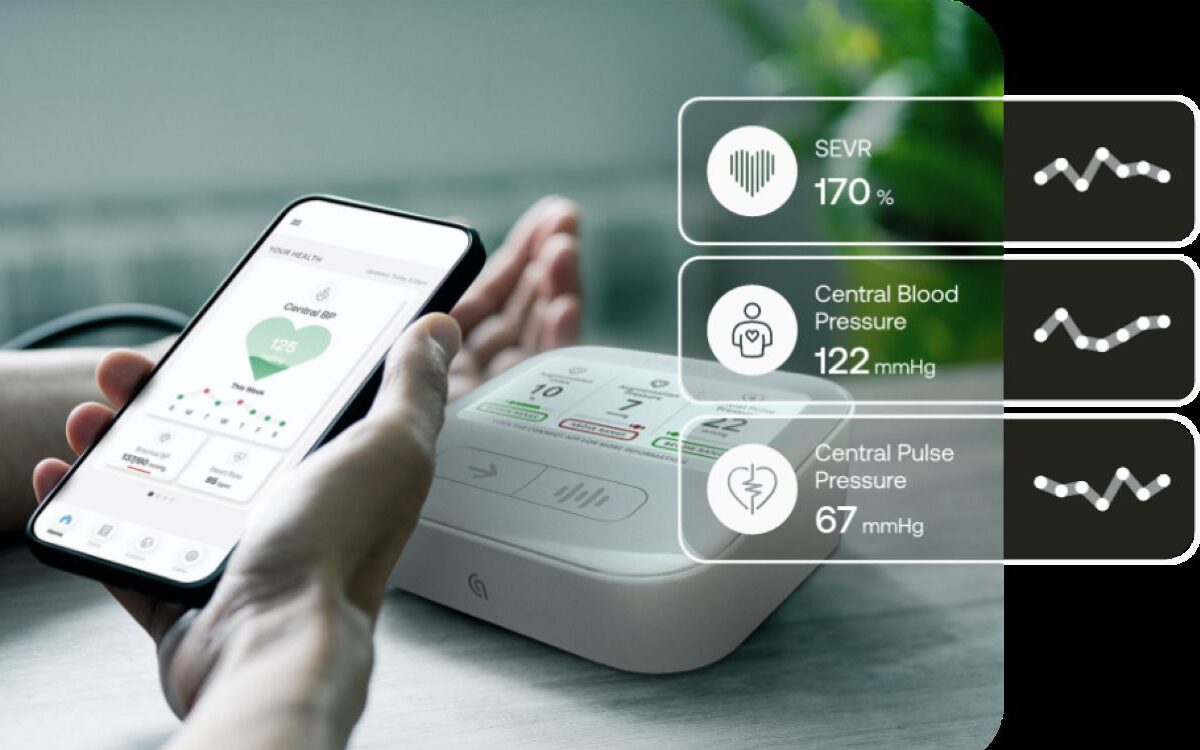
Using pulse wave analysis, we can read that signal from the wrist or arm and translate it into a picture of what’s happening closer to the heart. Rather than a single snapshot, this approach reveals how hard the heart is working, how effectively blood is being delivered to vital organs, and whether the arteries are beginning to come under strain. In many cases, these changes can be detected years before events like heart attacks, strokes, or cognitive decline begin to surface. This is not speculative. Pulse wave analysis has been studied for decades and has contributed to more than 2,700 peer-reviewed publications.
Across large population studies, a consistent pattern emerges. The Anglo-Cardiff Collaborative Trial followed more than 10,000 individuals and mapped how arteries change with age, defining what healthy and unhealthy vascular aging look like over time. The CAFE study then showed that measuring pressure near the heart, rather than just at the arm, provides a more accurate picture of cardiovascular risk and can guide more effective treatment. And the Strong Heart Study demonstrated that stiff arteries and abnormal pressure patterns strongly predict heart failure and death, even when traditional risk factors appear controlled.
Taken together, these findings point to a simple but overlooked truth. It’s not just how high your blood pressure is, but how your arteries handle that pressure over time. And by the time conventional measures flag a problem, the process of damage may already be far advanced.
Measuring vascular aging in everyday life
Until recently, understanding how the arteries age required specialised equipment and clinical settings. Today, that same underlying signal can be captured using technologies already embedded in everyday devices. Home blood pressure monitors and wearables that use optical sensors can detect subtle changes in blood flow and pressure, making it possible to measure vascular aging in daily life.
This represents a fundamental shift in how cardiovascular health can be observed. Instead of relying on occasional measurements taken in clinical settings, we can begin to capture how the system behaves continuously, across real-world conditions. The same signal that once required a lab can now be accessed through devices people already use, at a scale that was previously impossible.
Many of us already track our sleep, exercise, and diet. What’s been missing is a way to see how those behaviours affect the body’s internal systems. Now imagine a future where you can see how your cardiovascular system responds to a night of poor sleep, a period of stress, or a change in routine, and use that insight to adjust in real time. Measuring vascular aging creates that feedback loop. It connects what you do each day to how your arteries are functioning, making it possible to see how they respond and change over time.
This matters for everyone with a heart
For years, vascular aging has progressed silently, without a practical way to measure it outside of specialised settings. It has been unfolding in the background, as the arteries gradually stiffen and place increasing strain on the heart and the organs it supplies, often long before anything feels wrong or shows up in routine care.
Today, that is beginning to change. We now have the ability to bring this process into view, to see how our arteries are responding to the way we live. To understand how sleep, stress, movement, and treatment are shaping our cardiovascular health over time.
That makes this personal in a new way. It connects what we do every day to what is happening inside our bodies. It turns something abstract into something we can see, follow, and act on. Not all at once, but gradually, through small adjustments that compound over time.
The clock of aging hasn’t stopped. But we can now see its pace, understand its impact, and begin to change its course.
Author Bio

Catherine Liao, MBA, MSc | Health Economics Researcher, University of Cambridge | Chief Strategy Officer, CONNEQT Health
Catherine Liao is Chief Strategy Officer at Conneqt Health, driving the company’s consumer and clinical strategy for non-invasive cardiovascular diagnostics. She previously founded and led Blumio to acquisition, pioneering radar-based wearable sensing with partners including Google and Infineon. A health economist by training and a current PhD researcher at Cambridge, Catherine focuses on unlocking scalable, preventive health solutions that align clinical innovation with market opportunity and long-term system value.