
Every therapy that reaches a patient first has to clear a quieter hurdle that rarely makes headlines: finding enough of the right people to test it. That hurdle is where most clinical programs stumble. Roughly 80% of clinical trials fail to meet their enrollment timelines, and more than a third of investigational sites never enroll a single participant.1,2 The resulting delays stretch development by six to eight months on average, inflating costs and, more consequentially, keeping potentially life-changing therapies out of patients’ hands for longer than necessary.
Eligibility screening is still largely a manual exercise. A coordinator opens a chart, reads years of notes, cross-references diagnoses, lab values, and medication histories against as many as five dense protocols simultaneously, renders a judgment, and then does it again for the next patient, and the next. In therapeutic areas defined by complexity, this approach simply cannot keep pace. Diabetes mellitus spans multiple disease subtypes and tangled comorbidity profiles (cardiovascular disease, chronic kidney disease, retinopathy) layered over diverse medication regimens. Major depressive disorder brings its own diagnostic heterogeneity, high rates of psychiatric comorbidity, treatment-resistant phenotypes, and complicated psychotropic histories. Reviewing those records one at a time, against protocol after protocol, is precisely the kind of high-volume, high-stakes pattern-matching that human attention performs unevenly when the queue runs into the thousands.3,4
Over the past year, Areti Health evaluated an integrated AI engagement platform across active trials in two very different therapeutic areas, and measured its performance against the conventional manual workflow it was meant to replace.
What we built and how we tested it
The platform pairs four components rather than relying on a single model. Domain-adapted large language models handle record extraction, pulling structured codes and unstructured free text (progress notes, intake forms, scanned documents) into a normalized clinical profile. A clinical-intelligence knowledge graph adds context, synthesizing practice guidelines, pharmacologic profiling, patient-reported outcomes, and protocol intelligence so that matching reflects clinical reasoning rather than keyword overlap. A matching engine parses each protocol and builds tailored, weighted, multi-criteria algorithms capable of evaluating a patient against several trials at once. Finally, a conversational engagement agent conducts initial outreach and attitudinal pre-screening, all under continuous oversight from clinical research staff, with every patient-facing message held to IRB-approved standards.
Both evaluations were prospective and single-arm. Every AI determination was validated in parallel by expert clinical review, so the accuracy figures reflect agreement with experienced human reviewers rather than the system grading its own work.
Speed: roughly eighteen times faster
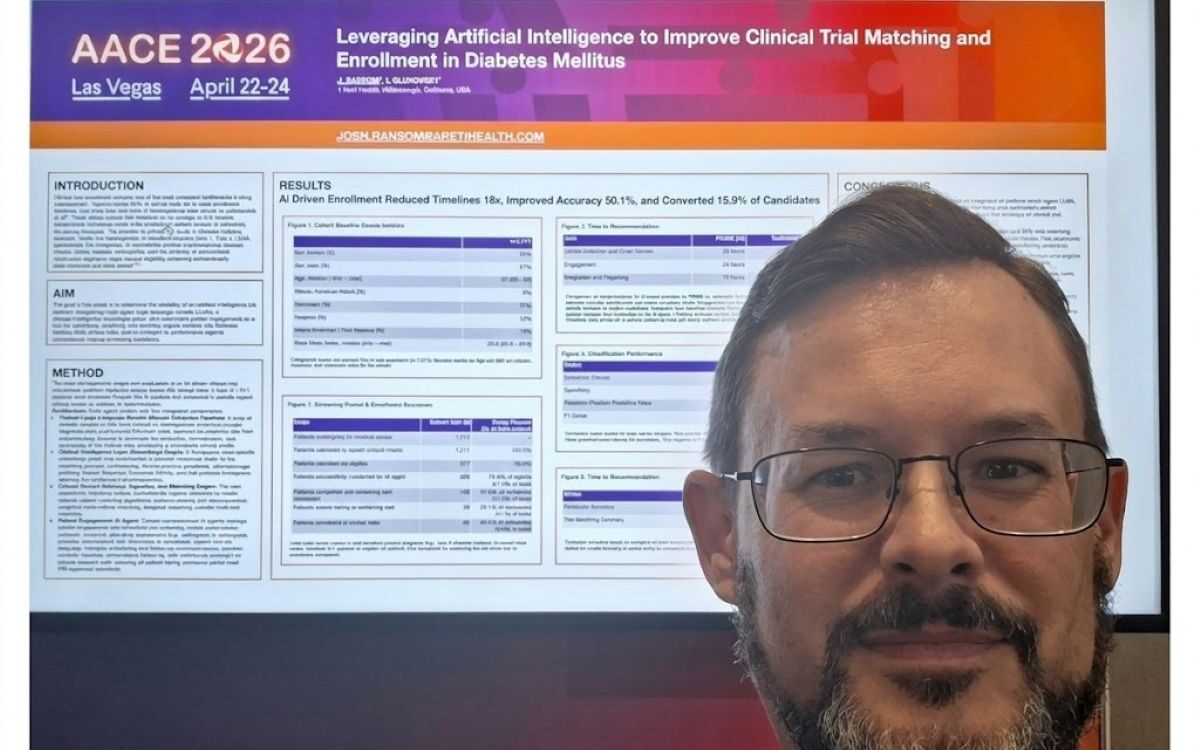
The most immediate finding was about time. In both studies, the platform produced eligibility recommendations in under one week, compared with the roughly eighteen weeks typical of conventional prescreening, more than an order-of-magnitude acceleration. The gains held across each phase of the workflow: cohort selection and chart review dropped from about five weeks to twenty hours, candidate engagement from three weeks to roughly a day, and integration and reporting from ten weeks to a few days.
Speed of this kind changes more than a Gantt chart. It compresses the gap between a protocol going live and the first qualified patients being identified, which is exactly the window where enrollment momentum is won or lost. It also redirects effort. By automating extraction, eligibility determination, and first-pass engagement, the platform returns hundreds of coordinator-hours per trial to the work only people can do well: informed-consent conversations, patient trust, and protocol adherence. That middle role is the easiest to overlook: the trust a coordinator builds eases a patient’s fear and makes joining a study feel far less daunting.
Accuracy: the part that matters most
Faster screening is only valuable if it is also right. Here the results were strongest in the diabetes evaluation. Across 1,311 patients screened, the platform identified 377 as eligible and supported the enrollment of 60 participants. Record extraction accuracy reached 91% against 82% for manual review, and trial-matching accuracy rose from 63% to 95%, a 32-percentage-point improvement. Sensitivity of 0.95 means the system surfaced the large majority of genuinely eligible patients, directly addressing the quiet failure mode of manual screening, in which eligible candidates are simply never reviewed.
The major depressive disorder evaluation tested whether those gains travel to a different clinical domain. Across 1,242 patients reviewed, extraction accuracy was 95% versus 84% manually, and trial-matching accuracy climbed from 26% to 73%, close to a tripling. Sensitivity was 0.92 and specificity 0.96. The MDD cohort also offered an early read on match quality rather than match quantity: of the patients who enrolled, 16 of 17 went on to complete every scheduled study visit. A small sample, but a meaningful signal that surfacing the right candidates can support not just enrollment but retention.
Beyond the metrics: equity and focus
Two benefits sit beneath the headline numbers. The first is equity of consideration. A systematic, automated review evaluates every patient in the population against the protocol, rather than relying on the convenience-based referral patterns that quietly shape (and bias) manual recruitment. When screening is exhaustive, eligibility stops depending on which charts a coordinator happened to reach.
The second is focus. Returning routine review time to clinical staff is not merely an efficiency argument; it concentrates skilled human attention on the moments in a trial where empathy and judgment are irreplaceable. The point isn’t removing people from the process. It’s freeing their expertise from work a well-supervised system handles faster and more consistently.
What the data can’t tell us yet
Enthusiasm should not outrun the evidence. Both evaluations were single-arm and used a single platform configuration, which constrains how far the results generalize. Precision (0.87 in the diabetes study and 0.71 in MDD) indicates that false-positive referrals remain a real cost, and the higher recall comes from a deliberately conservative bias toward not missing eligible patients. These evaluations also did not include a formal time-motion analysis, so the staffing savings, while substantial, are not yet quantified to the standard the claim deserves. That gap is already being addressed: a controlled, double-arm time-motion study is underway now to measure those savings directly. And the architecture is built around human oversight by design: the system augments clinical judgment and never substitutes for it.
They are refinements to a workflow that is already outperforming the status quo, not reasons to doubt the direction. The next phase of work (tightening precision, modeling patient willingness and propensity to complete visits, and extending the approach to additional indications) is squarely about turning a strong proof of concept into a dependable standard.
The bottleneck is solvable
For decades, slow enrollment has been treated as an unavoidable tax on drug development: a cost to be managed rather than a problem to be solved. The evidence from these two evaluations suggests that assumption is no longer safe. When an integrated AI platform can compress eighteen weeks of prescreening into a few days, lift matching accuracy by 30 points or more, and give every patient a fair look at participation, the calculus changes. Faster trials are not only cheaper trials; they are trials that put the right therapies in front of the right patients sooner. That is a goal worth building toward.
Author Bio

Dr. Josh Ransom is Chief Strategy Officer at Areti Health, bringing more than 20 years of experience in healthcare data and artificial intelligence for life sciences, clinical operations, and outcomes research. He has held executive roles at Medidata, BEKhealth, Quintiles Consulting (now IQVIA), and McKinsey and Company, and has published research in Nature and Cell. Dr. Ransom holds a PhD in Biomedical Sciences and Genetics from the University of Texas Southwestern Medical Center at Dallas.