
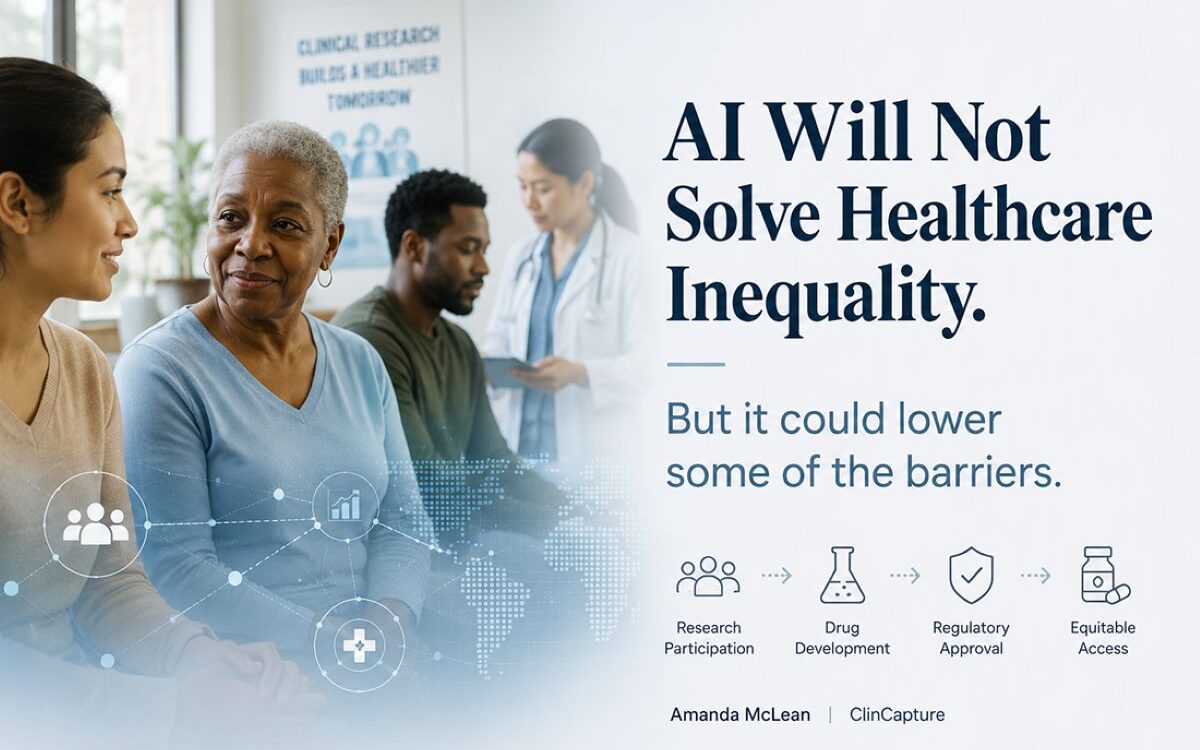
AI Will Not Solve Healthcare Inequality. But it Could Lower the Barriers

May 29, 2026 | Clinical Trials

Image Source: Graphic created by ClinCapture
Written by: Contributor
On behalf of: Life Science Daily News

There’s a lot of discussion right now around AI in healthcare, but most of it feels disconnected from how clinical research actually works day-to-day.

A lot of the conversation is centered around automation, replacing people, chatbots, and efficiency. Some of that matters, but one thing I think about much more is whether AI could eventually lower some of the barriers that have historically limited access to clinical research and life-saving treatments in the first place.

I’ve worked in clinical trial technology for over 10 years and spend most of my time talking to sponsors, CROs, data managers, and operational teams running studies. One thing that has always stood out to me is the disconnect between who participates in clinical research and who ultimately benefits from it.

Low-income and underserved communities in the U.S. often bear a disproportionate share of early clinical research participation, yet frequently do not receive equitable access to the resulting drugs or therapies once they reach the market. In many cases, the same populations helping generate the data behind new therapies may never realistically be able to afford them afterward.

None of this magically fixes healthcare inequality. Drug pricing, insurance systems, and broader socioeconomic issues are obviously much larger than AI. But I do think AI could help reduce some of the operational and financial barriers that make clinical research so concentrated within large institutions and wealthier healthcare systems today.

Clinical research is still incredibly expensive and inefficient in a lot of ways. Study startup takes too long. Protocols are getting more complicated. There is still an enormous amount of manual work involved in data review, reconciliation, monitoring, and study management. Smaller biotech companies and research organizations often struggle just to get studies operational.

This is where AI could realistically help.

If AI can reduce some of the time and manpower required for things like study configuration, protocol review, patient identification, monitoring workflows, and operational oversight, that could gradually lower the cost and complexity of running clinical research. That may create more opportunities for smaller organizations, universities, nonprofits, and emerging biotech companies to pursue research that historically may not have been financially realistic.

I also think AI could help decentralize parts of clinical research infrastructure that have traditionally been concentrated in major academic centers and large healthcare systems.

A lot of patients are excluded from trials simply because of geography and access. They may live too far from research sites, not have reliable transportation, work jobs that make repeated site visits difficult, or never even hear about relevant studies. AI combined with decentralized trial technologies could help identify eligible patients earlier, support remote participation models, and reduce some of the logistical barriers that keep people out of research entirely.

Another issue is that healthcare and clinical research data is still extremely fragmented. A huge amount of potentially useful information remains buried in PDFs, scanned records, disconnected systems, and unstructured physician notes. Historically, most smaller organizations simply didn’t have the resources to work with this type of data at scale. AI is starting to change that.

At the same time, there’s also a real risk that AI could make some of these disparities worse if it’s implemented irresponsibly. If models are trained on biased datasets, deployed only within wealthier healthcare systems, or used without enough human oversight, the technology could easily reinforce the same inequities that already exist today.

I don’t think AI is going to “solve” healthcare inequality. But I do think it has the potential to gradually reduce some of the operational friction, infrastructure barriers, and resource limitations that have historically limited who gets to participate in research and who ultimately benefits from medical innovation.

That’s probably the more realistic way to think about it.


Author Bio

Amanda McLean, VP of Sales & Customer Enablement, ClinCapture


Amanda McLean is VP of Sales & Customer Enablement at ClinCapture, an eClinical software company focused on EDC and decentralized clinical trial technology.

 

    References: U.S. Food & Drug Administration (FDA). “Diversity Action Plans to Improve Enrollment of Participants from Underrepresented Populations in Clinical Studies.” June 2024. FDA Commissioner Robert M. Califf, M.D.: “Participants in clinical trials should be representative of the patients who will use the medical products.” NIH Record. “Postbac Finds Underrepresentation in Clinical Trials.” September 2019.
    The views expressed in this article are those of the author and do not represent the editorial position of Life Science Daily News. Contributors may have a commercial interest in the topics they write about. For more information see our Contributor Policy

    Articles that may be of interest

    Clinical Trials Roundup | 19 June 2026

    Clinical Trials Roundup | 19 June 2026

    The Menarini Group and Karyopharm Therapeutics report that selinexor plus ruxolitinib improves spleen response over standard monotherapy in the Phase 3 SENTRY trial in myelofibrosis, Agios Pharmaceuticals reinforces the anti-hemolytic profile of mitapivat with new...

    read more
    Complement Inhibitor Setback: Sanofi Halts CIDP Study

    Complement Inhibitor Setback: Sanofi Halts CIDP Study

    Sanofi has halted a late-stage trial of its experimental complement inhibitor riliprubart in chronic inflammatory demyelinating polyneuropathy (CIDP), a setback that analysts say could create volatility across the wider complement inhibitor field. The company said in...

    read more
    Clinical Trials Roundup | 12 June 2026

    Clinical Trials Roundup | 12 June 2026

    Survodutide delivers dual Phase 3 success in obesity and metabolic liver disease at ADA 2026, secukinumab becomes the first targeted biologic to demonstrate sustained remission in polymyalgia rheumatica, dapirolizumab pegol meets its Phase 3 primary endpoint in...

    read more
    FDA Drug Approval Decisions: June and July 2026

    FDA Drug Approval Decisions: June and July 2026

    The summer months at the United States Food and Drug Administration are typically among the busiest on the regulatory calendar, and 2026 is proving no exception. With a succession of high-profile FDA drug approval decisions concentrated in June and July 2026, the...

    read more
    Daraxonrasib Doubles Survival in Pancreatic Cancer at ASCO

    Daraxonrasib Doubles Survival in Pancreatic Cancer at ASCO

    When Brian Wolpin, Professor of Medicine at Harvard Medical School and Director of the Hale Family Center for Pancreatic Cancer Research at Dana-Farber Cancer Institute, advanced to the next slide during the plenary session at the 2026 ASCO (American Society of...

    read more

    Articles that may be of interest

    Clinical Trials Roundup | 19 June 2026

    Clinical Trials Roundup | 19 June 2026

    The Menarini Group and Karyopharm Therapeutics report that selinexor plus ruxolitinib improves spleen response over standard monotherapy in the Phase 3 SENTRY trial in myelofibrosis, Agios Pharmaceuticals reinforces the anti-hemolytic profile of mitapivat with new...

    read more
    Complement Inhibitor Setback: Sanofi Halts CIDP Study

    Complement Inhibitor Setback: Sanofi Halts CIDP Study

    Sanofi has halted a late-stage trial of its experimental complement inhibitor riliprubart in chronic inflammatory demyelinating polyneuropathy (CIDP), a setback that analysts say could create volatility across the wider complement inhibitor field. The company said in...

    read more
    Clinical Trials Roundup | 12 June 2026

    Clinical Trials Roundup | 12 June 2026

    Survodutide delivers dual Phase 3 success in obesity and metabolic liver disease at ADA 2026, secukinumab becomes the first targeted biologic to demonstrate sustained remission in polymyalgia rheumatica, dapirolizumab pegol meets its Phase 3 primary endpoint in...

    read more
    FDA Drug Approval Decisions: June and July 2026

    FDA Drug Approval Decisions: June and July 2026

    The summer months at the United States Food and Drug Administration are typically among the busiest on the regulatory calendar, and 2026 is proving no exception. With a succession of high-profile FDA drug approval decisions concentrated in June and July 2026, the...

    read more
    Daraxonrasib Doubles Survival in Pancreatic Cancer at ASCO

    Daraxonrasib Doubles Survival in Pancreatic Cancer at ASCO

    When Brian Wolpin, Professor of Medicine at Harvard Medical School and Director of the Hale Family Center for Pancreatic Cancer Research at Dana-Farber Cancer Institute, advanced to the next slide during the plenary session at the 2026 ASCO (American Society of...

    read more