

The paradox of modern biomedical research
Biomedical research has never generated so much knowledge, and researchers have never struggled so much to keep pace with it. PubMed now indexes more than 40 million references drawn from roughly 26,000 journals[1]. ClinicalTrials.gov lists close to 590,000 registered studies and has added around 35,000 new registrations a year over the past five years[2]. Genomics, once a specialist discipline, has become one of the most data-intensive sciences on the planet: a decade ago, researchers already projected that by 2025 it would rival or surpass astronomy and the largest online platforms in the sheer volume of data produced, spanning acquisition, storage, distribution and analysis[3]. Add the accumulation of patents, regulatory evidence and real-world data, and the modern scientist confronts a landscape that is vast, fragmented, fast-moving and profoundly heterogeneous.
This is the paradox of contemporary biomedical research. The limiting factor is no longer access. Almost everything is one query away. The limiting factor is coherence. The challenge is no longer finding information. It is transforming fragmented knowledge into scientific intelligence.
From information scarcity to information overload
The nature of the bottleneck has inverted within a single professional generation. In the 1980s, the scarce resource was information itself. Researchers depended on physical libraries, printed journals, interlibrary loans and the slow circulation of reprints. Knowing that a relevant study existed was itself an achievement and retrieving it could take weeks.
The 2000s dissolved that constraint. Digital infrastructure changed everything: PubMed opened the biomedical literature to anyone with a browser, ClinicalTrials.gov brought transparency to the clinical trial landscape, public genomic repositories made reference datasets openly available, and the open-data movement encouraged institutions to share rather than hoard. Within a few years, the barriers to accessing scientific information had largely fallen.
Today the bottleneck has moved somewhere else entirely. Researchers can access almost everything. What they cannot do is connect everything. A specialist in a single therapeutic area may face thousands of new publications a year, alongside trial registrations, omics datasets, patent filings and regulatory opinions that speak different vocabularies and live in different silos. Abundance has not resolved the problem of knowledge, it has relocated it. And that naturally raises a harder question about the tools we still rely on.
Why search is no longer enough
This is the intellectual heart of the matter. A search engine, however powerful, answers a fundamentally shallow question. Ask it about a target or a disease and it responds, in effect: “Here are 1,237 papers.” That is retrieval. It is not understanding.
The questions scientists actually need answered are of a different kind:
- What is the current consensus, and how settled is it?
- Which therapeutic approaches are emerging, and which are fading?
- Where is the evidence contradictory, and why?
- Which clinical trials are likely to change practice rather than merely add data?
- What knowledge gaps remain, and which are worth pursuing?
None of these can be resolved by ranking documents. They require synthesis: reading across sources, weighing quality, reconciling conflicts and situating each finding within a broader argument. The distinction between retrieval and synthesis is the central fault line of modern research. Search hands you the raw material. It does nothing to build the structure. For decades that structural work has fallen entirely on human experts, and it does not scale with the literature.
AI is transforming scientific work, not replacing scientists
Large language models matter here for a specific reason, and it is not that they know everything. They do not and treating them as oracles is a serious error. Their value lies in a different capability: they can operate across many sources at once. They can connect findings, summarise long and technical texts, compare competing results, reason over heterogeneous inputs and compress weeks of synthesis into hours. Applied carefully, they can screen citations, extract structured data and draft evidence summaries, tasks that increasingly appear in real systematic-review workflows[4],[5].
The important consequence is not substitution but relocation. AI does not replace scientific judgement; it changes where scientists spend their time. Instead of searching, they validate. Instead of collecting, they interpret. Instead of laboriously assembling evidence, they use the assembled evidence as a starting point for what humans do best: generating and testing new hypotheses.
This reframing matters because the narrative that machines will simply do science misunderstands both the capabilities of the technology and the nature of scientific work. A model can assemble evidence, but it cannot replace scientific judgement. The scientist’s expertise becomes more valuable, not less, because it is now applied at the point of highest leverage: deciding what the synthesis means, whether it can be trusted, and what to do next. The most credible reviews of these tools reach the same measured conclusion, that they are genuinely useful assistants but are not yet ready for unsupervised use[6].
The rise of AI-native scientific workflows
The deeper transformation is not simply technological, it is architectural. The next generation of scientific platforms will do far more than retrieve documents. They will orchestrate the entire scientific reasoning process, from the initial question to an evidence-based decision.
In its simplest form, this process follows a continuous chain:
Question → Evidence gathering → Evidence synthesis → Critical review → Report generation → Collaborative discussion → Decision
What distinguishes an AI-native workflow from a search interface with a chatbot bolted on is that each stage feeds the next in a traceable, revisable way. Evidence is gathered against an explicit question, synthesised into a structured argument, subjected to critical review, and only then turned into an output that a team can interrogate and act upon. The human remains in the loop at every stage, but the mechanical burden of moving from a question to a defensible, evidence-based answer is dramatically reduced. This is a change in the shape of the work itself, not merely a faster way to run the old process.
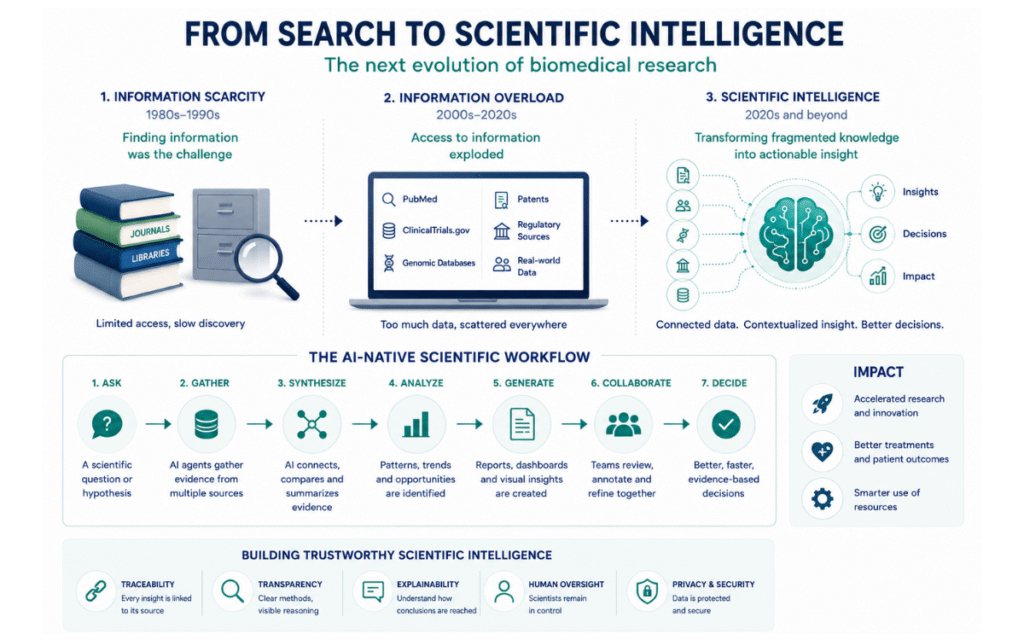
The shift from information scarcity to scientific intelligence, and the seven stage AI-native research workflow that supports it, from question through evidence gathering, synthesis, analysis and collaboration to decision.
Trust is the real challenge
None of this is worth having if it cannot be trusted, and this is where naive enthusiasm becomes dangerous. Generative models can produce fluent, confident text that is factually wrong, and in medical contexts the stakes are high. Independent evaluations have found that general purpose models will repeat and elaborate on false clinical details planted in a prompt in a high proportion of cases, and reviews written for clinicians place hallucination at the centre of the risks that must be managed before these tools enter practice[7],[8].
The response is not to abandon the technology but to engineer it around a small number of non-negotiable principles: provenance, so that every claim is linked to its source; transparent citation, so that sources can be checked rather than assumed; explainability, so that a conclusion can be examined rather than trusted blindly; reproducibility, so that the same inputs yield the same defensible outputs; and human oversight at every consequential step. The principle is simple to state and demanding to implement: scientific intelligence is valuable only if every conclusion can be traced back to the evidence that supports it. Without auditability, synthesis becomes opinion rather than evidence.
The next generation of biomedical research
The lesson is not that AI will replace researchers. It is that the role of the researcher is evolving. As the volume of knowledge outstrips any individual’s capacity to read it, the decisive skill shifts from accumulation to discernment: from gathering evidence to judging it.
The future of biomedical research will not be defined by those who can access the most information, but by those who can transform fragmented evidence into trustworthy scientific intelligence. In that future, AI will not replace scientists. It will amplify their capacity to discover, reason and innovate.
Author Bio