Update 29th July 2026: For the completed first-half picture, including the June listings and Nasdaq’s H1 figures, see Biotech IPO 2026: From Drought to Record-Breaking Deals.
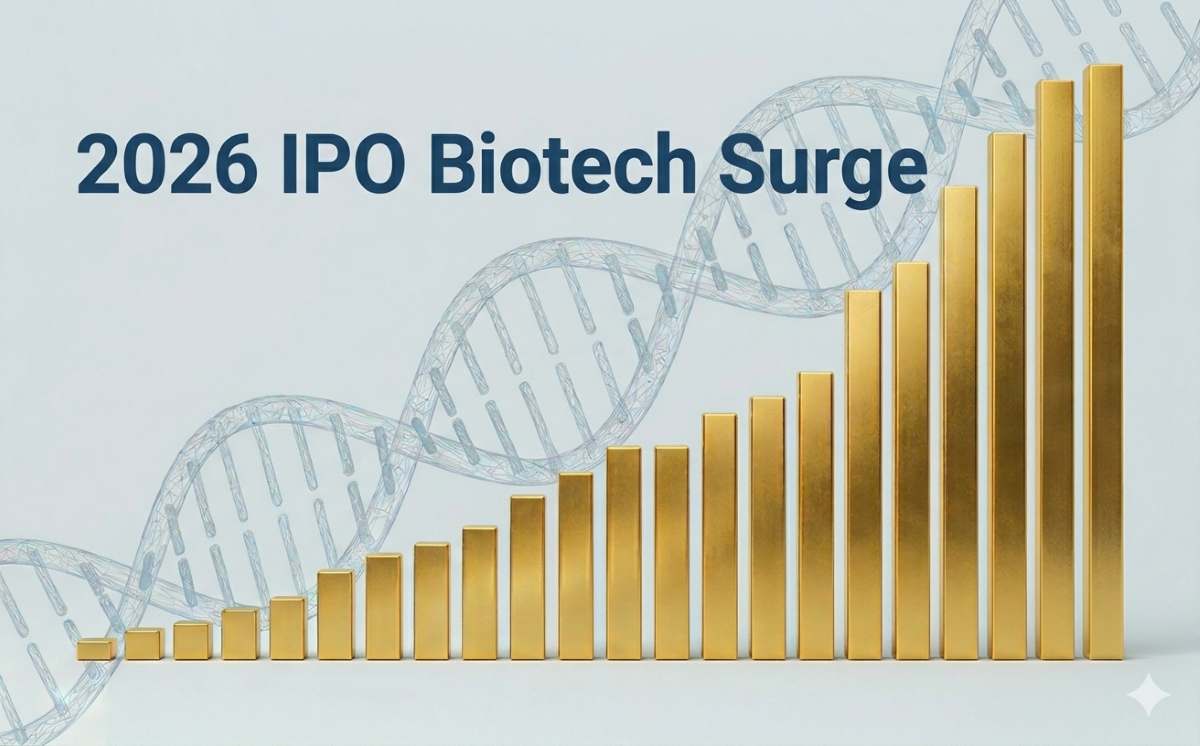
The biotech IPO surge has turned 2026 into a comeback year, and one statistic captures it: in the first six months, biopharma companies raised more from initial public offerings than the entire sector managed across the whole of 2025. After a punishing multi-year drought, the public markets have reopened for life sciences, and the pace has caught even optimistic investors by surprise.
A first quarter that rewrote the 2025 baseline
The scale of the rebound is best understood against how low the bar had fallen. By one count, only 15 US biopharma companies completed IPOs in the whole of 2025, the lowest level in years. By a stricter measure, just eight biotechs braved public markets, the fewest in at least five years. Either way, 2025 represented a nadir.
The first quarter of 2026 cleared that full-year mark in weeks. According to data compiled by J.P. Morgan and DealForma, six biopharma IPOs raised roughly $1.8bn in Q1, already surpassing the proceeds collected across all of 2025. A broader tally from BioSpace put the figure at 10 companies either going public or launching offerings in the quarter, comfortably eclipsing the previous year’s class.
Just as striking as the volume is the size of each deal. Biotechs that priced offerings in the quarter banked a median of around $287.5m, more than double the equivalent figure from early 2025 and the highest quarterly median since the pandemic-era peak of 2021. Investors, it seems, are no longer interested in token raises. They are writing large cheques for a smaller number of companies.
M&A is the engine behind the biotech IPO surge
The most consistent explanation offered by market watchers is that the biotech IPO surge has been pulled along by a parallel boom in mergers and acquisitions. Q1 2026 recorded around $40.9bn of biopharma M&A across 32 deals, and in the final 12 days of March alone, seven separate transactions each topped $1bn for a combined headline value near $29bn.
That dealmaking matters for IPOs in two ways. It returns cash to investors who then need somewhere to redeploy it, and it signals that late-stage assets carry a tangible acquisition premium. Analysts at PitchBook have argued that M&A has been the leading driver of the renewed IPO appetite, because the companies now going public resemble the very candidates large pharma is hunting. The dynamic is examined in this Life Science Daily News rundown of every billion-dollar biopharma deal of 2026, which sets out the patent cliff pressures fuelling the buying spree.
The patent cliff is central. Merck, facing the loss of exclusivity for Keytruda before the end of the decade, has been among the most active acquirers, and it is far from alone. With a 64% rise in the XBI biotech index over the preceding year providing the backdrop, the funding environment has, in the words of one Jefferies analysis, returned towards normalcy. The bank’s analysts wrote that biotech momentum can continue throughout 2026, noting that larger acquisitions free up capital that can flow into secondary and IPO offerings.
Record-breaking debuts keep coming
The numbers behind the biotech IPO surge have been underlined by a run of headline-grabbing listings. In February, cancer specialist Eikon Therapeutics raised about $381m, briefly the largest biotech IPO since 2024. Later that month, the AI-led protein design company Generate:Biomedicines outdid it with roughly $400m, debuting on 27 February.
Those records did not last. In April, obesity biotech Kailera Therapeutics raised $625m on Nasdaq under the ticker KLRA, surpassing Moderna’s $600m debut from December 2018 to become the largest biotech IPO on record. Kailera’s pipeline, licensed from China’s Jiangsu Hengrui Pharmaceuticals, is built around next-generation GLP-1 mechanisms for obesity, a category investors are funding aggressively.
The crown changed hands again in June, when tumour-focused Parabilis Medicines priced an upsized Nasdaq offering of around $670m, accompanied by a concurrent $75m private placement from Regeneron. These two debuts both fell in the second quarter rather than the first, yet they confirm that the momentum captured in the Q1 data was not a fleeting blip. The window has stayed open, and it has stayed open for the largest deals the sector has seen in years.
Why the rebound is narrower than it looks
For all the records, the recovery is more selective than the headlines suggest. The number of offerings priced in early 2026 was broadly in line with the quiet years of 2022 to 2025. What changed was the size of each raise, not the breadth of access. Capital has concentrated around de-risked, late-stage and clinically validated companies, leaving earlier-stage developers still struggling to reach the market.
Performance after listing has also been uneven. Kailera’s shares fell sharply in the weeks after its debut, a reminder that a record raise does not guarantee a durable valuation. Les Funtleyder, a healthcare portfolio manager at E Squared Capital Management, observed that completing these deals at all marks a profound change from an environment a year ago in which biotech new issues were almost impossible to sell.
The macro picture remains awkward. Jonathan Norris of HSBC Innovation Banking has pointed to two persistent headwinds: broader economic uncertainty and a revolving door at the FDA. Layered on top is the gravitational pull of artificial intelligence, which absorbed close to 80% of global venture capital in a record $300bn first quarter, squeezing attention and funding for everything else.
What it means for the rest of 2026
The reopening is real, but few expect a return to the frenzy of 2020 and 2021, when around 100 biotechs went public globally in a single year. Janita Good, a partner at law firm Fieldfisher, has cautioned that a gradual increase is more likely than a sudden surge, with recovery dependent on macroeconomic stability and vulnerable to geopolitical shocks, including continued tension in the Middle East.
For now, the direction of travel is clear. A sector that spent three years frozen out of public markets has, in a single quarter, raised more than it managed in the whole of the prior year, and has since produced the two largest biotech IPOs in history. Whether the biotech IPO surge broadens to lift earlier-stage companies, or remains a story about a handful of large, de-risked names, will define the second half of 2026. Companies including Seaport Therapeutics, Hemab Therapeutics and Avalyn Pharma have already signalled their intent to test the water.
The full first-half picture, including the record listings that followed in June, is covered in Biotech IPO 2026: From Drought to Record-Breaking Deals.