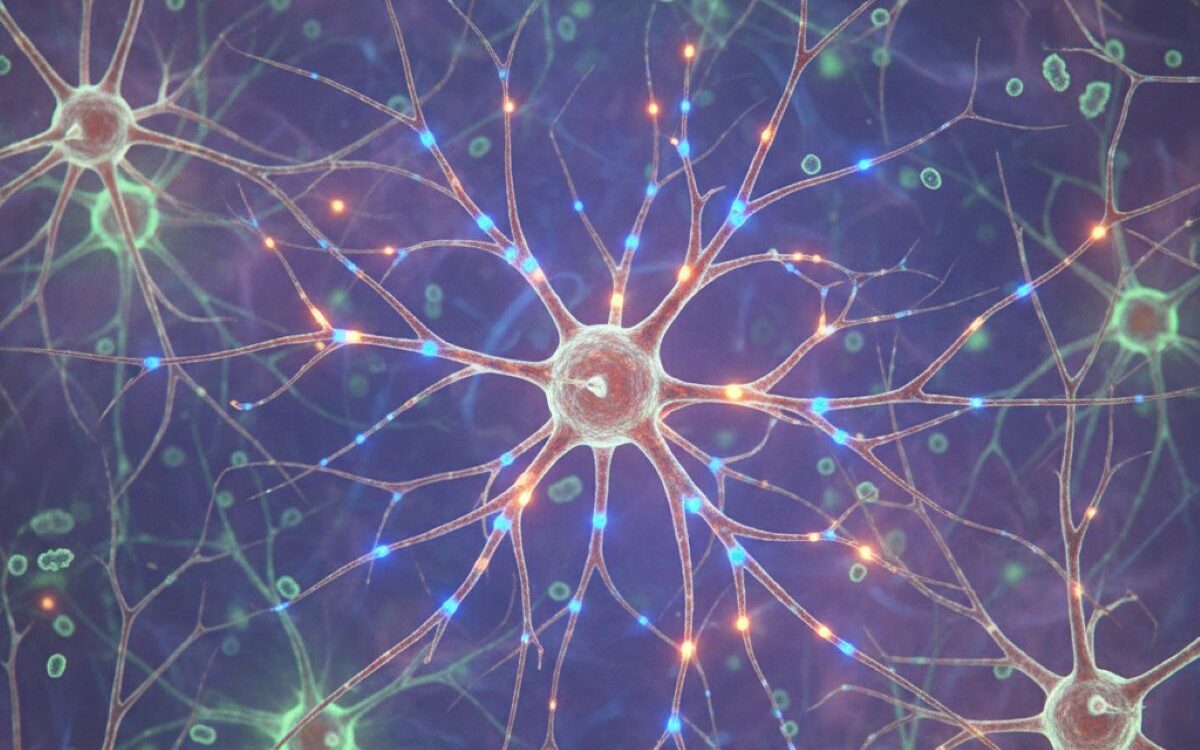
Brain Cell Communication at the Molecular Level

Dec 1, 2025 | Biotech

Image Source: Google Gemini
Written by: Nicolas Hubacz, M.S.
On behalf of: Life Science Daily News

Brain Cell Communication at the Molecular Level

Neural communication isn’t abstract, it’s a sequence of tightly regulated biophysical events. Ion gradients shift, channels open and close with millisecond precision, calcium signals trigger chemical release, and receptors convert molecular binding into electrical or biochemical change. What looks smooth in a video is actually a rapid cascade of physics, chemistry, and cell biology working in perfect coordination.

Sodium & Potassium: The Electrical Spark

Neurons fire when voltage-gated sodium (Na⁺) channels open, generating an action potential. Potassium (K⁺) channels quickly repolarize the membrane, allowing high-frequency signalling across circuits.

Calcium: The “Send” Signal

At the synapse, the arriving action potential opens calcium (Ca²⁺) channels. Calcium acts as the molecular trigger that drives synaptic vesicles to fuse and release neurotransmitters.

Neurotransmitters: Chemical Messages

Released neurotransmitters carry distinct instructions: glutamate excites, GABA inhibits, acetylcholine supports attention and encoding, norepinephrine sharpens alertness and signal-to-noise. These molecules determine how the next cell responds.

Receptors: Decoding the Signal

Ionotropic receptors open ion channels directly for fast changes in membrane potential, while metabotropic receptorsactivate slower intracellular pathways. The same neurotransmitter can have very different effects depending on the receptor subtype it binds.

Clearing the Message

Transporters and enzymes rapidly clear neurotransmitters to prevent signalling overlap. Acetylcholinesterase, for example, breaks down acetylcholine within milliseconds, ensuring each message is brief and precise.

The brain’s communication system is built on this constant interplay of ions, channels, transmitters, and receptors — a molecular conversation happening millions of times per second.

LinkedIn Profile for Nicholas Hubacz

    References:

    Articles that may be of interest

    A Milestone in Rare Disease Genomics

    A Milestone in Rare Disease Genomics

    Why popEVE Matters Interpreting missense variants has long been one of the most persistent challenges in clinical genetics. These single–amino-acid substitutions can subtly alter protein structure or function, yet their effects are often context-dependent and...

    read more
    The Passing of a Scientific Giant: James D. Watson

    The Passing of a Scientific Giant: James D. Watson

    Renowned molecular biologist James D. Watson has died at the age of 97, his son and the Cold Spring Harbor Laboratory (CSHL) in New York confirmed. The scientist, best known for co-discovering the double helix structure of DNA in 1953, passed away following a brief...

    read more
    Rewriting the MND Playbook

    Rewriting the MND Playbook

    How AI and Biomarkers Are Accelerating the Fight Against Motor Neurone Disease Every ninety minutes in the United Kingdom, someone receives a diagnosis of Motor Neurone Disease (MND), also known as Amyotrophic Lateral Sclerosis (ALS), and every ninety minutes, someone...

    read more
    Challenges in Life Sciences Real Estate

    Challenges in Life Sciences Real Estate

    The commercial real estate market serving the life sciences industry is currently undergoing a complex period of adjustment. The underlying dynamics that once propelled rapid growth, such as enthusiastic venture capital, strong demand from biotech and pharmaceutical...

    read more

    Articles that may be of interest

    A Milestone in Rare Disease Genomics

    A Milestone in Rare Disease Genomics

    Why popEVE Matters Interpreting missense variants has long been one of the most persistent challenges in clinical genetics. These single–amino-acid substitutions can subtly alter protein structure or function, yet their effects are often context-dependent and...

    read more
    The Passing of a Scientific Giant: James D. Watson

    The Passing of a Scientific Giant: James D. Watson

    Renowned molecular biologist James D. Watson has died at the age of 97, his son and the Cold Spring Harbor Laboratory (CSHL) in New York confirmed. The scientist, best known for co-discovering the double helix structure of DNA in 1953, passed away following a brief...

    read more
    Rewriting the MND Playbook

    Rewriting the MND Playbook

    How AI and Biomarkers Are Accelerating the Fight Against Motor Neurone Disease Every ninety minutes in the United Kingdom, someone receives a diagnosis of Motor Neurone Disease (MND), also known as Amyotrophic Lateral Sclerosis (ALS), and every ninety minutes, someone...

    read more
    Challenges in Life Sciences Real Estate

    Challenges in Life Sciences Real Estate

    The commercial real estate market serving the life sciences industry is currently undergoing a complex period of adjustment. The underlying dynamics that once propelled rapid growth, such as enthusiastic venture capital, strong demand from biotech and pharmaceutical...

    read more