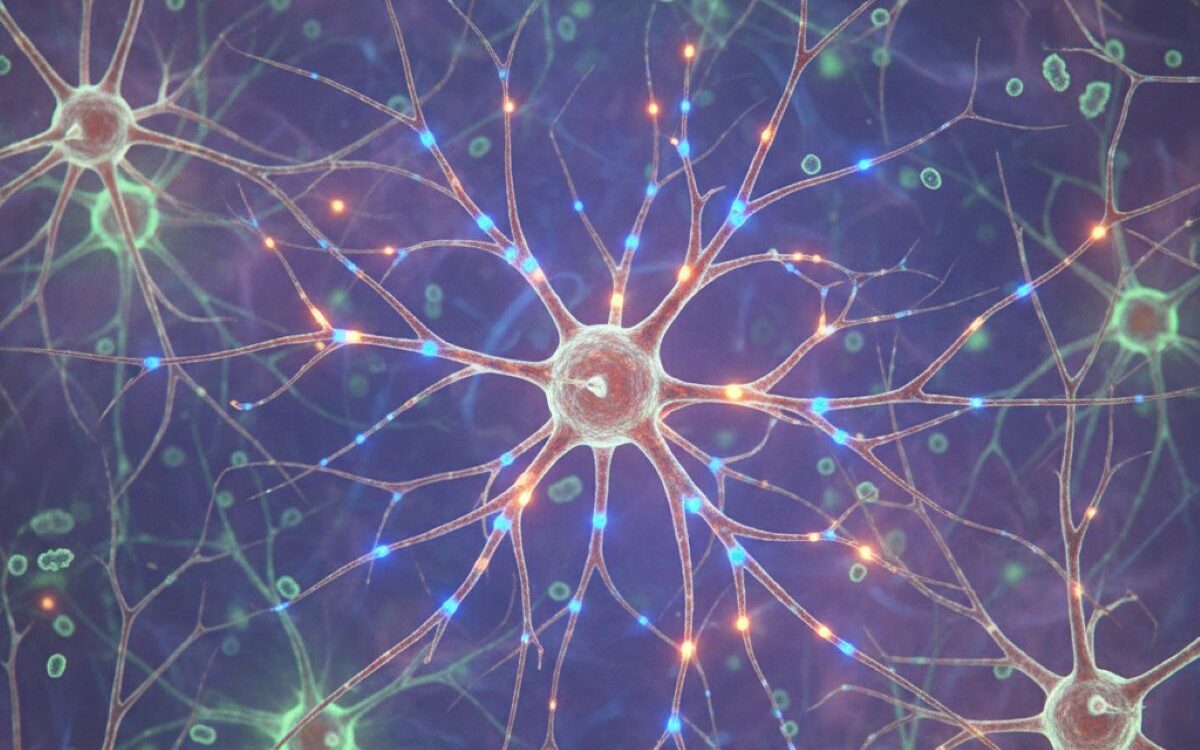
Brain Cell Communication at the Molecular Level
Neural communication isn’t abstract, it’s a sequence of tightly regulated biophysical events. Ion gradients shift, channels open and close with millisecond precision, calcium signals trigger chemical release, and receptors convert molecular binding into electrical or biochemical change. What looks smooth in a video is actually a rapid cascade of physics, chemistry, and cell biology working in perfect coordination.
Sodium & Potassium: The Electrical Spark
Neurons fire when voltage-gated sodium (Na⁺) channels open, generating an action potential. Potassium (K⁺) channels quickly repolarize the membrane, allowing high-frequency signalling across circuits.
Calcium: The “Send” Signal
At the synapse, the arriving action potential opens calcium (Ca²⁺) channels. Calcium acts as the molecular trigger that drives synaptic vesicles to fuse and release neurotransmitters.
Neurotransmitters: Chemical Messages
Released neurotransmitters carry distinct instructions: glutamate excites, GABA inhibits, acetylcholine supports attention and encoding, norepinephrine sharpens alertness and signal-to-noise. These molecules determine how the next cell responds.
Receptors: Decoding the Signal
Ionotropic receptors open ion channels directly for fast changes in membrane potential, while metabotropic receptorsactivate slower intracellular pathways. The same neurotransmitter can have very different effects depending on the receptor subtype it binds.
Clearing the Message
Transporters and enzymes rapidly clear neurotransmitters to prevent signalling overlap. Acetylcholinesterase, for example, breaks down acetylcholine within milliseconds, ensuring each message is brief and precise.
The brain’s communication system is built on this constant interplay of ions, channels, transmitters, and receptors — a molecular conversation happening millions of times per second.
LinkedIn Profile for Nicolas Hubacz
For more articles from Nicolas Hubacz check out Scientific Horizons