
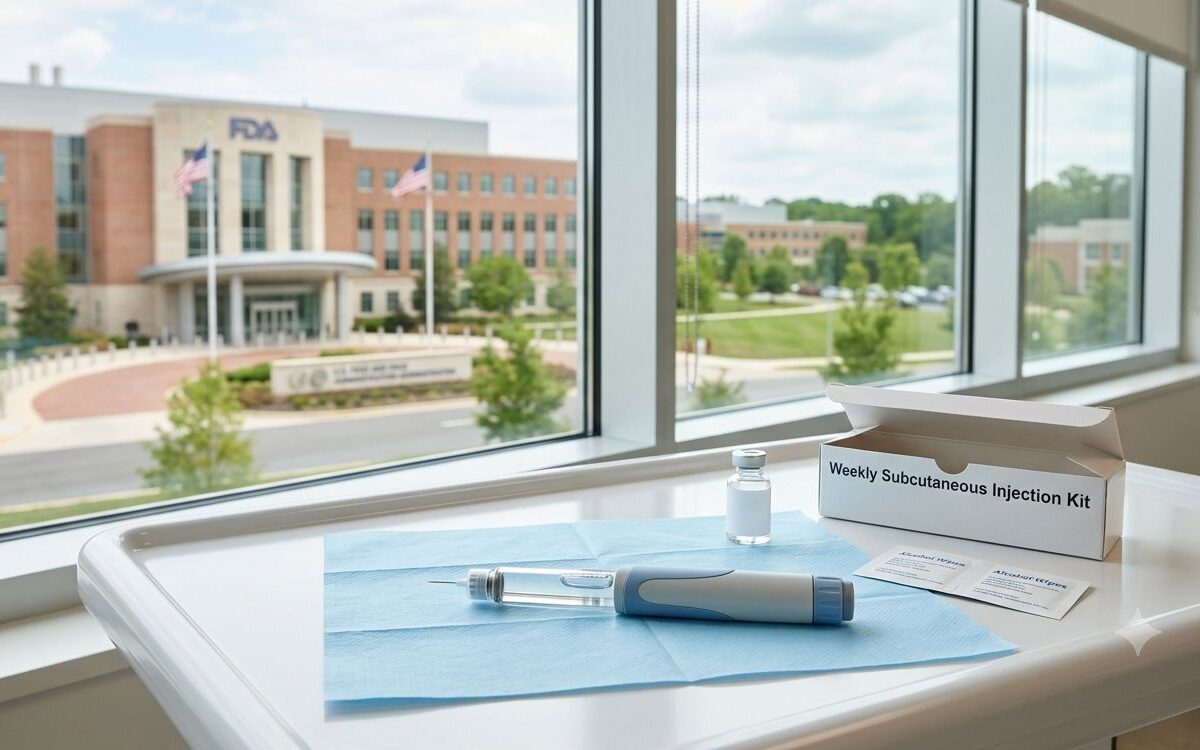
The CagriSema FDA review has become one of the most closely watched regulatory processes in metabolic medicine. Novo Nordisk filed a New Drug Application for its once-weekly obesity combination in December 2025, and a decision is widely expected in the final quarter of 2026. With pivotal data published in the New England Journal of Medicine, a missed head-to-head endpoint against Eli Lilly’s tirzepatide, and fresh diabetes results presented in June 2026, the CagriSema FDA review carries unusual complexity for a drug that has already reset expectations across the weight management field.
What CagriSema Is and How It Works
CagriSema is a fixed-dose combination of cagrilintide, a long-acting amylin analogue, and semaglutide, a GLP-1 receptor agonist. Both components are dosed at 2.4 mg and delivered together in a single subcutaneous injection once a week.
The two molecules act on complementary pathways. Semaglutide slows gastric emptying and suppresses appetite through GLP-1 receptor activation. Cagrilintide mimics amylin, the satiety hormone co-secreted with insulin by pancreatic beta cells. Engaging both pathways at once is intended to produce weight loss greater than either agent achieves alone. That dual mechanism is central to the CagriSema FDA review, because it is the first time the FDA has been asked to evaluate a GLP-1 and amylin combination in a single fixed-dose product.
Novo Nordisk has positioned the drug as the successor to its semaglutide franchise, which includes Wegovy and Ozempic, and as a direct answer to Eli Lilly’s tirzepatide, marketed as Zepbound and Mounjaro.
The NDA Filing and the CagriSema FDA Review Timeline
Novo Nordisk submitted the NDA on 18 December 2025, formally starting the clock on the CagriSema FDA review. The application seeks approval for chronic weight management in adults with obesity, defined as a body mass index of 30 or above, or overweight at a BMI of 27 or above with at least one weight-related comorbidity, as an adjunct to a reduced-calorie diet and increased physical activity.
Under standard procedures, the FDA has 60 days from submission to decide whether an application is complete enough to review, and to assign a target action date under the Prescription Drug User Fee Act. As of July 2026, neither the agency nor Novo Nordisk has publicly confirmed a PDUFA date for the CagriSema FDA review. Company guidance points to a decision in the fourth quarter of 2026, consistent with the standard ten to twelve month clock for a new molecular entity.
The filing does not appear to carry Priority Review, which would have compressed the review to six months. No advisory committee meeting has been scheduled, although the agency retains discretion to convene an external expert panel.
REDEFINE 1: The Core Evidence Base
The CagriSema FDA review rests on two pivotal placebo-controlled trials. REDEFINE 1 enrolled 3,417 adults with overweight or obesity and without type 2 diabetes, and ran for 68 weeks.
Participants receiving CagriSema lost an average of 22.7 per cent of body weight under the trial product estimand, which models the effect if everyone had adhered to treatment, against 2.3 per cent on placebo. Under the treatment policy estimand, which reflects real-world discontinuation, the figures were 20.4 per cent and 3.0 per cent. The active comparator arms lost 14.9 per cent on semaglutide alone and 11.5 per cent on cagrilintide alone, evidence of genuine additive benefit from the combination.
Some 91.9 per cent of CagriSema recipients lost at least 5 per cent of body weight, compared with 31.5 per cent on placebo. Among participants classified as obese at baseline, 54 per cent fell below the obesity threshold during the trial, against 11.1 per cent on placebo.
Timothy Garvey, Professor of Medicine at the University of Alabama at Birmingham and lead investigator, said the trial delivered weight loss
“in the highest range of efficacy observed with existing weight loss interventions”.
REDEFINE 2 and the Diabetes Population
REDEFINE 2 studied 1,206 adults with both obesity and type 2 diabetes across 12 countries over the same 68-week period.
Weight loss reached 15.7 per cent under the trial product estimand, against 3.1 per cent for placebo, and 13.7 per cent versus 3.4 per cent under the treatment policy estimand. The lower figures reflect a well-documented pattern, in that patients with type 2 diabetes typically lose less weight on incretin therapies than those without the condition.
Glycaemic control improved substantially, an outcome that strengthens the dual-benefit argument at the heart of the CagriSema FDA review. Some 73.5 per cent of participants on CagriSema reached an HbA1c of 6.5 per cent or below, compared with 15.9 per cent on placebo.
The first author was Melanie Davies, Professor of Diabetes Medicine at the University of Leicester and Director of the NIHR Leicester Biomedical Research Centre.
“The results from our study were very positive,” she said.
Both trials were published in the New England Journal of Medicine in June 2025, giving the dataset behind the CagriSema FDA review a peer-reviewed foundation.
Safety Data Under Review
Tolerability will shape the CagriSema FDA review as much as efficacy. In REDEFINE 1, the most common adverse events were gastrointestinal. Nausea affected 55 per cent of recipients, constipation 30.7 per cent, and vomiting 26.1 per cent. Discontinuation due to adverse events reached 5.9 per cent, against 3.5 per cent on placebo.
These rates sit broadly in line with other incretin-based therapies already on the market. The open question for regulators conducting the CagriSema FDA review is whether combining two appetite-suppressing mechanisms produces an additive gastrointestinal burden that alters the benefit-risk calculation in a market already offering several tolerable alternatives.
REDEFINE 4 and the Tirzepatide Question
Although the CagriSema FDA review is anchored on placebo-controlled data, a separate head-to-head trial has done more than anything else to shape sentiment around the drug.
REDEFINE 4 was an 84-week open-label Phase 3 study in 809 adults with obesity and at least one comorbidity, with a mean baseline weight of 114.2 kg. It compared CagriSema 2.4 mg with tirzepatide 15 mg. Results released on 23 February 2026 showed CagriSema producing 23.0 per cent weight loss under the efficacy estimand, against 25.5 per cent for tirzepatide.
Under the treatment regimen estimand, which measures effect regardless of adherence, the figures were 20.2 per cent and 23.6 per cent. Both estimands point the same way, and the trial did not meet its primary endpoint of non-inferiority.
The two headline numbers, 23.0 per cent and 20.2 per cent, describe the same trial under different statistical assumptions rather than conflicting results, a distinction frequently blurred in coverage of the study.
Novo Nordisk shares fell more than 12 per cent in Copenhagen trading on the day of the announcement, while Eli Lilly gained around 4 per cent in United States pre-market trading.
Martin Holst Lange, Executive Vice President for Research and Development and Chief Scientific Officer at Novo Nordisk, said the company was “pleased with the weight loss of 23% for CagriSema” in the open-label trial. He argued that the drug could still become the first GLP-1 and amylin combination to reach the market, and that cagrilintide adds clinically meaningful weight loss on top of semaglutide alone.
The REDEFINE 4 outcome has no direct bearing on the CagriSema FDA review for weight management, which is judged against placebo. It matters instead for prescribers, payers, and formulary committees deciding where the drug sits once approved.
REIMAGINE: Building the Diabetes Case
Alongside the obesity filing that triggered the CagriSema FDA review, Novo Nordisk is assembling a case for a second indication in type 2 diabetes through the REIMAGINE programme.
Phase 3 results from REIMAGINE 1, 2 and 3 were presented at a late-breaking symposium at the American Diabetes Association’s 2026 Scientific Sessions in New Orleans in June, with simultaneous publication in The Lancet Diabetes and Endocrinology and The Lancet.
In REIMAGINE 2, CagriSema 2.4 mg reduced HbA1c by 1.91 percentage points from a mean baseline of 8.2 per cent, against 1.75 points for semaglutide 2.4 mg alone. Weight loss reached 14.2 per cent, compared with 10.2 per cent on semaglutide monotherapy. Among participants on the combination, 43 per cent lost at least 15 per cent of body weight and 24 per cent lost at least 20 per cent.
Lange described the REIMAGINE results as promising, pointing to the pairing of a novel amylin analogue with semaglutide’s established effects on both glucose control and weight. Novo Nordisk has said it will discuss a regulatory pathway for diabetes with authorities, though no supplemental application has been announced.
Dosing Questions and the Higher-Dose Programme
One issue sits beneath the CagriSema FDA review and is unlikely to be resolved by it. In REDEFINE 1, participants who remained on lower doses lost more weight than those on the highest dose, an inversion suggesting the dosing regimen is not yet optimised.
Prakhar Agrawal, an Analyst at Cantor Fitzgerald, wrote in February 2025 that “a lot of fine-tuning still needs to be done on dosing”, noting that the low-dose group appeared to plateau at around 52 weeks while the high-dose group had not.
Novo Nordisk’s answer is REDEFINE 11, a Phase 3 trial testing longer duration at the top dose and dose re-escalation in patients who had scaled back because of side effects. A readout is expected in the first half of 2027. A separate higher-dose Phase 3 study, testing a 2.4 mg and 7.2 mg combination, is due to begin in the second half of 2026.
The company also withdrew a Phase 2 study of alternative injection devices for CagriSema in type 2 diabetes, announced on 7 July 2026. The move appears unrelated to efficacy, but it signals continued adjustment of the delivery and commercial strategy.
The Competitive Backdrop
The CagriSema FDA review is unfolding in the most crowded therapeutic area in pharmaceuticals. Eli Lilly’s tirzepatide is entrenched through Zepbound and Mounjaro, and REDEFINE 4 has reinforced perceptions of a clinical edge. Behind both, Amgen’s MariTide, Viking Therapeutics’ oral candidates, and Novo Nordisk’s own zenagamtide continue to advance through the clinic.
Approval would nonetheless give Novo Nordisk something no competitor currently holds, namely the first fixed-dose pairing of a GLP-1 receptor agonist with an amylin analogue. Whether that mechanistic novelty translates into formulary preference, in a market where payers increasingly negotiate on price rather than on percentage points of weight loss, is a question the CagriSema FDA review will not answer.
What Happens Next
The immediate milestone in the CagriSema FDA review is the PDUFA action date, expected in the fourth quarter of 2026. Observers will watch for any FDA request for additional information, the possible scheduling of an advisory committee, and the agency’s reading of the combined gastrointestinal profile.
Outside the United States, Novo Nordisk has not confirmed a European Medicines Agency submission for weight management, and no MHRA pathway has been announced for the United Kingdom, where NICE appraisal and NHS access decisions would follow any licence.
The outcome of the CagriSema FDA review will indicate whether combination therapy becomes the next standard in obesity care, or whether single-molecule agents continue to define the field. Either way, it stands as a landmark moment in the treatment of metabolic disease.