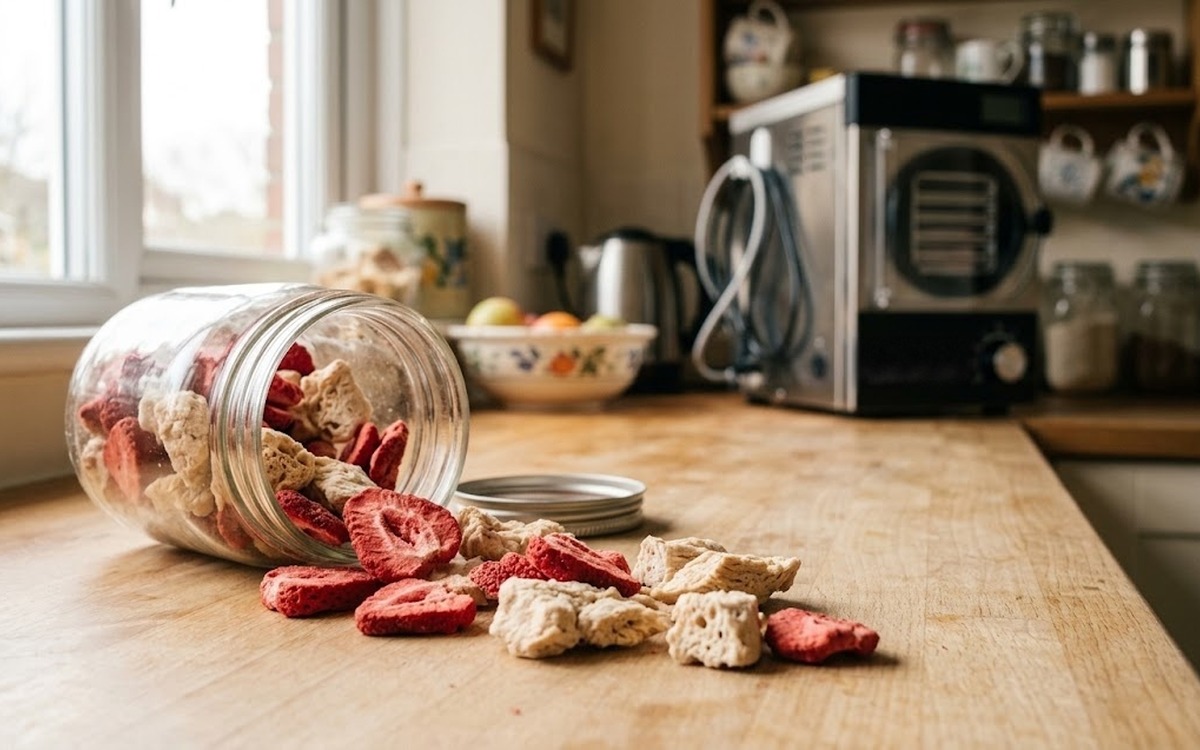
Once concentrated in commercial manufacturing, freeze-drying has entered home kitchens and small food businesses through countertop equipment. That shift has made freeze-dried food safety a live question for small operators. University of Minnesota Extension describes home freeze-drying as a relatively new technology that has become available within roughly the past decade.[7]
It is easy to see the appeal. Freeze-dried “astronaut ice cream” may be the most familiar example. Freeze-dried food is easy to transport, stores well when properly packaged, and often retains its flavor, color, and quality better than food dried with heat. The finished product also looks deceptively safe and stable. It comes out dry. It may be crisp enough to snap. It looks preserved.
But none of that proves it is safe to eat.
That is the part of the freeze-dried food safety conversation we need to get right. Freeze-drying is a preservation process used to extend the shelf life of foods, not automatically a food safety kill step. Removing water can prevent microorganisms from growing, but it does not necessarily destroy the microorganisms that were already there.
What the Process Actually Does
Freeze-drying, also called lyophilization, starts by freezing the food. Next, the pressure is lowered so the ice can change directly from a solid to a vapor through a process called sublimation. A secondary drying phase removes more of the bound water. What remains is a porous, low-moisture food that can have a long shelf life when the process and packaging are properly controlled.[1] By sufficiently reducing water activity, freeze-drying can produce food that no longer supports pathogen growth and may not require refrigeration. That conclusion must be based on a measured endpoint and packaging capable of maintaining it—not simply on completion of an equipment’s preset cycle. But that is not the whole story.
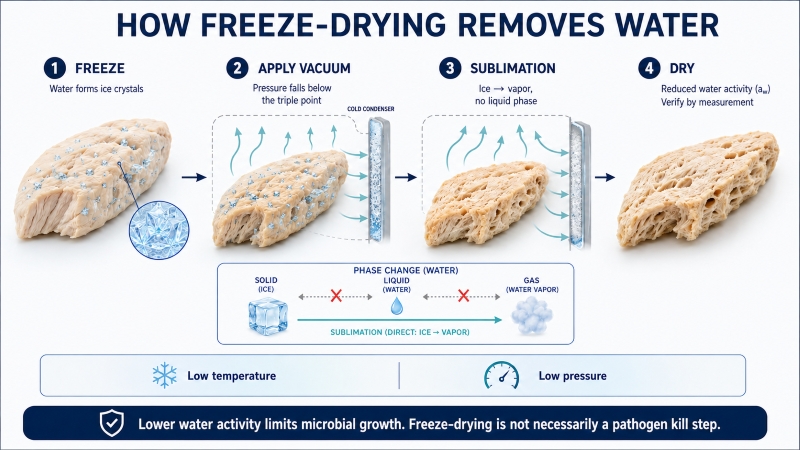
The freeze-drying process. Image generated using ChatGPT
Here is the significant distinction: a freeze-drying cycle is designed primarily to remove water. Lethality treatments are scientifically validated to reduce a target pathogen by a defined amount. A 5-log reduction, for example, reduces the pathogen load by 100,000-fold, which is generally the minimum reduction recognized. Cooking is a familiar example: the food reaches a specified internal temperature for the required time meeting the 5-log reduction for a lethality step. Unless product-specific evidence demonstrates the required pathogen reduction, freeze-drying should not be used as the kill step.
Laboratories routinely use freeze-drying to preserve viable microbial cultures such as probiotics.[2] That alone should make us wary about assuming freeze-drying reliably controls pathogens. Foodborne pathogen research supports that caution. In one study using inoculated coriander, freeze-drying only produced limited reductions of Salmonella, Listeria monocytogenes, and Escherichia coli O157:H7. The largest decrease reported was about 2 log10 colony-forming units per gram—roughly a 100-fold reduction, which is short of the required 5-log reduction for lethality.[3] The outcome of any process will depend on the organism, food, equipment, cycle, temperature, and other factors. Coriander does not represent every food, but that is not the warning. The warning is that we should not assign reliable lethality values to a drying process without evidence.
Dry Is Not the Same as Safe
Water activity (aw) is central to this discussion. Moisture content tells us how much water is in a food. Water activity describes how available that water is to support microbial metabolism and growth.[4] The two are related, but they are not interchangeable.
Consider a cooked chicken breast at the start of the cycle. Freezing changes much of its water into ice, but it does not remove that water. The frozen chicken still contains nearly as much water as it did before freezing; much of it is simply less available because it is locked in the form of ice. During freeze-drying, the ice is removed as vapor through sublimation. The finished chicken therefore contains much less water and has a lower water activity, which helps prevent microbial growth during storage.
A lower water activity is a preservation control, not proof of pathogen destruction. Pathogens that survive the process may remain viable even when they cannot multiply. They can still cause illness if the dried food is consumed, and they may begin growing again if moisture is reintroduced and time-temperature conditions permit.
For purposes of its draft guidance on low-moisture ready-to-eat foods, FDA considers low-moisture foods to have a water activity of 0.85 or below.[5] The wording matters. Preventing growth is not the same as destroying microorganisms. FDA’s draft guidance makes that distinction directly. Freeze-dried foods generally do not support the growth of environmental pathogens, but pathogens can survive in them and still cause foodborne illness.[5] A finished product may be shelf-stable and not require refrigeration, but that does not make it sterile or pathogen-free.
Product composition including fat and sugar, as well as thickness, load size, and tray placement can all affect drying. Appearance and texture are ineffective ways to evaluate a final product. A product may feel dry on the surface while thicker or uneven portions retain more moisture and potentially have a higher water activity. Even when the target water activity has been reached it does not prove that a pathogen was never present or that the process destroyed it.
Build Safety Into the Food Before It Is Dried
With higher-risk foods, freeze-dried food safety controls need to start before the freeze–dryer door closes. Raw meat, poultry, seafood, eggs, unpasteurized dairy products, and prepared meals can carry hazards that freeze-drying may preserve right along with the food.
If cooking is needed to control pathogens, the food should receive a validated cooking step before freeze-drying or after rehydration and before eating. Intended use matters here. If the product will be eaten directly from the package, relying on the consumer to add a kill step later is not realistic. Lethality needs to be established before drying, followed by careful protection from recontamination.
Cooking is only part of the process. The food still needs appropriate time and temperature control while it is cooled, portioned, loaded, and held before the cycle begins. Trays, utensils, hands, equipment surfaces, and packaging areas can reintroduce contamination after cooking. Once a ready-to-eat product is contaminated, the freeze dryer should not be expected to fix it.
Rehydration is another important process step. Research involving dehydrated vegetables found that L. monocytogenes and Salmonella enterica could survive in the dried product and grow after rehydration when temperature control was poor.[6]
Asking the right questions will support freeze-dried food safety:
- What hazards are associated with the ingredients and the way the food will be eaten?
- Is a validated lethality step needed, and where will it occur?
- How will time and temperature be controlled before drying?
- Are product thickness, loading, and cycle settings consistent?
- What quantitative endpoint will show that drying is complete, including water-activity measurement when appropriate?
- How will the food be protected from contamination after drying?
- Will the packaging prevent moisture uptake and recontamination?
That last question deserves more attention than it often gets. Freeze-dried foods readily absorb moisture from the surrounding air, so packaging is part of the process control, not an afterthought. The food should be packaged promptly in food-grade, hermetically sealed materials with an effective moisture barrier and stored in a cool, dry location. A vacuum seal alone does not establish moisture-barrier performance, and no package can compensate for incomplete drying or contamination before sealing.[7]
Home Equipment Does Not Remove the Need for Validation
Countertop equipment has made freeze-drying more accessible, but it has not made process control optional. Validation and verification are not interchangeable. Validation establishes, through scientific support, that a product-specific process—including formulation, piece size, load pattern, cycle parameters, target aw, packaging, and storage—can achieve its intended safety outcome. Verification confirms that a batch met the established limits, such as through cycle records and water-activity measurements. A preset cycle, a successful-looking batch, or a claim that food can last for decades provides neither.
The stakes change when home preservation becomes a business. Freeze-dried candy and other already shelf-stable foods do not present the same hazard profile as meat, eggs, dairy foods, seafood, or complete meals. In jurisdictions using the FDA Food Code framework, the regulatory authority may treat freeze-drying as a specialized processing method requiring a variance and an approved HACCP plan.[8] Requirements vary by product and jurisdiction; a cottage-food allowance in one state does not mean the same product or process is permitted elsewhere. Anyone planning to sell higher-risk freeze-dried foods should contact the appropriate regulatory authority before production begins—not after the labels are printed.
Freeze-drying is a remarkable technology and a useful preservation tool. It can reduce waste, extend storage, and produce high-quality foods. But moving the equipment from the manufacturing environment to the countertop does not change the science of freeze-dried food safety.
The practical rule is simple: a freeze dryer can preserve food that was made safe through appropriate controls. It should never be expected to rescue food that was unsafe going in.
Author Bio

Melissa Vaccaro, MS, CP-FS, PCQI, is Senior Food Safety Program Specialist at the National Environmental Health Association (NEHA), where she serves as a subject matter expert in retail and manufactured food safety education. Vaccaro teaches NEHA and FDA food safety courses and is a Lead Instructor for FSPCA Human Food courses. Before joining NEHA, she spent 24 years with the Pennsylvania Department of Agriculture as a Food Sanitarian and Program Specialist, and was recognized as an FDA Certified Retail Food Standardization Officer and Certified Health Officer. She is also a Certified Professional Food Manager.

Ashley Miller, MPH, CP-FS, is Senior Program Coordinator at the National Environmental Health Association (NEHA), with more than 15 years of experience in environmental health, food safety, program leadership and policy development. Before joining NEHA, Miller held food safety leadership roles at Amazon, where she helped launch national grocery and convenience store operations, expand food safety technology systems and standardize global safety metrics. She previously served with Mesa County Public Health, conducting inspections and leading regional COVID-19 response planning. Miller holds a Master of Public Health from the University of South Florida and a BS in Food Science from the University of Florida. She is also a Preventive Controls Qualified Individual and an Advanced HACCP practitioner.