

For many years, the perception of obesity and metabolic syndrome has largely been framed within the context of lifestyle and individual choices. However, an unprecedented paradigm shift is taking place as researchers gain a more profound insight into the physiological pathways that lead to such disorders. Thus, obesity and metabolic syndrome can no longer be considered the results of someone’s lack of willpower but should rather be viewed as complex diseases which can be managed and treated through medical means. Among the leading players in the treatment of obesity, type 2 diabetes, and related metabolic diseases are GLP-1 receptor agonists, medications originally developed for type 2 diabetes.
Mechanistic Insights: Beyond Glucose Control
GLP-1 receptor agonists (GLP-1RAs) act in a similar way to the endogenous hormone GLP-1 that helps maintain glucose homeostasis. The main mechanism of action of GLP-1RAs is their ability to stimulate insulin secretion in a glucose-dependent manner and reduce glucagon secretion. But the new data show that the effect of GLP-1RA action is not limited to this. The receptors of GLP-1 are found all over the body, including in the brain, heart, kidneys, and adipose tissue, affecting many physiological processes [1].
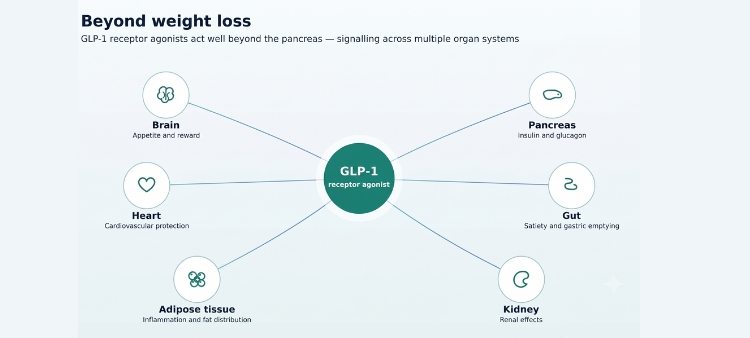
GLP-1 receptor agonists act beyond the pancreas, signalling across multiple organ systems.
One of the most significant discoveries has been their profound effect on appetite regulation. GLP-1RAs act on GLP-1 receptors in the brain, particularly in areas involved in satiety and reward pathways, leading to reduced food intake and increased feelings of fullness. This central action contributes significantly to the observed weight loss in patients [2].
Beyond appetite, GLP-1RAs influence adipogenesis and systemic inflammation. Studies suggest that these agents can modulate adipose tissue function, potentially reducing visceral adiposity as well as inflammation. Chronic low-grade inflammation is a hallmark of obesity and metabolic syndrome, contributing to insulin resistance and cardiovascular disease. GLP-1RAs have demonstrated anti-inflammatory properties, which may contribute to their broader metabolic and cardiovascular effects [3].
Expanding Therapeutic Scope: Clinical Trial Data
The clinical evidence supporting the expanded therapeutic utility of GLP-1RAs is rapidly accumulating, particularly in the areas of cardiovascular health and emerging brain-health associations.
Cardiovascular Outcomes
Initially recognised for their glucose-lowering effects, GLP-1RAs have consistently shown remarkable cardioprotective effects. The landmark SELECT trial, involving over 17,600 patients with pre-existing cardiovascular disease and overweight or obesity but without diabetes, demonstrated that once-weekly subcutaneous semaglutide (2.4 mg) significantly reduced the incidence of major adverse cardiovascular events (MACE) by 20% compared to placebo over a mean follow-up of 39.8 months [4]. This trial provided compelling evidence that GLP-1RAs offer benefits beyond glycaemic control, directly impacting cardiovascular morbidity and mortality in a broad population with obesity.
Early Dementia and Brain-Health Associations
An exciting, albeit still preliminary, area of research explores the potential of GLP-1RAs in neuroprotection and cognitive function. Type 2 diabetes and insulin resistance are increasingly linked to an elevated risk of cognitive decline and dementia, including Alzheimer’s disease. GLP-1 receptors are present in the brain, and studies suggest that GLP-1RAs may exert neuroprotective effects through various mechanisms, including reducing neuroinflammation, improving cerebral blood flow, enhancing insulin sensitivity in the brain, and promoting neuronal survival [5].
While early clinical trials and observational studies have shown promising associations between GLP-1RA use and a lower risk of dementia or improved cognitive outcomes, particularly in individuals with type 2 diabetes, the evidence is still considered preliminary. More well-designed, long-term clinical trials are needed to definitively establish the role of GLP-1RAs in preventing or treating neurodegenerative diseases [5].
The Next Wave: Multi-Hormone Agonists
The success of GLP-1RAs has paved the way for the development of next-generation therapies that target multiple metabolic pathways simultaneously. Triple-hormone agonists, such as retatrutide, represent a significant leap forward. Retatrutide activates receptors for glucose-dependent insulinotropic polypeptide (GIP), GLP-1, and glucagon, aiming to harness the synergistic effects of these hormones.
Retatrutide, a triple agonist targeting the GLP-1, GIP, and glucagon receptors, represents one of the most promising next-generation obesity therapies. In a Phase 2 clinical trial published in the New England Journal of Medicine, participants receiving the highest dose achieved a mean weight reduction of up to 24.2% after 48 weeks [6]. More recently, Eli Lilly announced positive top-line results from the Phase 3 TRIUMPH-1 trial, reporting an average weight loss of approximately 28.3% after 80 weeks in participants receiving 12 mg retatrutide. These Phase 3 findings have been reported through company announcements and are awaiting full peer-reviewed publication [7]. Retatrutide remains an investigational molecule and is not currently approved for clinical use.
These agents demonstrate superior weight loss efficacy compared to single or dual agonists, along with significant improvements in cardiometabolic health measures.
However, with enhanced efficacy come considerations regarding safety and efficacy trade-offs. While generally well-tolerated, multi-hormone agonists may present a higher incidence of gastrointestinal side effects (nausea, diarrhoea, vomiting) compared to single-agonist therapies. The long-term safety profile and optimal dosing strategies for these potent new agents are actively being studied in ongoing clinical trials [7].
Where Research Still Needs to Catch Up
Despite the remarkable progress, several critical areas require further research to optimise the long-term management of metabolic disease with GLP-1-based therapies.
Long-Term Metabolic Adaptation
Weight loss, regardless of the method, often triggers compensatory metabolic adaptations that promote weight regain. The body’s intricate homeostatic mechanisms fight to restore lost weight, leading to decreased energy expenditure and increased appetite. Understanding how GLP-1RAs influence these long-term metabolic adaptations and whether they can reset the body’s weight set point is crucial for sustained weight management. Research into the persistence of these effects and strategies to counteract weight regain post-discontinuation is ongoing.
Muscle and Bone Preservation
Rapid and substantial weight loss, while beneficial for overall health, can sometimes lead to a disproportionate loss of lean muscle mass and a reduction in bone mineral density. This is a particular concern for older adults or individuals at risk of sarcopenia. Evidence indicates that GLP-1RA treatment alone can reduce bone mineral density at the hip and spine, while combining treatment with exercise appears to protect it [8]. More dedicated research is needed to develop strategies for muscle and bone preservation during GLP-1RA-induced weight loss, including investigating the role of resistance training, adequate protein intake, and potential co-interventions.
Durability Post-Discontinuation
One of the most significant challenges is the durability of effects post-discontinuation. Studies like the STEP 1 trial extension have shown that participants who discontinue GLP-1RA therapy often regain a substantial portion of their lost weight within a year [9]. This highlights the chronic nature of obesity and the need for ongoing treatment or novel strategies to maintain benefits after stopping medication. Further research is essential to understand the underlying biological mechanisms driving this weight regain and to identify interventions that can promote sustained weight management post-treatment.
Conclusion
The landscape of metabolic disease treatment is undergoing a profound transformation, with GLP-1 research at its epicentre. The shift from viewing obesity as a lifestyle failure to recognising it as a complex, treatable condition driven by hormonal and inflammatory pathways is empowering both patients and clinicians. Beyond their established role in glucose control, GLP-1RAs are demonstrating significant benefits in cardiovascular health and showing promising, albeit preliminary, associations with brain health. The advent of multi-hormone agonists like retatrutide heralds a new era of even more potent therapies, offering unprecedented levels of weight loss and metabolic improvement.
However, the journey is far from over. Critical research gaps remain, particularly concerning long-term metabolic adaptation, the preservation of muscle and bone mass during rapid weight loss, and strategies to ensure the durability of treatment effects after discontinuation. Addressing these questions will be paramount to fully realise the transformative potential of GLP-1-based therapies and to usher in a future where metabolic diseases are not just managed, but effectively and sustainably treated.
Author Bio