
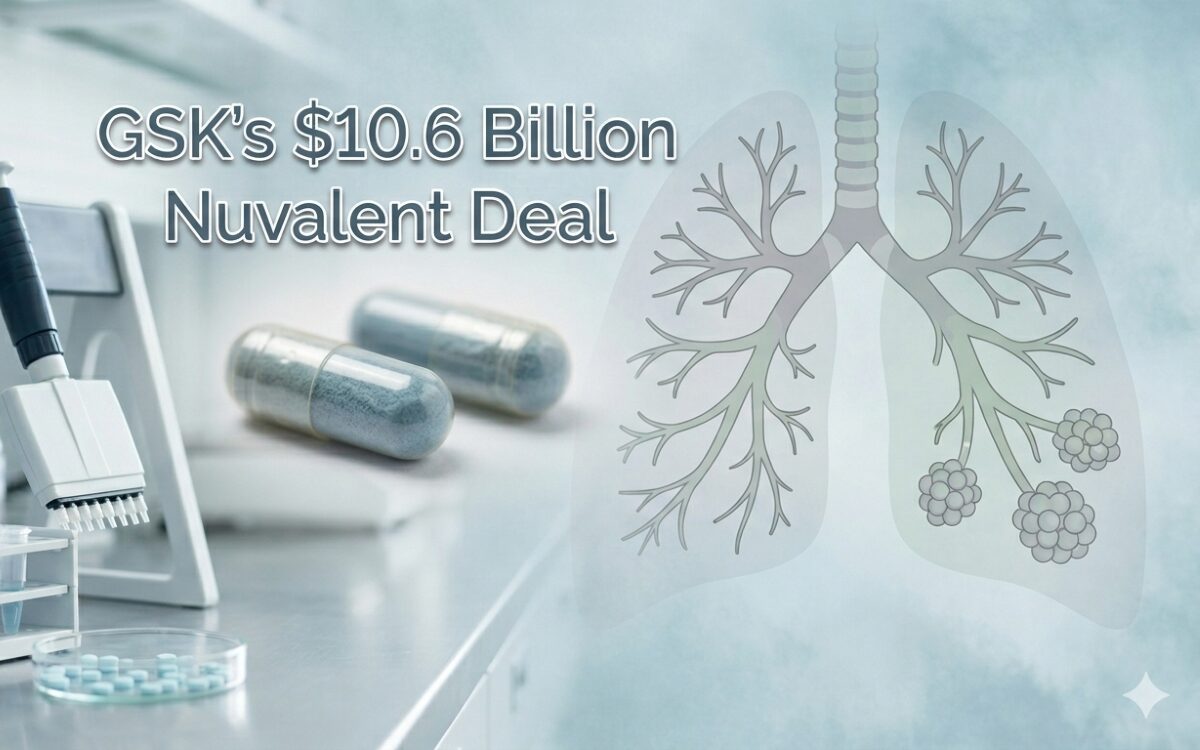
Two FDA decision dates, 18 September and 27 November, are now the most important dates on GSK’s calendar. On 9 June 2026, the British pharmaceutical giant announced it had agreed to acquire Cambridge, Massachusetts-based Nuvalent for $10.6 billion in cash, securing two late-stage precision oncology therapies for non-small cell lung cancer that are already under FDA review. If both drugs are approved on schedule, GSK could be generating new oncology revenue before the year is out. If either decision is delayed, the financial case for paying a 40% premium becomes considerably harder to justify.
The GSK Nuvalent acquisition is the largest deal in GSK’s history for more than a decade, the second largest biopharma transaction of 2026, and the clearest signal yet of what new Chief Executive Luke Miels intends to do with the company he inherited from Emma Walmsley at the start of the year.
A Strategic Pivot, Not Just a Large Deal
Miels had told investors in February that he would focus on transactions in the £2 billion to £4 billion range, deals that were, in his words, “hiding in plain sight.” The Nuvalent acquisition, at $10.6 billion gross and $9.4 billion net of cash, departs sharply from that framing. It is also GSK’s third acquisition of 2026, following RAPT Therapeutics for approximately $2.2 billion, which added an immunology asset for food allergy, and 35Pharma, which brought cardiovascular metabolism programmes. The three deals together constitute a deliberate pipeline transformation across three therapeutic areas within six months.
What distinguishes the Nuvalent deal from the others is its stated ambition. GSK is not merely adding two drugs. It is, in Miels’s own framing, building a lung cancer franchise from which further assets, including the company’s B7-H3-targeted antibody-drug conjugate Ris-Rez, currently in Phase 3 development, can expand. That platform logic matters because it justifies a premium that would otherwise look stretched for two drugs that have not yet received regulatory approval.
“The two lead products are potential best-in-class assets that could launch this year if approved by the FDA,” Miels said, “and offer significant new treatment options to patients with two forms of non-small cell lung cancer.” The acquisition, he added, provides GSK with immediate new sales growth opportunities and improved profit contributions from 2027.
Two Drugs Built to Outlast Their Predecessors
At the heart of the GSK Nuvalent acquisition are zidesamtinib (NVL-520) and neladalkib (NVL-655). Both are next-generation, brain-penetrant tyrosine kinase inhibitors designed not simply to match existing therapies, but to overcome the specific mechanisms by which those therapies eventually fail.
Zidesamtinib targets ROS1, a receptor tyrosine kinase whose rearrangement drives a genetically distinct subset of NSCLC. Existing ROS1 inhibitors, including crizotinib, entrectinib, and the more recent repotrectinib, have demonstrated meaningful activity but are limited by acquired resistance through solvent-front mutations. Zidesamtinib was engineered with a ROS1-selective, TRK-sparing profile to address those resistance patterns and maintain efficacy in patients who have already progressed on earlier agents. Data from ARROS-1, the drug’s Phase 1/2 trial, presented at the 2026 ASCO Annual Meeting, reported a 40% objective response rate across ten tumour types in a heavily pre-treated population, with only one dose reduction due to treatment-related adverse events and no treatment discontinuations. The FDA has accepted Nuvalent’s New Drug Application with a PDUFA target action date of 18 September 2026.
Neladalkib targets ALK, a fusion oncogene found in approximately 2%–8% of all NSCLC cases. The current standard of care includes the second-generation inhibitor alectinib and the third-generation lorlatinib, both of which have delivered strong progression-free survival in earlier lines of treatment. The clinical challenge is that acquired resistance is effectively inevitable in metastatic disease, and dual TRK/ALK inhibitors carry CNS adverse event risks that limit tolerability and dose intensity. Neladalkib was designed to be ALK-selective and TRK-sparing, with CNS penetrance, to drive deeper and more durable responses while avoiding those off-target toxicities. Pivotal data from the ALKOVE-1 Phase 1/2 trial, presented at the IASLC 2025 World Conference on Lung Cancer and at ASCO 2026, supported an NDA submission, which the FDA accepted with Priority Review status and a PDUFA target action date of 27 November 2026.
Both drugs carry FDA Breakthrough Therapy and Orphan Drug Designations. Analysts at Jefferies, cited by the Financial Times, estimate peak annual sales for the Nuvalent portfolio of between $5 billion and $7 billion. GSK describes both candidates as having multi-blockbuster potential.
The Patients Behind the Pipeline
Understanding why these drugs command such attention requires a closer look at who develops ALK- and ROS1-positive NSCLC. Both alterations occur predominantly in non-smokers and light smokers with adenocarcinoma histology, and both affect patients who are typically younger than the broader lung cancer population. Real-world data indicate that ROS1-rearranged NSCLC has a median age at diagnosis of around 50 years, with the majority of patients being female and never-smokers. ALK-positive disease follows a similar demographic profile, with a median diagnosis age below 60 and a notably high proportion of never-smokers across published cohorts.
This matters commercially as well as clinically. Younger patients with a relatively long expected treatment horizon, who are otherwise healthy and able to tolerate therapy, represent a more favourable revenue profile than older populations with comorbidities and shorter duration of treatment. Patients who fail one TKI and move to the next remain on therapy; improving that sequencing pathway, which is exactly what zidesamtinib and neladalkib are designed to do, extends both clinical benefit and commercial duration. Additionally, up to a third of treatment-naive ROS1-positive patients present with brain metastases, and CNS progression occurs in up to 50% of those pre-treated with TKIs. The brain-penetrant design of both Nuvalent candidates is therefore not incidental: it addresses the most common site of treatment failure in this population.
A Third Asset and the Platform Logic
Beyond the two lead programmes, the deal delivers NVL-330, a potential best-in-class HER2 inhibitor currently in Phase 1 trials for patients with HER2-altered NSCLC. This early-stage candidate adds a third molecular target within the same tumour type, and its inclusion signals that Nuvalent was building a lung cancer company rather than simply developing two drugs. GSK also acquires Nuvalent’s full preclinical portfolio.
The platform framing connects to Ris-Rez, GSK’s B7-H3-targeted ADC in Phase 3. An established commercial and clinical infrastructure in lung cancer makes combination studies and label expansions significantly more achievable. GSK is not entering this tumour type blind: it is buying a position from which to operate.
It is also worth noting a detail that received limited attention in initial coverage. GSK confirmed it will assume Nuvalent’s existing revenue-sharing arrangements, which include low-single-digit royalties payable to Royalty Pharma and Deerfield. These obligations modestly reduce the net economics of any future product revenues, though their scale is unlikely to be material relative to the potential sales profile of the two lead assets.
The Patent Cliff Driving the Urgency
The financial context for this acquisition is well understood by investors, but worth stating clearly. GSK’s HIV portfolio generated £7.7 billion in 2025, making it the company’s dominant revenue engine. Patent protection for dolutegravir, sold as Tivicay and a cornerstone of modern HIV treatment regimens, begins expiring from 2027, with core patents running out through 2028. That creates a structural revenue gap that GSK’s existing pipeline cannot fully absorb without significant new launches.
Oncology is the intended counterweight. GSK reported oncology sales of £1.97 billion in 2025, approximately 6% of total group revenue of £32.66 billion. GSK’s London-listed rival AstraZeneca derived 44% of its 2025 revenue from oncology. That comparison captures the scale of the challenge. Oncology sales at GSK grew 43% year-on-year in 2025, but from a low base. The Nuvalent acquisition is the most consequential single step the company has taken towards narrowing that gap.
GSK said the deal is expected to be accretive to sales and core operating profit in 2027, and accretive to core earnings per share in 2029, inclusive of synergies and pipeline reprioritisation. It has maintained its 2026 full-year guidance of 7%–9% core operating profit and earnings-per-share growth, confirming the acquisition will be funded through a combination of new and existing debt facilities and available cash.
The accretion timeline is directly linked to the FDA decisions. If zidesamtinib is approved in September and neladalkib in November, commercial launches begin before the end of 2026 and revenue contributions flow into 2027 as guided. A significant delay to either decision pushes that accretion timeline out and places additional pressure on other parts of the portfolio to compensate.
A Deal That Reflects the Wider Market
The Nuvalent acquisition does not exist in isolation. Biotech deals globally had reached $106 billion across 201 transactions in 2026 at the time of the announcement, according to PitchBook data, putting the sector on course for its strongest year since the pre-pandemic peak. A recent Life Science Daily News analysis of the biopharma M&A 2026 landscape identified the structural forces converging to drive this activity: looming patent expirations across large-cap pharma, strengthening biotech equity markets, and fierce competition for a limited supply of de-risked, late-stage assets.
The 40% premium GSK paid, against a closing price of $88.49 to reach $124 per share, reflects that scarcity dynamic precisely. Nuvalent’s shares surged nearly 39% to approximately $123.25 on announcement, repricing to within a dollar of the offer, signalling high market confidence that the deal will close. GSK shares fell 2.6% in London, a predictable response to the scale of the outlay and the premium attached to it.
The transaction is expected to close in the third quarter of 2026, subject to regulatory approvals. For GSK, the next test is not whether the deal closes, but whether two FDA committees agree, before the year ends, that zidesamtinib and neladalkib are ready for patients. Everything that follows, the accretion, the platform, the franchise, depends on that answer.