
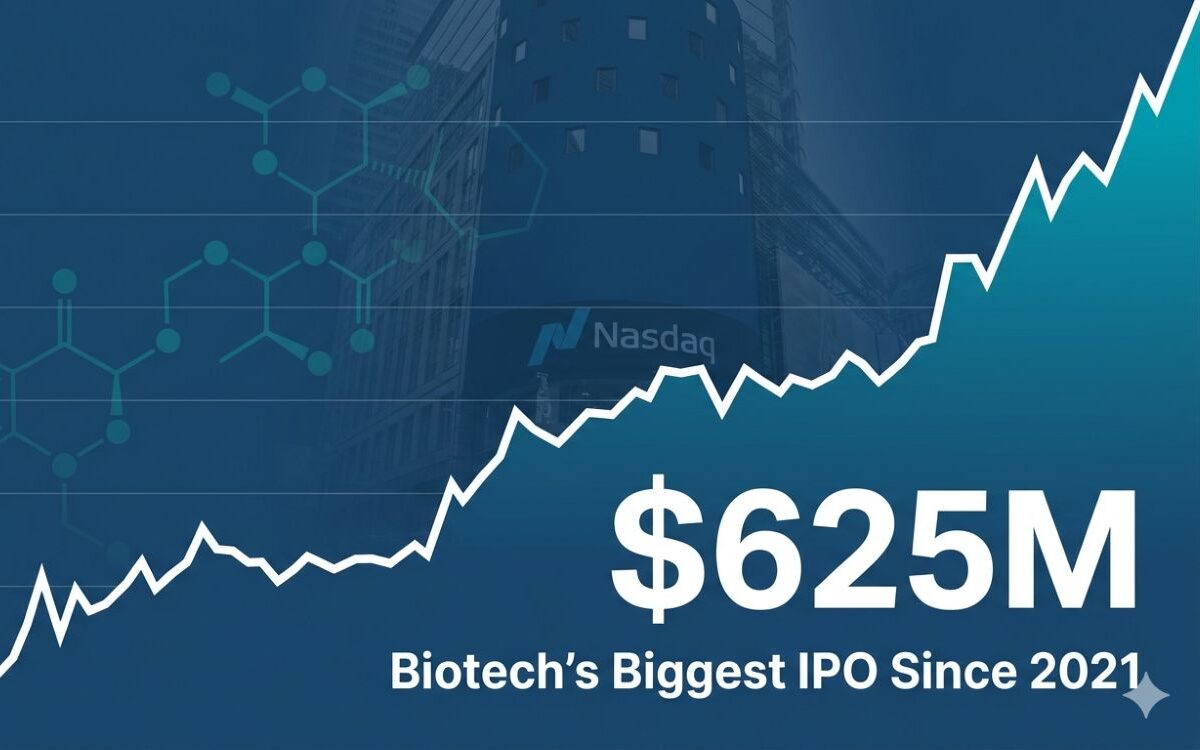
When Kailera Therapeutics priced its initial public offering on 16 April 2026, it did more than raise money. The Kailera Therapeutics IPO set a new benchmark for an industry that had spent the better part of three years in the wilderness. Priced at $625 million, it was already the largest US biotech listing since 2021, eclipsing Moderna’s then-record $604 million IPO from 2018. When underwriters exercised their overallotment option in full on 20 April, the final gross proceeds reached $718.8 million. Six drugmakers that went public in the first quarter of 2026 collectively raised $1.7 billion, a median haul ranking as the highest for any quarter since the sector’s 2021 peak. Kailera alone surpassed that total.
The company initially sold approximately 39 million shares at $16 each, the top of its marketed range, after originally planning to offer 33.3 million shares at $14 to $16 apiece. The deal was reportedly double-digits oversubscribed. Underwriters subsequently exercised their full overallotment option, bringing total shares sold to nearly 44.9 million. By the close of trading on its first day, Kailera’s shares had surged 63%, settling at $26. For a sector that has spent years trying to reopen the IPO window, it was a striking signal.
A Company Built at Speed
Kailera was founded in May 2024, making it barely two years old at the time of its public debut. It emerged from a $400 million Series A round and was built around a portfolio of four obesity drug candidates licensed from Jiangsu Hengrui Pharmaceuticals, one of China’s largest pharmaceutical companies. A $600 million Series B followed in October 2025, the second-largest private biotech raise of that year. By the time of the IPO, Kailera had secured more than $1 billion in private funding and a combined cash position sufficient to fund its pipeline well into 2028.
The company is led by Ron Renaud, a veteran biotech executive who previously built and sold three companies: Idenix Pharmaceuticals, Translate Bio, and most recently Cerevel Therapeutics, which was acquired by AbbVie in 2024 for approximately $8.7 billion. His track record was a significant draw for investors.
Kailera’s backers include Bain Capital Private Equity, Bain Capital Life Sciences, Atlas Venture, RTW Investments, and the Qatar Investment Authority, which indicated an interest in purchasing up to $225 million in aggregate at the IPO price. Affiliates of Bain Capital are expected to hold approximately one third of the company following the offering.
The Pipeline: GLP-1 Ambition Across Multiple Formats
The Kailera Therapeutics IPO is fundamentally a bet on the global obesity market, and on ribupatide in particular. Ribupatide (also referred to as KAI-9531) is a once-weekly injectable GLP-1 and GIP receptor dual agonist, a mechanism broadly similar to Eli Lilly’s Zepbound (tirzepatide), which has rapidly captured significant market share since its approval.
In a Phase 3 trial conducted in China by Hengrui, injectable ribupatide produced a mean weight reduction of 19.2% at the highest dose over 48 weeks, compared with 1.4% in the placebo group. Crucially, weight loss showed no plateau effect in either the Phase 2 or Phase 3 studies, a characteristic that has drawn comparisons with the most effective agents currently on the market.
Ribupatide is currently being evaluated in the KaiNETIC global Phase 3 programme, with the first trial enrolling 1,800 participants, which began in December 2025. KaiNETIC-3 will include a head-to-head comparison with Novo Nordisk’s Wegovy (semaglutide), providing a direct clinical benchmark against one of the two dominant products in the obesity space. Topline results from the KaiNETIC programme are expected in 2028.
The IPO proceeds, combined with Kailera’s existing cash, are allocated as follows: $625 million to support the global Phase 3 programme for injectable ribupatide through the second quarter of 2028; $150 million to advance oral ribupatide to Phase 3; and $50 million to take KAI-7535 through completion of a planned Phase 2 study.
Oral ribupatide is a once-daily tablet formulation of the same peptide. In a Phase 2 study involving 166 patients with obesity, the 50mg dose produced a mean weight loss of 12.1% over 26 weeks, with adverse events described as mild. Global Phase 3 trials of oral ribupatide are planned to begin in the first half of 2027.
KAI-7535 is a once-daily oral small molecule GLP-1 receptor agonist. Unlike peptide-based drugs, small molecules are typically easier to manufacture and formulate as pills. Kailera initiated a Phase 2 trial of KAI-7535 in April 2026 and expects topline results in 2027.
Rounding out the portfolio is KAI-4729, a once-weekly injectable tri-agonist designed to activate the GLP-1, GIP, and glucagon receptors simultaneously, placing it in the same mechanistic category as Eli Lilly’s experimental retatrutide, which has demonstrated weight loss exceeding 28% in clinical trials.
What the IPO Tells Us About the Broader Market
The significance of the Kailera Therapeutics IPO extends well beyond the company itself. It arrived at a moment when the biotech IPO market was showing clear signs of recovery after a prolonged contraction driven by rising interest rates, declining biotech equity valuations, and a general retreat of risk appetite between 2022 and 2024.
The IPO market showed encouraging signs of recovery in early 2026, with 10 companies going public or commencing offerings in the first quarter alone, already exceeding the total 2025 class. Biotech listings had fallen to their lowest level in at least five years in 2025, with only eight companies accessing public markets during that period.
The real driver behind this resurgence, according to investors, is the M&A market. “It’s been a torrid pace linked to the patent cliff,” said Nimish Shah, partner at Venrock Healthcare Capital Partners. Large pharmaceutical companies facing significant patent expiries are acquiring aggressively, and later-stage biotechs are increasingly exploring public listings while fielding acquisition offers.
The last obesity drugmaker to go public, Metsera, raised $275 million in its January 2025 IPO and was subsequently acquired by Pfizer for $65.60 per share in cash at closing, in a deal that attracted a competing $10 billion bid from Novo Nordisk before Pfizer ultimately prevailed. That acquisition underscored the premium investors and acquirers alike are prepared to pay for credible obesity assets with meaningful clinical data.
The GLP-1 space sits at the centre of this activity. Analyst forecasts consistently point to the obesity drug market as one of the largest commercial opportunities in the history of the pharmaceutical industry, driven not by niche premium pricing but by broad adoption across health systems globally. The obesity story is no longer just about GLP-1 hype; it is becoming a platform business with multiple modalities, multiple routes of administration, and a growing shift in competitive advantage from molecular novelty to scale, supply, and positioning.
China as a Source of Innovation
One of the more notable aspects of Kailera’s model is its explicit reliance on drug candidates originating in China. All four of its clinical-stage assets were licensed from Hengrui, a company that has invested heavily in GLP-1 research and whose domestic clinical programme has generated some of the most compelling weight loss data in the field. This approach reflects a broader shift in how global biopharma views Chinese drug development.
China is no longer just a manufacturing base or a generics developer; it is increasingly a source of licensable innovation. Kailera is one of several US-based biotechs to have adopted this model, licensing assets with established safety and early efficacy profiles from Chinese partners and then running global trials sufficient for regulatory approval in the US and Europe. The strategy compresses timelines and reduces early-stage uncertainty, though it also introduces regulatory and geopolitical considerations that investors will be watching closely.
The obesity sector’s embrace of Chinese-origin assets is not limited to Kailera. AstraZeneca committed to a deal with China’s CSPC Pharmaceuticals worth up to $18.5 billion in potential milestones, focused entirely on next-generation obesity and metabolic disease candidates, in January 2026. For more on how that transaction is reshaping competitive dynamics in the sector, see the Life Science Daily News analysis of the AstraZeneca China Obesity Drug Deal.
A Market Entering Its Most Competitive Phase
Kailera enters a landscape where Novo Nordisk and Eli Lilly currently dominate, but where both companies face intensifying pressure from an expanding field of challengers. Novo Nordisk has submitted a new drug application to the FDA for CagriSema, a combination of semaglutide and the amylin analogue cagrilintide, which achieved approximately 23% weight loss over 68 weeks in Phase 3 trials, though it narrowly missed a non-inferiority endpoint against tirzepatide in the REDEFINE 4 study. Eli Lilly, meanwhile, continues to advance its oral GLP-1 programme and next-generation triple agonist.
The competitive dynamics of the obesity market are evolving rapidly. Injectable and oral formats, varying durations of action, and differentiated tolerability profiles are all becoming points of competition. Kailera’s strategy of developing both injectable and oral formulations is designed to address a broad patient population, including those who require the stronger weight reduction typically associated with injectable therapy.
Scott Wasserman, Kailera’s Chief Medical Officer, has described the early oral ribupatide results as indicating a “potentially game-changing clinical profile,” a characterisation that resonated with investors who pushed the IPO to its record-setting size.
Conclusion
The Kailera Therapeutics IPO is a landmark event for multiple reasons. It confirms that the biotech IPO window has reopened in a meaningful way. It signals the robustness of investor appetite for obesity assets with credible Phase 3 programmes. And it demonstrates the growing acceptance of Chinese-origin drug candidates as the basis for globally competitive pipelines.
Whether ribupatide will ultimately challenge or surpass the efficacy of tirzepatide or semaglutide remains a question for the KaiNETIC data, expected in 2028. What is already clear is that Kailera has secured $718.8 million in gross proceeds and the institutional credibility to find out. For a sector that spent much of the past three years waiting for conditions to improve, it represents a meaningful turning point.