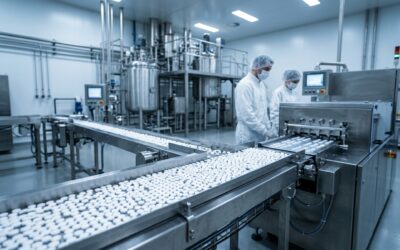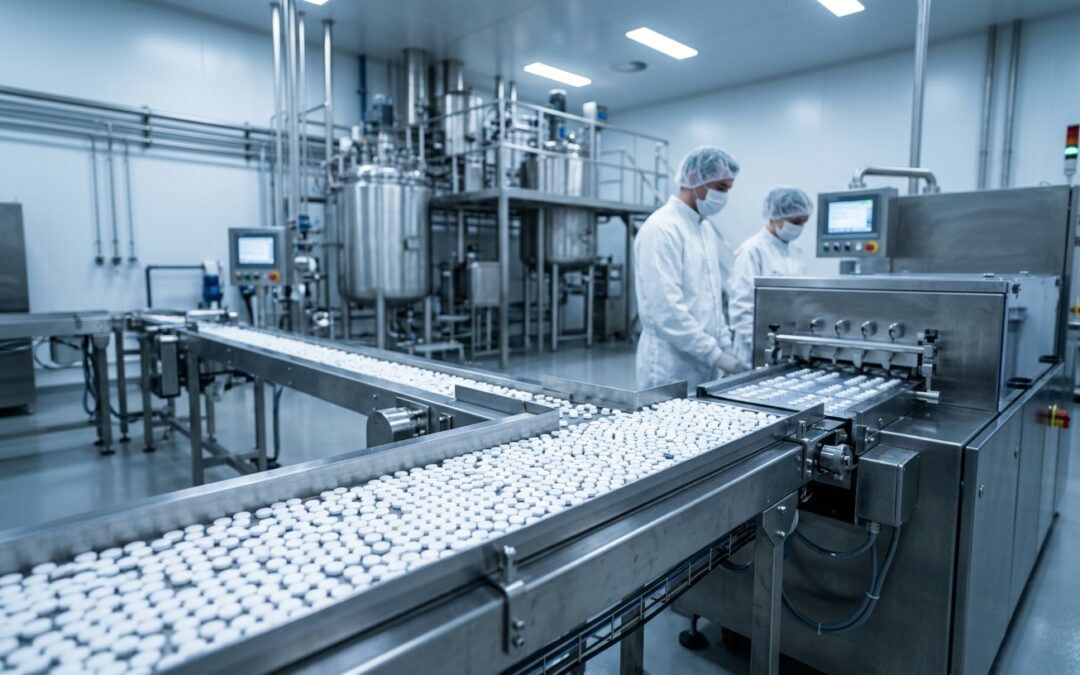

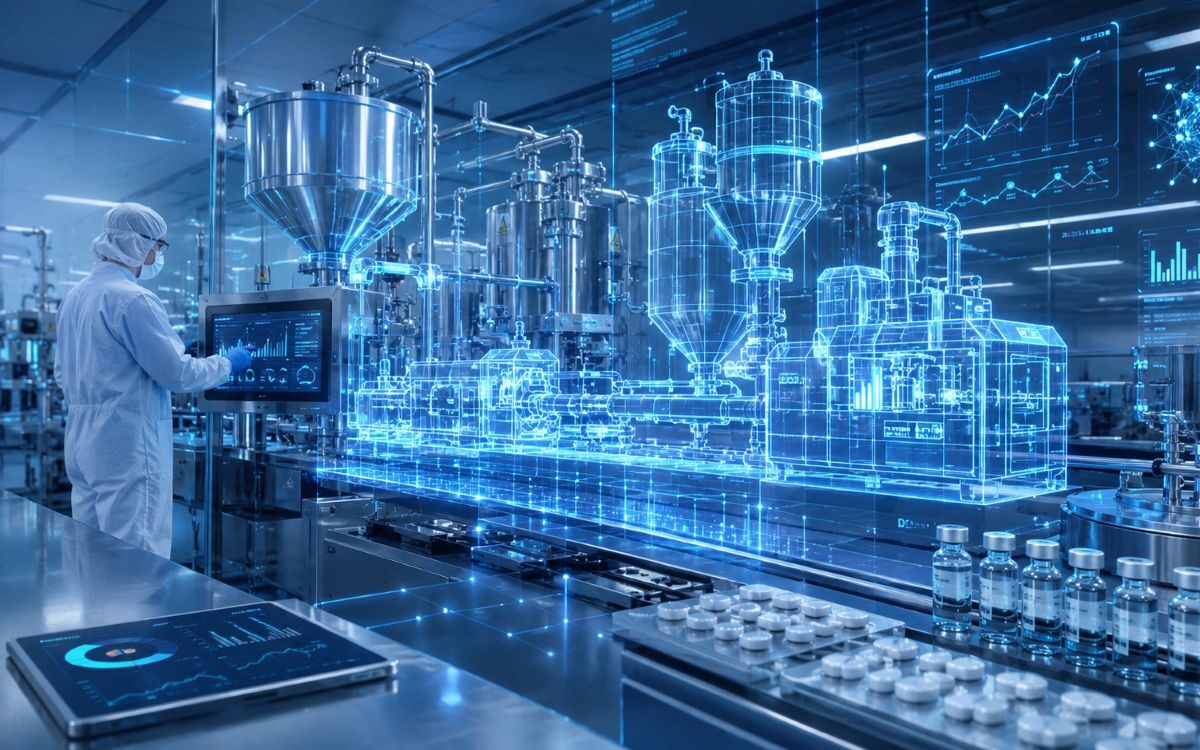
Pharmaceutical manufacturing is entering a new scientific era. For decades, the industry has relied on validated processes, fixed control strategies, laboratory testing and carefully documented batch records to prove that medicines are made consistently and safely. These foundations remain essential. But as medicines become more complex, supply chains become more fragile and regulators encourage advanced manufacturing, the next step is becoming clear: the factory of the future will need to understand itself in real time.
That is where the digital twin comes in.
A digital twin is not simply a dashboard, a simulation model or a three-dimensional visualisation of a factory. In pharmaceutical manufacturing, it is best understood as a dynamic virtual representation of a process, asset, production line or facility that is continuously informed by data from the physical system. The Digital Twin Consortium describes digital twins as data-driven virtual representations of real-world entities and processes, synchronised at a defined frequency and fidelity, while NIST highlights their ability to help manufacturers observe, diagnose, predict and optimise systems in near real time. [1,2]
In practical terms, a digital twin allows manufacturing teams to ask a powerful question before making a change on the plant floor: what is likely to happen next?
From process monitoring to process understanding
The pharmaceutical industry already generates large volumes of manufacturing data. Process analytical technology, distributed control systems, manufacturing execution systems, laboratory information systems, environmental monitoring and equipment sensors all capture information about how a process behaves. Yet in many facilities, these data streams remain fragmented.
A digital twin brings those signals together around a scientific model of the process. That model may be mechanistic, data-driven or hybrid. It can include residence time distribution, mass and energy balances, equipment behaviour, critical process parameters, material attributes and historical deviation data. The result is not just visibility, but prediction.
This matters because pharmaceutical quality is built on process understanding. A digital twin can help identify whether a process is drifting toward an out-of-specification result, whether a raw material variation is likely to affect performance, or whether a change in equipment settings could improve yield without increasing risk. It can also allow engineers to test process changes virtually before committing resources, materials and production time.
Why digital twins are gaining momentum now
Several trends are converging. Continuous manufacturing is becoming more important, and regulators have provided scientific and regulatory guidance for its development, implementation, operation and lifecycle management through ICH Q13. [3] Continuous manufacturing naturally benefits from real-time monitoring and control, because material is constantly moving through connected unit operations.
At the same time, advanced analytics and artificial intelligence are becoming more mature. FDA’s January 2025 draft guidance on AI for regulatory decision-making proposes a risk-based credibility assessment framework for AI models used to generate information supporting drug safety, effectiveness or quality. [4] While this guidance is broader than manufacturing alone, its emphasis on context of use, model credibility and risk-based evaluation is directly relevant to digital twins in regulated environments.
Regulatory pathways are also evolving. FDA’s Advanced Manufacturing Technologies Designation Program is intended to encourage early adoption of technologies that can improve manufacturing reliability, robustness, product quality and supply. [5] FDA’s Emerging Technology Program has also supported industry engagement on novel manufacturing technologies, including advanced analytical tools and modelling approaches. [6]
These signals do not mean that every digital twin will be accepted automatically in a regulatory submission. They do suggest that digital manufacturing science is moving from theory into regulated practice.
Where digital twins can change pharmaceutical manufacturing
The clearest near-term value is in process development and scale-up. A digital twin can help scientists understand how a process behaves at laboratory, pilot and commercial scale. Instead of relying only on physical experiments, teams can simulate process conditions, identify sensitive parameters and design more efficient development studies.
A second application is continuous manufacturing. In a continuous line, changes in one unit operation can affect upstream and downstream performance. A digital twin can model these relationships and support advanced process control. FDA researchers have already explored a digital twin based on residence time distribution theory to train an artificial neural network predictive controller for a continuous pharmaceutical manufacturing process. The study reported strong simulation performance for set-point tracking and disturbance rejection compared with conventional control. [7]
A third opportunity is predictive maintenance. Equipment failures in sterile filling, bioreactors, tablet compression or lyophilisation can be costly and disruptive. A digital twin that integrates equipment condition data can help detect early warning signs, schedule maintenance more intelligently and reduce unplanned downtime.
A fourth use case is quality assurance. Digital twins may support deviation investigation, root cause analysis, continued process verification and, in more advanced settings, real-time release strategies. Instead of reviewing quality after the fact, manufacturers could move toward a more predictive quality model, where risk is detected and managed earlier.
For biologics and advanced therapies, the opportunity may be even greater. Bioprocesses are sensitive to biological variability, raw material differences and subtle changes in operating conditions. Recent reviews have highlighted the potential of digital twins in biopharmaceutical manufacturing, while also noting the importance of validation, data integrity, integration and clear definitions. [8,9]
The barriers are scientific, not just technical
The promise of digital twins should not hide the challenges. A pharmaceutical digital twin must be credible, validated and maintained throughout its lifecycle. It must be clear what the model is intended to do, what decisions it supports, what data it requires and what level of uncertainty is acceptable.
Data quality is a major issue. A digital twin is only as strong as the data feeding it. Missing sensor data, poorly contextualised batch records, inconsistent naming conventions and legacy systems can all weaken the model. Interoperability between equipment, automation systems, MES, ERP and quality systems is also critical.
There is also the question of change control. If a digital twin learns from new data, updates its parameters or incorporates AI, manufacturers must define how those changes are governed. In a GxP environment, model drift is not only a technical problem; it is a compliance and patient-safety concern.
Cybersecurity is another priority. A digital twin connected to operational technology and manufacturing systems could become a sensitive part of the production infrastructure. Protecting data integrity, access control and system availability will be essential.
Finally, digital twins require new skills. Pharmaceutical scientists, automation engineers, data scientists, quality professionals and regulatory teams will need to work together. The future manufacturing scientist may need to understand both process chemistry and model credibility, both GMP and machine learning, both plant-floor reality and virtual simulation.
A future manufacturing science
The most important point is that digital twins are not a replacement for pharmaceutical science. They are a way to deepen it.
A well-designed digital twin captures process knowledge, tests scientific assumptions, improves decision-making and supports better control. It can make manufacturing more resilient, more efficient and more responsive. It can also help companies move from reactive quality management to predictive quality assurance.
The pharmaceutical factory of the future may not be fully autonomous, and it should not be uncontrolled. But it may be self-aware in a scientifically meaningful way. It may know when a process is drifting, when a batch is at risk, when equipment performance is declining and when a change can be made safely.
For patients, the goal is simple: reliable access to high-quality medicines. For manufacturers, the path will require investment, validation, collaboration and regulatory dialogue. For pharmaceutical science, the digital twin represents something larger than a new technology. It is a new way of linking data, process understanding and quality into one living manufacturing system.
Digital twins are not just part of the future of pharmaceutical manufacturing. They may become one of the sciences that defines it.
Author Bio