For decades, the laboratory rat has been the quintessential symbol of biomedical research. Yet, as 2025 draws to a close, a profound shift is reshaping the life sciences landscape. Global regulatory bodies are no longer merely encouraging alternatives to animal testing; they are actively legislating for their replacement. Driven by ethical concerns and the undeniable scientific limitations of animal models, major agencies in the United Kingdom and the United States have launched ambitious roadmaps to integrate Artificial Intelligence (AI) and 3D-bioprinted tissues into the regulatory approval process. This convergence of policy and technology marks a historic tipping point, promising safer, faster, and more human-relevant drug development.
The UK’s Ambitious Roadmap to Replacement
In November 2025, the UK government unveiled a landmark strategy that positions the nation at the forefront of this global transition. The new roadmap outlines a comprehensive plan to phase out the use of animals in scientific research, backed by substantial government investment. The strategy is not merely aspirational; it sets concrete deadlines that will fundamentally alter how safety testing is conducted.
Under the new guidelines, the testing of products for skin and eye irritation on animals will be banned by the end of 2026. Furthermore, the use of animals to detect adventitious agents, such as contaminants like viruses or bacteria, in medicines is set to be prohibited by 2027. These specific targets represent a decisive move away from the “tick-box” compliance of the past, forcing pharmaceutical companies to adopt validated non-animal alternatives.
To support this transition, the government has pledged £75 million in funding. This capital is allocated to foster a national network of laboratories and research hubs dedicated to refining and validating New Approach Methodologies (NAMs). These methodologies include advanced computer modelling and micro-physiological systems, commonly known as organs-on-chips. A key component of this initiative is the establishment of the UK Centre for the Validation of Alternative Methods (UKCVAM), which will act as a central authority to accelerate the regulatory acceptance of these new tools.
Lord Patrick Vallance, the UK Science Minister, emphasised the dual benefits of this strategy during the announcement.
“Nobody in our country of animal lovers wants to see suffering and our plan will support work to end animal testing wherever possible and roll out alternatives as soon as it is safe and effective to do so,” he stated. Crucially, Lord Vallance noted that this roadmap is designed to ensure that government, businesses, and animal welfare groups can collaborate to find alternatives “faster and more effectively.”
The reaction from the scientific community has been cautiously optimistic. While some researchers warn that a complete replacement for complex systemic interactions remains distant, the establishment of a clear regulatory timeline provides the certainty industry needs to invest heavily in alternative technologies. Organisations such as the NC3Rs have welcomed the plan, viewing it as a necessary framework to move from small-scale pilots to industrial standardisation.
FDA’s Strategic Pivot in the United States
Across the Atlantic, the US Food and Drug Administration (FDA) has been executing its own strategic pivot. Following the passage of the FDA Modernization Act 2.0 in late 2022, which removed the federal mandate for animal testing in drug development, the agency has moved to operationalise this flexibility.
In April 2025, the FDA released a pivotal document titled Roadmap to Reducing Animal Testing in Preclinical Safety Studies. This roadmap specifically targets the development of monoclonal antibodies, a class of drugs widely used to treat cancer and autoimmune diseases. The agency announced its intention to phase out animal testing requirements for these therapies, citing the high predictive value of human-specific in vitro models.
This regulatory evolution addresses a longstanding inefficiency in drug development, specifically the poor translation rate from animal models to human patients. Statistics have long shown that approximately 90 per cent of drugs that pass animal trials fail in human clinical trials, often due to unforeseen toxicity or lack of efficacy. By shifting focus to human-relevant data, the FDA aims to improve these success rates.
The agency’s roadmap encourages the adoption of an “integrated safety assessment approach.” This involves combining data from multiple non-animal sources, such as AI-driven computational models and engineered human tissues, to build a comprehensive safety profile of a new drug. The shift signals to biotech companies that submitting data from non-animal models is no longer just an alternative path, but potentially the preferred one for specific therapeutic classes.
3D-Printed Skin: A Technological Leap
One of the most critical components of this transition is the maturation of 3D bioprinting technology. No longer a futuristic concept, 3D-printed human tissues are now achieving the structural complexity and functional fidelity required for regulatory validation.
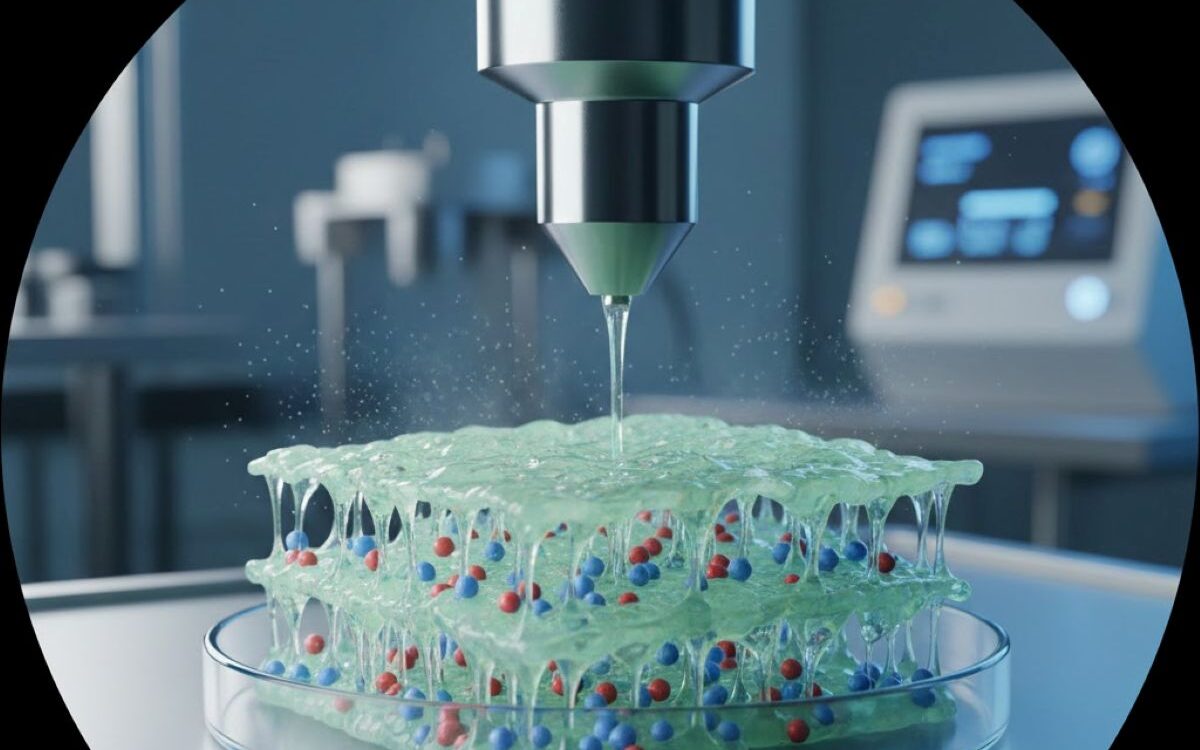
A striking example of this progress emerged in October 2025, when researchers at the Mayo Clinic, in collaboration with regenerative medicine company CollPlant, announced the development of a fully humanised 3D-bioprinted skin model. This model utilises a proprietary plant-derived recombinant human collagen (rhCollagen) bioink to create a stratified tissue that mimics the dermis and epidermis of real human skin.
Unlike previous generations of synthetic skin, this bioprinted model contains a complex matrix of human fibroblasts, melanocytes, and keratinocytes. It is capable of replicating the barrier functions of natural skin, making it an ideal platform for testing topical and transdermal drugs. The implications for the pharmaceutical and cosmetic industries are immediate. With the UK ban on animal testing for skin irritation looming in 2026, technologies like this provide a timely and scientifically superior solution.
The model is designed to be integrated into high-throughput screening workflows, allowing researchers to test hundreds of formulations rapidly. This scalability addresses one of the primary criticisms of early tissue engineering, specifically that it was too slow and expensive for industrial application. By validating these models against historical human data, companies are building the evidence base necessary to gain regulatory acceptance.
AI and the Hybrid Model of Testing
While 3D tissues offer a physical replacement for animal models, Artificial Intelligence provides the analytical engine to predict biological outcomes. The integration of AI into toxicology, a field now frequently referred to as “computational toxicology,” allows researchers to model the effects of a drug on the human body before a physical experiment is even conducted.
Dr Jo Varshney, founder and CEO of VeriSIM Life, a company specialising in AI-driven drug development, describes the current era as a move towards a “hybrid model.” In recent industry discussions, she noted that while animal testing will not vanish overnight, its role is becoming increasingly selective.
“We will see a shift: animal studies becoming more selective, used only when needed to fill gaps that models cannot yet cover,” Dr Varshney explained.
AI platforms can analyse vast datasets of molecular structures and historical clinical trial results to predict toxicity and efficacy with high accuracy. When combined with data from organ-on-chip systems, these algorithms can simulate complex systemic interactions, such as how a drug is metabolised by the liver or whether it crosses the blood-brain barrier.
This data-driven approach is also being championed by European regulators. The European Medicines Agency (EMA) has recently updated its guidance on New Approach Methodologies (NAMs), emphasising the need for “mechanistic transparency” in AI models. This means that for an AI prediction to be accepted by regulators, the underlying biological reasoning must be clear and explainable, ensuring that the “black box” of the algorithm does not obscure potential safety risks.
Industry at a Tipping Point
The convergence of clear regulatory roadmaps and mature technologies has placed the life sciences industry at a tipping point. The market for organ-on-chip and 3D bioprinting technologies is projected to grow exponentially, reaching over $1.3 billion by the early 2030s. This growth is driven not just by regulatory pressure, but by the economic reality that traditional animal testing is slow, expensive, and often unreliable.
Companies like SenzaGen, known for their genomic-based skin sensitisation tests, are already seeing the benefits of this shift. Peter Nählstedt, CEO of SenzaGen, commented on the UK’s recent announcement, noting that it confirms the transition to non-animal testing is accelerating. This acceleration strengthens commercial opportunities for platforms that have already secured OECD approval.
For pharmaceutical companies, the transition presents both a challenge and an opportunity. The challenge lies in retooling established R&D workflows and validating new methods to the satisfaction of conservative regulators. The opportunity, however, is significant: the potential to shave years off the drug development timeline and reduce the billions of dollars lost to late-stage clinical failures.
A New Era of Human-Centric Science
The regulatory push of 2025 serves as a clear declaration that the era of the “gold standard” animal model is drawing to a close. By mandating the phase-out of specific animal tests and providing the framework for their replacement, the UK and US governments are accelerating the adoption of better science.
The combination of AI’s predictive power and the biological fidelity of 3D-printed tissues offers a more accurate reflection of human physiology than any animal model could provide. As these technologies continue to evolve and gain regulatory confidence, the reliance on animal testing will diminish, replaced by a new paradigm of human-centric research that is safer for patients and more ethical for all.