

Retatrutide, Eli Lilly’s investigational triple hormone receptor agonist, has now reported positive results across five Phase 3 trials. In the pivotal TRIUMPH-1 obesity study, participants on the highest dose lost an average of 28.3% of their body weight at 80 weeks, the largest mean reduction reported in a pivotal obesity trial to date. On 23 July 2026, Lilly announced results from two further Phase 3 studies and confirmed that it intends to file for approval in the first quarter of 2027.
The weight loss figures are exceptional by any historical standard. The cardiovascular findings are less clear cut, and important questions about durability, body composition, cost and access remain unanswered.
A note on availability. Retatrutide is an investigational medicine. It has not been approved by the FDA, the European Medicines Agency or the MHRA, and it is not available on prescription in any market. Lilly states that the molecule is legally available only to participants in its clinical trials. Any product offered for sale online or through unregulated channels under this name is unlicensed, has not been assessed for content, purity or sterility, and should not be assumed to be equivalent to the compound studied in the trials described below. The MHRA has seized unlicensed product labelled as retatrutide in the UK on more than one occasion, as set out later in this article.
How Retatrutide Works: A Triple Receptor Approach
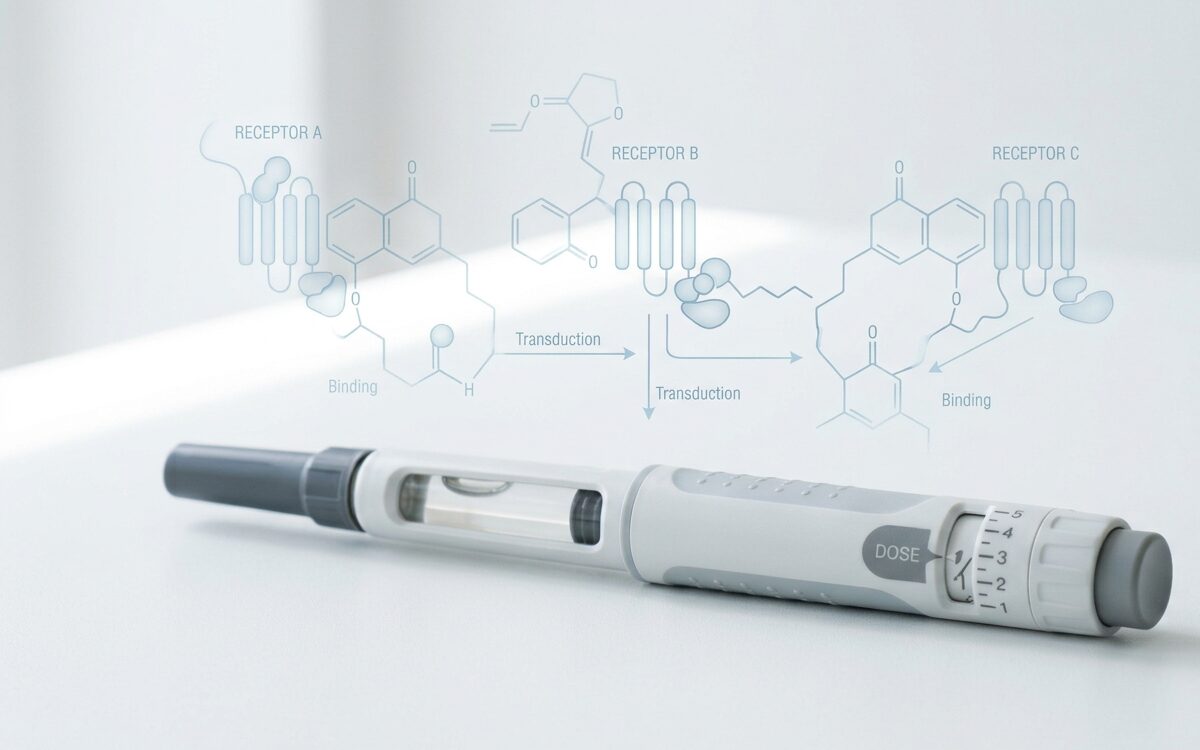
The mechanism distinguishes retatrutide from the incretin therapies currently on the market. Semaglutide (marketed as Wegovy and Ozempic) targets a single receptor, glucagon-like peptide-1 (GLP-1). Tirzepatide (marketed as Zepbound and Mounjaro) targets two, GLP-1 and glucose-dependent insulinotropic polypeptide (GIP). Retatrutide is a triple agonist of GIP, GLP-1 and glucagon receptors, activating all three simultaneously.
Each receptor does something different. GLP-1 activation suppresses appetite, slows gastric emptying and enhances insulin secretion. GIP activation amplifies the insulin response and may aid fat metabolism. The glucagon component is the real point of difference: it raises energy expenditure, promotes hepatic fat oxidation and may reduce liver fat. The working hypothesis, consistent with the Phase 3 data but not proven by them, is that pairing appetite suppression with raised energy expenditure beats dual or single agonism. No energy expenditure or body composition data have been reported alongside the TRIUMPH toplines.
Phase 2: The Early Signal
Retatrutide drew attention in June 2023, when Phase 2 results in The New England Journal of Medicine showed 24.2% average weight loss over 48 weeks at the highest dose, beyond anything then reported for a GLP-1 therapy. The same data showed reductions in liver fat, positioning it as a candidate for metabolic dysfunction-associated steatotic liver disease (MASLD) as well as obesity.
TRIUMPH-1: The Pivotal Obesity Data
TRIUMPH-1 (NCT05929066) enrolled 2,339 adults with obesity, or overweight with at least one weight-related comorbidity, excluding those with diabetes. Participants were randomised to once-weekly subcutaneous retatrutide at 4 mg, 9 mg or 12 mg, or to placebo, over 80 weeks. Topline results were announced on 21 May 2026, with detailed data presented at the American Diabetes Association’s 86th Scientific Sessions in June 2026.
Under the efficacy estimand, mean body weight reductions at 80 weeks were 19.0% at 4 mg (47.2 lbs, 21.4 kg), 25.9% at 9 mg (64.4 lbs, 29.2 kg) and 28.3% at 12 mg (70.3 lbs, 31.9 kg), against 2.2% with placebo. Under the treatment-regimen estimand, which includes all randomised participants regardless of adherence, the corresponding figures were 17.6%, 23.7% and 25.0%, against 3.9% with placebo. The two estimands answer different questions and should not be mixed.
Among participants on 12 mg, 45.3% lost 30% or more of their body weight and 65.3% reached a BMI below 30. Of those who began the trial with class 3 obesity (BMI of 40 or above), 37.5% finished below the obesity threshold.
The widely reported 30.3% figure needs context. It comes from a prespecified blinded extension of 532 participants with a baseline BMI of 35 or above who had completed 80 weeks and tolerated their dose, then received a maximum tolerated dose of 9 mg or 12 mg, meaning those originally on placebo or lower doses moved onto active treatment. Those continuing on 12 mg to 104 weeks lost 30.3% on average (85.0 lbs, 38.6 kg). Striking, but a self-selected tolerant subgroup with no placebo comparator, and not the primary endpoint.
Cardiometabolic markers also improved, with significant reductions from baseline in waist circumference, non-HDL cholesterol, triglycerides, systolic blood pressure and high-sensitivity C-reactive protein. The 12 mg group averaged a 24.1 cm (9.5 inch) waist reduction. Specific blood pressure and lipid figures were not disclosed in the topline release.
Osteoarthritis and Sleep Apnoea
TRIUMPH-4, announced in December 2025, examined retatrutide in 445 adults with obesity and knee osteoarthritis, randomised in equal groups to 9 mg, 12 mg or placebo. This was a heavier population than TRIUMPH-1, with a mean baseline weight of 112.7 kg and a mean BMI of 40.4. Over 68 weeks, participants on 12 mg lost an average of 28.7% of body weight (71.2 lbs, 32.3 kg) alongside substantial reductions in osteoarthritis pain.
Lilly reported WOMAC pain subscale reductions of up to 4.5 points from a mean baseline of 6.0: 4.5 points at 9 mg (75.8%), 4.4 at 12 mg (74.3%) and 2.4 with placebo (40.3%). A post-hoc analysis found roughly one in eight retatrutide-treated participants free of knee pain at week 68, against just over 4% on placebo. Post-hoc findings are hypothesis-generating, and there is no clear dose response, with 9 mg marginally outperforming 12 mg for reasons not yet explained.
Tolerability in TRIUMPH-4 was noticeably worse than in TRIUMPH-1. Discontinuation due to adverse events reached 12.2% at 9 mg and 18.2% at 12 mg, against 4% with placebo. Lilly noted that discontinuation correlated with baseline BMI and included participants who stopped because of perceived excessive weight loss, an unusual reason that may become more common as efficacy rises.
TRIUMPH-1 also included subgroups with knee osteoarthritis and obstructive sleep apnoea. As summarised by the Cleveland Clinic Journal of Medicine, retatrutide reduced knee pain subscale scores by up to 73.1% and the apnoea-hypopnoea index by up to 60.6% in those subgroups.
Diabetes: TRANSCEND-T2D-1 and TRIUMPH-2
TRANSCEND-T2D-1 (NCT06354660) was a 40-week study in 537 adults with type 2 diabetes inadequately controlled on diet and exercise alone, conducted at 48 sites in the United States, Mexico and India, with a mean diabetes duration of 2.5 years. Topline results were reported in March 2026, and full results were published in The Lancet on 6 June 2026. It is the first retatrutide Phase 3 trial to complete peer review.
Under the treatment-regimen estimand, mean HbA1c reductions were 1.69% at 4 mg, 1.86% at 9 mg and 1.94% at 12 mg, against 0.81% with placebo. Under the efficacy estimand, Lilly reported reductions of up to 2.0%. Between 82% and 89% reached an HbA1c below 7.0%, and 75% to 83% reached 6.5% or lower. Weight loss at 12 mg was 15.3% under the treatment-regimen estimand and 16.8% (36.6 lbs, 16.6 kg) under the efficacy estimand, with no plateau by week 40. No severe hypoglycaemia was reported. The authors flag one significant limitation: participants were largely medication-naïve, which limits how far the findings generalise to people already taking antihyperglycaemic medication or insulin.
TRIUMPH-2, reported on 23 July 2026, studied retatrutide over 80 weeks in adults with type 2 diabetes and obesity or overweight. Mean weight loss reached 20.8% (49.6 lbs, 22.5 kg) at 12 mg, with HbA1c reductions of up to 1.6%. Weight loss in people with type 2 diabetes is consistently lower than in those without, a pattern seen across the incretin class.
The Cardiovascular Question: TRIUMPH-3
TRIUMPH-3 (NCT05882045) is the trial that complicates the picture. It enrolled 1,949 adults with severe obesity and established cardiovascular disease, with or without type 2 diabetes, testing 9 mg and 12 mg over 80 weeks. Participants lost up to an average of 22.6% of body weight (55.8 lbs, 25.3 kg) from a mean baseline of 245.6 lbs (111.4 kg).
Risk factor improvements at 12 mg were substantial: triglycerides down 37.0%, non-HDL cholesterol down 16.5%, systolic blood pressure down 9.3 mmHg, waist circumference down 19.0 cm (7.5 inches) and high-sensitivity C-reactive protein down 51.2%.
The event data were less conclusive. In prespecified analyses of time to first MACE, there were 44 MACE-5 events (all-cause death, heart attack, stroke, heart failure event or coronary revascularisation) on pooled retatrutide against 52 on placebo: a hazard ratio of 0.82, 95% confidence interval 0.55 to 1.22. On the narrower MACE-3 composite of cardiovascular death, heart attack or stroke, there were 27 events against 23, a hazard ratio of 1.12, interval 0.64 to 1.96. Both intervals cross 1.0, and the MACE-3 estimate numerically favours placebo. Lilly attributed this to lower-than-anticipated event rates in both arms, a plausible explanation for an underpowered comparison but not a demonstration of benefit. Improving risk factors is not the same as reducing events, and the dedicated outcomes trial is still running.
How Retatrutide Compares
No head-to-head trial of retatrutide against tirzepatide or semaglutide exists, so every comparison here is across separate trials with different populations, durations and endpoints. The obesity pipeline is also crowded, with Novo Nordisk’s CagriSema combination therapy reporting its own strong Phase 3 results.
With that qualification, the ordering is consistent. Retatrutide reached 28.3% mean weight loss at 80 weeks in TRIUMPH-1. Tirzepatide reached 20.9% at 72 weeks in SURMOUNT-1, and subcutaneous semaglutide 14.9% at 68 weeks in STEP 1. A network meta-analysis published in the Annals of Internal Medicine, covering 26 randomised trials and 15,491 adults without diabetes, placed retatrutide ahead of both at maximum evaluated doses.
Daniel Drucker, Professor of Medicine at the University of Toronto and a leading figure in incretin biology, told The Pharmaceutical Journal that retatrutide is the medicine in this class researchers have regarded as most potent, and the likely option for patients needing the largest reductions. Hannah Beba, clinical lead for obesity at the West Yorkshire Health and Care Partnership, told the same publication the results were genuinely striking.
The margin is clinically meaningful: a patient losing 28% rather than 15% of body weight would expect larger gains in metabolic health, joint function and quality of life. Whether that means fewer events is, as above, unestablished.
Safety Profile
The safety profile follows patterns familiar from other incretin-based therapies, with gastrointestinal effects predominating. In TRIUMPH-1, nausea affected 42.4% of participants on 12 mg against 14.8% on placebo, diarrhoea 32.0% against 13.5%, constipation 26.1% against 10.9%, and vomiting 25.3% against 4.8%. Events were generally mild to moderate and diminished over time. Two deaths occurred, both in the 4 mg group, both judged unrelated to the study drug.
Discontinuation due to adverse events rose with dose: 4.1% at 4 mg, 6.9% at 9 mg and 11.3% at 12 mg, against 4.9% with placebo. The 4 mg dose is notable for delivering 19.0% weight loss with a discontinuation rate marginally below placebo, which may prove relevant to real-world dosing.
Dysesthesia, a tingling or altered sensation, affected roughly 5% to 13% of retatrutide-treated participants in TRIUMPH-1 against 0.9% on placebo, and considerably more in TRIUMPH-4, at 8.8% on 9 mg and 20.9% on 12 mg against 0.7%. Urinary tract infections were also more frequent on active treatment. Events were generally mild and rarely caused discontinuation, but neither signal has a long-term profile and the variation between trials is unexplained.
What the Data Does Not Yet Answer
Four gaps are worth flagging.
Durability. No withdrawal data have been reported for retatrutide. Across the incretin class, discontinuation is followed by substantial weight regain: participants in tirzepatide’s SURMOUNT-4 and semaglutide’s STEP 4 both regained a significant proportion of lost weight after switching to placebo. There is no reason to expect retatrutide to behave differently, and treatment would in practice be indefinite.
Body composition. Weight loss of this magnitude raises questions about lean mass and bone density, particularly in older patients. Body composition data have not been included in the topline releases.
Publication status. Only one of the five Phase 3 trials has completed peer review. TRANSCEND-T2D-1 was published in The Lancet in June 2026. TRIUMPH-1 has been presented at the American Diabetes Association Scientific Sessions but not published in full. TRIUMPH-4 remains topline only, and the Giblin et al. paper in Diabetes, Obesity and Metabolism sets out the rationale and design of the TRIUMPH registrational trials rather than reporting results. TRIUMPH-2 and TRIUMPH-3 are company-reported topline results with no published dataset.
Cost and access. No price has been indicated, and pricing will shape health technology assessment as much as efficacy will. The UK access position is set out below.
Regulatory Path and Timeline
Retatrutide has not been submitted for regulatory approval in any market. On 23 July 2026, Lilly confirmed that it plans to submit a Biologics License Application to the FDA in the first quarter of 2027. A standard FDA review takes approximately 10 to 12 months, which would place a decision in late 2027 or 2028 at the earliest. A filing is not an approval, and timelines move.
Kenneth Custer, Executive Vice President and President of Lilly Cardiometabolic Health, said that across five positive Phase 3 studies retatrutide has shown powerful efficacy, and that the TRIUMPH-2 and TRIUMPH-3 results give the company the clinical data package to support global submissions for obesity, knee osteoarthritis pain and obstructive sleep apnoea.
Further readouts from the TRIUMPH and TRANSCEND programmes are expected through 2026 and 2027, including maintenance dosing studies and the cardiovascular outcomes trial. Regulatory submissions outside the United States have not been detailed.
The UK Picture: Licensing, Access and the Illicit Market
The Q1 2027 filing is to the FDA. Lilly has said the TRIUMPH-2 and TRIUMPH-3 results give it the package to support global submissions, but has not set out UK timing. Availability here would require three separate steps: marketing authorisation from the MHRA, a NICE technology appraisal, and commissioning decisions by NHS England and integrated care boards. None follows automatically from the one before.
The tirzepatide precedent shows what that can mean in practice. NICE recommended tirzepatide for weight management in technology appraisal TA1026 in December 2024, for adults with a BMI of at least 35 and at least one weight-related comorbidity, with the threshold reduced by 2.5 for people from South Asian, Chinese, other Asian, Middle Eastern, Black African or African-Caribbean backgrounds. That put an estimated 3.4 million people in England in scope. NHS England then submitted a funding variation request, which NICE accepted, to extend the time allowed to comply.
The figures that followed are the ones worth holding onto. NHS England’s interim commissioning guidance sets out an eligible cohort of 220,000 individuals over the first three years, with the full eligible population to be given access within a maximum period of 12 years, based on cohort prioritisation led by clinical need. Roughly one in fifteen eligible patients will have been reached by the end of 2028.
Access widens by cohort. Year one, 2025/26, covered only patients with a BMI of 40 or above and at least four qualifying comorbidities drawn from a defined list of hypertension, dyslipidaemia, obstructive sleep apnoea, cardiovascular disease and type 2 diabetes. Year two, the current year, adds those with a BMI between 35 and 39.9 and the same four comorbidities. Year three extends to a BMI of 40 or above with three.
A NICE recommendation is therefore not the same as availability, and the surrounding requirements are substantial. Wrap-around care incorporating nutritional and dietetic advice is mandatory alongside prescribing, for a minimum of nine months in primary care. Tirzepatide carries Black Triangle status, requiring additional safety monitoring. Other NICE-recommended weight management medicines carry a maximum prescription duration of two years, whereas tirzepatide has no set stopping rule and may be prescribed indefinitely, which is the model a drug like retatrutide would inherit. From 2026/27 the Quality and Outcomes Framework introduces two obesity indicators, OB004 on consistent identification and timely referral, and OB005 on consideration of weight management pharmacotherapies, both with explicit attention to ethnicity-adjusted BMI thresholds.
Capacity rather than efficacy is the binding constraint. For scale, NHS England puts the cost of obesity to the health service at approximately £11.4 billion a year, with wider societal costs of around £74.3 billion, against 29% of adults in England living with obesity and 64% living with overweight or obesity.
The implication for retatrutide is uncomfortable. A more potent agent, and on current pricing patterns a more expensive one, would enter a system that has committed to reaching 220,000 of 3.4 million eligible patients in three years. For UK readers the question is less whether retatrutide works than where it would sit in a queue that is already twelve years deep.
One part of the UK picture is already settled. Retatrutide is circulating illegally in Britain despite holding no approval anywhere in the world. On 28 May 2026 the MHRA’s Criminal Enforcement Unit raided a country estate near Northampton, recovering around 12,000 doses of unlicensed weight loss medicines including retatrutide and tirzepatide, and arresting two men on suspicion of offences under the Human Medicines Regulations 2012. It was the agency’s largest seizure of such products, and followed the discovery in October 2025 of what the MHRA described as the first illicit weight loss medicine production facility found in Britain, where more than 2,000 unlicensed retatrutide and tirzepatide pens were seized.
The scale is not marginal. In its 2025 enforcement review, the MHRA reported seizing more than 5,000 illegally traded GLP-1 products, disrupting over 1,500 websites and social media accounts selling medical products unlawfully, and removing more than 1,200 social media posts, as part of illegal medicines seizures worth almost £45 million across the year. That review also records the October 2025 Northampton warehouse raid.
Demand is running well ahead of NHS supply. A UCL study published in BMC Medicine estimated that 2.9% of adults in Great Britain, around 1.6 million people, used a GLP-1 or GLP-1/GIP medication to support weight loss in the year to early 2025, with roughly 910,000 using one exclusively for that purpose. Of that exclusive-use group, 91.4% used products licensed for weight loss in Great Britain, most commonly Mounjaro. A further 3.3 million said they would consider starting within a year. As the study’s lead author, Professor Sarah Jackson, observed, that level of use far outstrips NHS England’s initial three-year target of 220,000 patients.
A drug that has not yet been filed for approval in any market already has a British supply chain.
What Retatrutide Could Mean for Obesity Treatment
If approved, retatrutide would extend what obesity pharmacotherapy can achieve. Mean weight loss approaching 30% moves into a range previously associated with bariatric surgery, though the comparison should be handled carefully: surgery has decades of durability and mortality data behind it, produces anatomical and hormonal changes a weekly injection does not replicate, and does not depend on continued adherence. Several bariatric specialists have cautioned against treating the two as interchangeable on the basis of percentage weight loss alone.
For patients with severe obesity and significant comorbidities, particularly type 2 diabetes, knee osteoarthritis or obstructive sleep apnoea, a non-surgical option producing reductions of this magnitude would be a meaningful addition. Whether it becomes widely available, and to whom, will depend on pricing, health technology assessment and commissioning decisions that have not yet begun.
For now, the evidence base is strong on weight and glycaemic control, incomplete on cardiovascular outcomes, and silent on durability after discontinuation. The remaining readouts and the regulatory filing will determine how much of the early promise holds.