

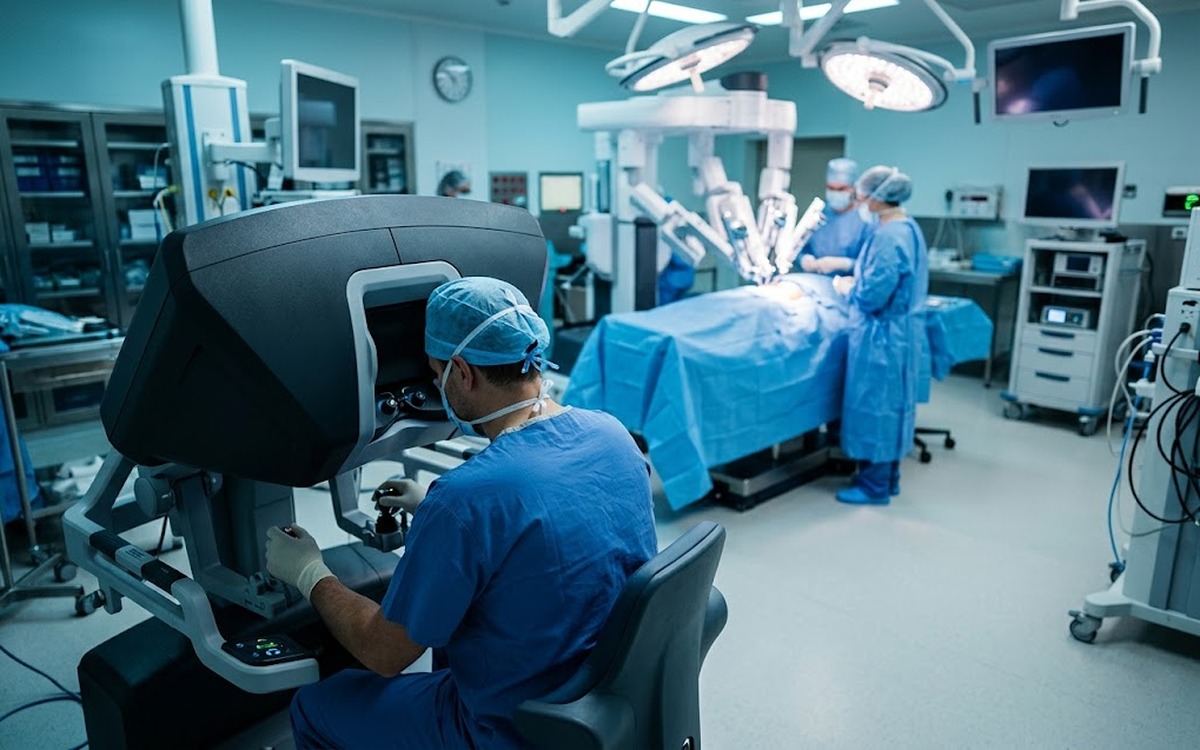
Robotic gastrectomy delivers measurably better perioperative outcomes than conventional laparoscopic surgery for gastric cancer, according to a nationwide analysis of Japanese surgical practice covering more than 22,000 patients.
Gastric cancer is the fifth most commonly diagnosed cancer worldwide and the fifth leading cause of cancer death, accounting for an estimated 980,000 new cases and 642,000 deaths in 2024, according to GLOBOCAN data from the International Agency for Research on Cancer. The burden is heavily concentrated in Asia, which accounts for close to 71 per cent of cases, with age standardised incidence rates highest in Eastern Asia. Surgery remains the mainstay of curative treatment, even as systemic options continue to advance.
The study, published in Gastric Cancer on 29 May 2026, drew on Japan’s National Clinical Database, a nationwide registry capturing the large majority of surgical procedures performed in the country. The researchers identified patients who underwent minimally invasive distal or total gastrectomy between January 2023 and December 2024. Using propensity score matching to control for differences in patient characteristics, they assembled 9,743 matched pairs of robotic and laparoscopic distal gastrectomy cases and a further 1,617 matched pairs for total gastrectomy.
Across both procedure types, robotic surgery was associated with 33 to 40 per cent less blood loss, a 50 to 65 per cent lower likelihood of conversion to open surgery, and shorter postoperative hospital stays. In distal gastrectomy specifically, robotic surgery also reduced serious postoperative complications and intra-abdominal infections.
The trade off was theatre time. Robotic distal gastrectomy took roughly 50 minutes longer on average than the laparoscopic equivalent, and robotic total gastrectomy required close to 70 additional minutes.
What the numbers do and do not show
The research was led by Professor Susumu Shibasaki of the Department of Surgery at Fujita Health University Okazaki Medical Center, working with colleagues at Fujita Health University, the University of Tokyo and Gunma University, with support from the Japanese Gastric Cancer Association. The authors report no grant or external funding.
Shibasaki has been careful not to overstate the effect sizes, noting that the absolute magnitudes of the differences were small while arguing that their consistency across multiple perioperative measures is what makes them meaningful.
That framing matters. This is retrospective registry data rather than a randomised trial, so it establishes association rather than causation. Propensity score matching balances measured variables between the two groups, but it cannot account for factors the database does not capture, including the possibility that higher volume centres and more experienced surgeons are also the ones with robotic platforms. Case selection is a plausible residual confounder in any comparison of this design.
The benefits were also not uniform. Robotic total gastrectomy did not show a statistically significant improvement in the primary outcome of major postoperative complications. The authors attribute this to the procedure being both more technically demanding and less frequently performed, which limits the accumulation of robotic experience.
The training and access story underneath the data
The more interesting finding may be the trend line rather than the headline comparison. When set against an earlier nationwide analysis conducted before Japan extended national health insurance coverage to robotic gastrectomy in 2018, the current results show better outcomes for robotic surgery than the earlier cohort did.
The researchers attribute this to three things happening at once: incremental improvement in the platforms themselves, a larger pool of surgeons qualified to use them, and expanded training capacity. In other words, the case for robotic gastrectomy in Japan appears to have strengthened as the reimbursement environment allowed volume to build.
That has implications well beyond Japan. Health systems weighing robotic adoption tend to model the capital cost and the per case consumables, but this dataset suggests the outcome gap is partly a function of institutional maturity rather than a fixed property of the technology. It also puts a number on the theatre capacity question. An additional 50 to 70 minutes per case is a real constraint for systems already managing surgical backlogs, and it will sit differently in a high volume specialist centre than in a district hospital.
For now, the evidence supports robotic gastrectomy as a credible minimally invasive option for gastric cancer, with the strongest case in distal gastrectomy.