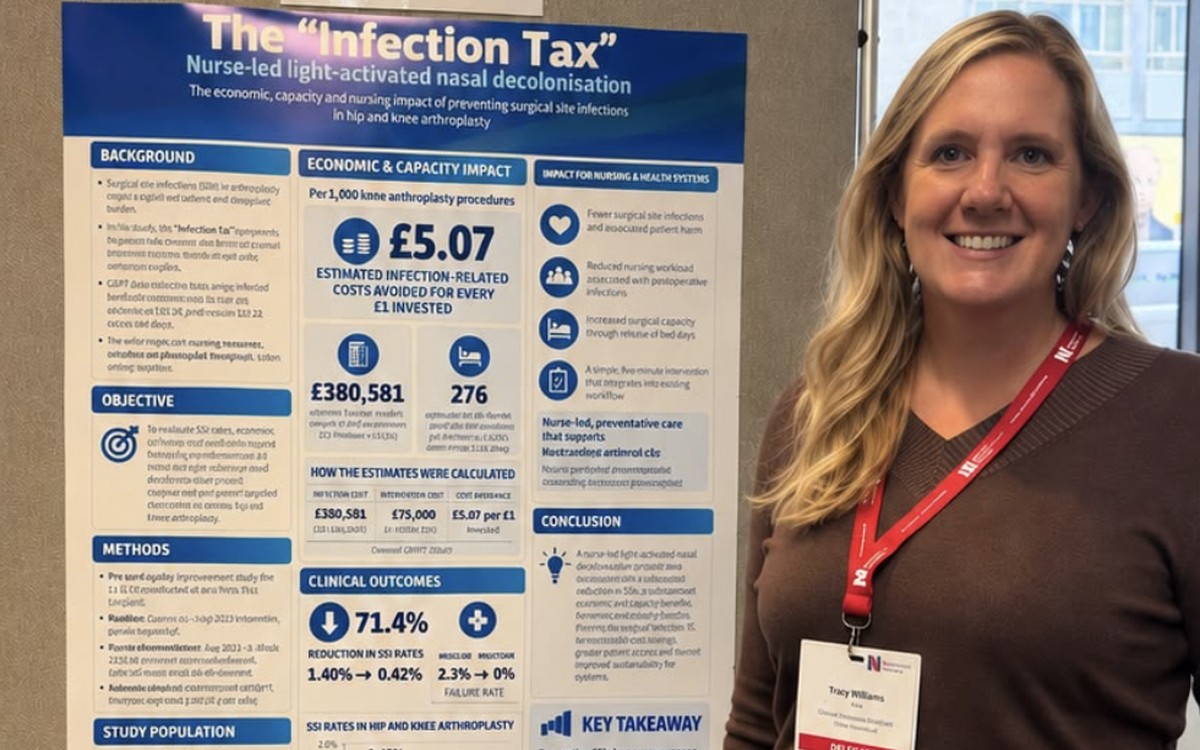
Surgical site infections can consume up to 75 staff hours and displace three operations, research finds
A single surgical site infection (SSI) can consume an estimated 45 to 75 additional hours of healthcare staff time and create downstream demands equivalent to the capacity needed for two to three new surgical procedures, according to research presented at the International Nursing Research Conference 2026 in Glasgow.
The research highlights the wider impact that preventable infections can have on hospital workforce, operating capacity and patient flow, at a time when healthcare systems are under pressure to tackle surgical waiting lists and improve productivity.
The abstract, The Infection Tax: The Hidden Workforce and Surgical Capacity Burden of Surgical Site Infections, examines the additional nursing and multidisciplinary workload associated with managing an SSI.
Beyond the direct clinical impact on patients, an infection can result in an extended hospital stay, additional follow-up appointments, readmission and a prolonged care pathway. Collectively, these demands consume staff time and hospital capacity that could otherwise be used to treat other patients.
According to the research, each SSI may require between 45 and 75 additional hours of healthcare staff time, while the associated downstream care demands can use capacity equivalent to approximately two to three new surgical procedures.
At a health-system level, the cumulative impact of preventable infections could therefore contribute to pressures on surgical waiting lists, bed availability, healthcare staff and costs.
The findings also come amid evidence of variation in infection-prevention practices between hospitals.
A 2025 Getting It Right First Time (GIRFT) report, based on a survey of 39 preoperative assessment services in England, identified significant differences in decolonisation practices between healthcare providers and surgical specialties.
Of the 39 services surveyed, 11 said they did not provide preoperative decolonisation washes to patients who had not tested positive for MRSA or MSSA, while 28 did. GIRFT also identified variation in the length of time for which decolonisation treatments and washes were used before elective surgery.
National Institute for Health and Care Excellence (NICE) guidance recommends that patients bathe or shower with soap either the day before or on the day of surgery.
It also recommends considering nasal decolonisation alongside a chlorhexidine body wash before procedures in which Staphylococcus aureus is likely to cause an SSI, taking into account the type of procedure and individual patient risk factors.
Carolyn Cross, CEO of life sciences company Ondine Biomedical, which presented the research, said the findings demonstrate that the consequences of SSIs extend beyond the individual patient.
“When a single surgical site infection absorbs tens of additional staff hours and uses capacity that could otherwise support two or three operations, the consequences extend well beyond the individual patient,” Cross said.
“Across an already stretched health system, this infection tax compounds quickly. Preventing infections is therefore essential not only to improving patient outcomes, but also to protecting the workforce, reducing waiting lists and making better use of limited surgical capacity.”
One area of focus for SSI prevention is the nasal cavity, which is a major reservoir for Staphylococcus aureus, a pathogen associated with surgical site infections.
Ondine Biomedical (AIM: OBI) is developing photodisinfection-based treatments for infection prevention. Its STERIWAVE® nasal photodisinfection technology is designed to rapidly reduce potentially harmful pathogens in the nasal cavity.
The treatment is administered in minutes and is intended to complement existing infection-prevention measures, including screening, skin preparation, antimicrobial prophylaxis and other perioperative protocols.
Unlike antibiotic-based approaches, photodisinfection is designed to destroy pathogens without generating antimicrobial resistance.
Ondine said effective and scalable infection-prevention approaches could help hospitals reduce the clinical and operational consequences of SSIs while preserving staff time and supporting more timely access to surgery.
The research was presented at the International Nursing Research Conference 2026, which brought together nurses, researchers, clinicians and healthcare leaders in Glasgow to discuss research and innovation aimed at improving nursing practice and patient care.