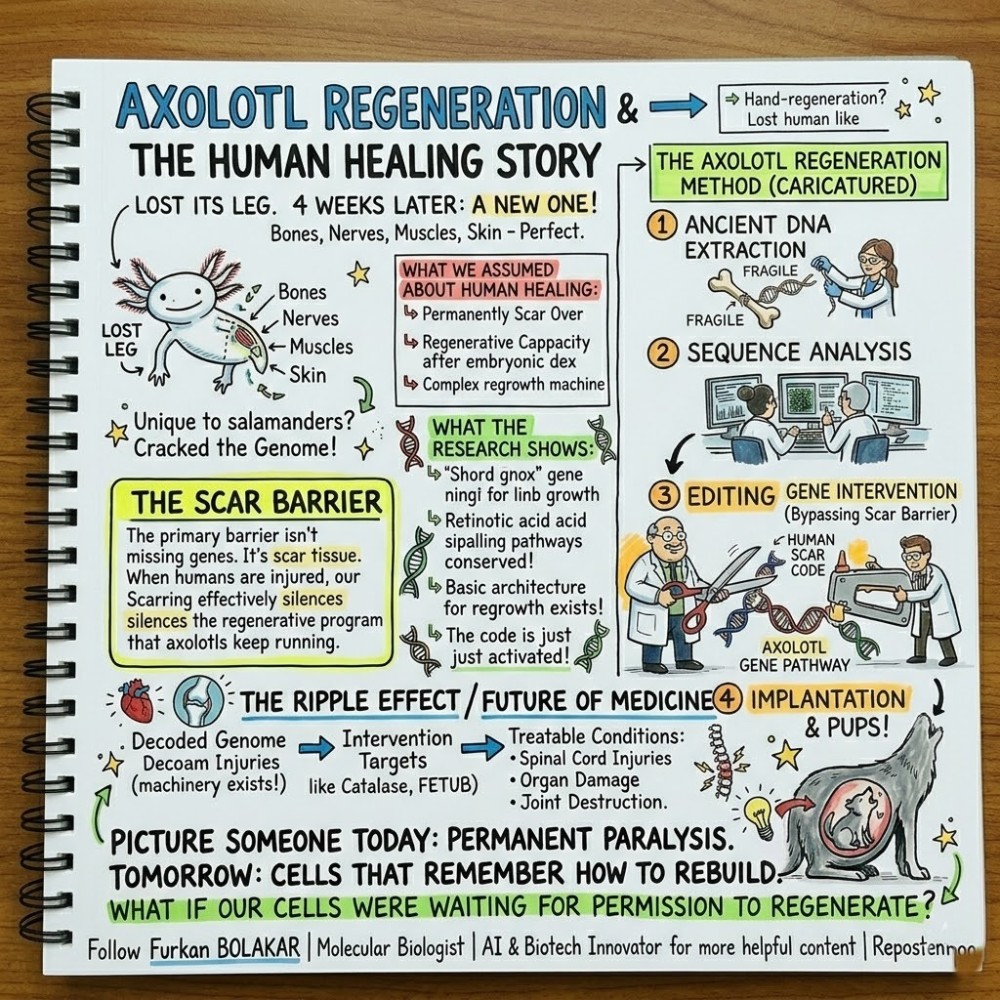

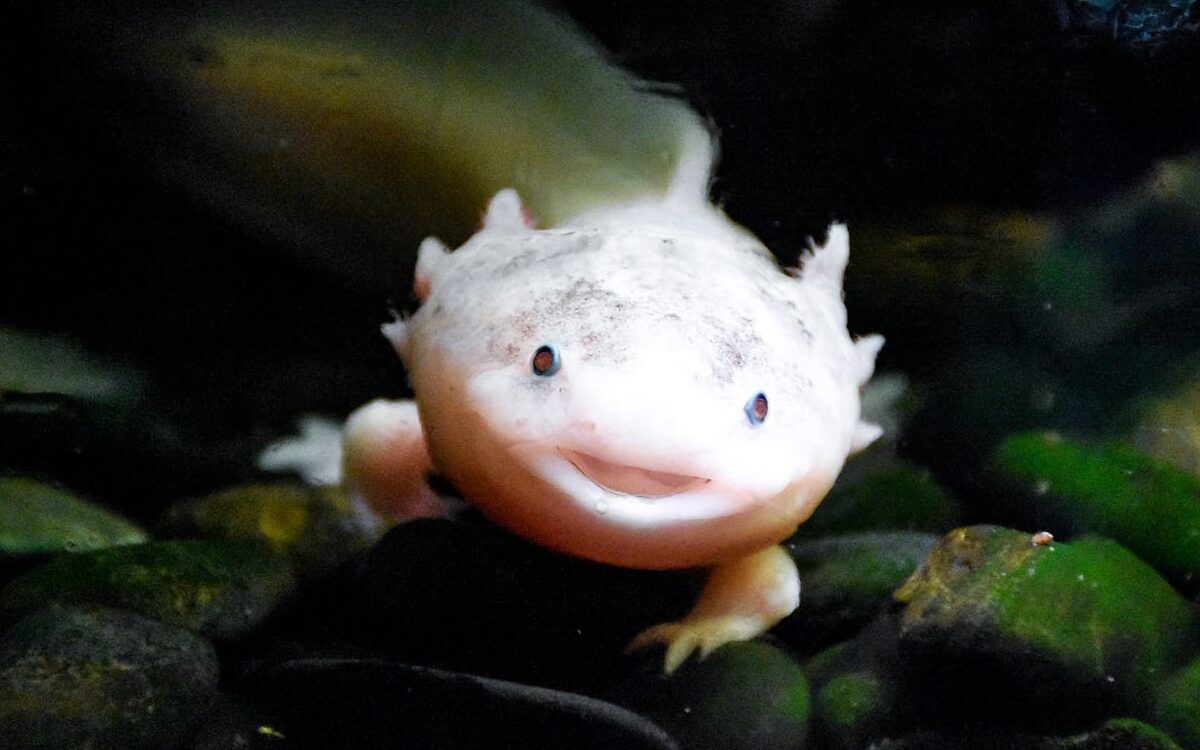
An axolotl loses its leg to a predator. Four weeks later, it has a functional replacement bones, nerves, muscles, and skin are perfectly re-formed. It is a biological masterpiece that has fascinated science for centuries.
For decades, the prevailing dogma in biomedical science was that this extraordinary regenerative capacity was an evolutionary quirk, a trick unique to a few primitive vertebrates, and utterly inaccessible to humans..
Then, researchers sequenced the massive axolotl genome, and the findings completely rewrote the narrative of human healing.
Challenging Old Assumptions
Historically, clinical medicine has viewed major human tissue damage through a lens of permanent loss. Our standard understanding of injury response was stark:
- Once complex mammalian tissue is severely damaged, it forms scar tissue permanently.
- The inherent “regenerative program” is strictly an embryonic phenomenon that disappears after development.
- The required biological machinery for complex regrowth is simply absent in the human genome.
Therefore, clinically, once limbs, organ structures, or spinal cord tracts are lost, they were considered gone forever. We accepted repair (scarring) as our only pathway, assuming regeneration (regrowth) was impossible.
The Science Says Otherwise: It’s Dormant, Not Missing
The genomic era has shattered these assumptions. Research now proves that the essential basic architecture for complex regrowth is conserved across vertebrates, including humans.
Consider these groundbreaking parallels:
- The Shox Gene: Humans possess the exact same Shox gene that directs limb development in the axolotl during regeneration.
- Retinoic Acid Signaling: Key signaling pathways crucial for organized tissue polarity and growth essentially the “maps” cells follow to rebuild exist actively in both species.
The decoding of the genome confirms a stunning reality: The necessary biological “code” for regeneration exists within our cells today. It is not missing. It is merely repressed or functionally silent.
The Paradigm Shift: The “Scar Barrier”
This brings us to the most crucial insight in modern regenerative medicine, and the realization that shifted the entire trajectory of research.
The primary barrier to human regeneration isn’t missing genetics; it’s our own immune response: The scar
In humans, acute trauma triggers an aggressive, evolutionary trade-off. We prioritize rapid sealing of a wound the formation of dense, fibrotic scar tissue to prevent immediate infection and blood loss. This evolutionary urgency, vital for survival on the savanna thousands of years ago, comes at a high cost: Scarring effectively “locks down” the cellular microenvironment, permanently silencing the regenerative pathways that axolotls keep running.
The Path Forward: Clinical Reprogramming
The ripple effect of this understanding is transforming the future of clinical therapy. We are moving from identifying pathways to targeting interventions.
Current scientific investigations are focused on how to bypass this “scar barrier.” Researchers are developing methods to manipulate the wound site’s chemical environment, essentially reprogramming it from a scarring response toward a regenerative one. This involves activating dormant genes such as:
- Catalase & FETUB: These genes have been identified as playing a key role in limb and tail regeneration in axolotls, with research suggesting that their regulated expression influences whether cells can participate in the regenerative process at the wound site.
Today, this research is in trials. Tomorrow, at scale, the implications are profound. This isn’t just about limbs; it is about making permanent spinal cord injuries treatable, reversing organ failure, and restoring destroyed joints.
For over a century, we accepted that human bodies can only scar. Science has proven that paradigm false.
Perhaps the better clinical question today is no longer “If we can regenerate?” but rather: What permission are our cells waiting for to begin rebuilding?
Author: Muhammet Furkan Bolakar
LinkedIn: Profile