

Rentosertib reaches Phase III, Isomorphic Labs raises $2.1 billion, and the EU defers its high-risk AI deadlines. What is still missing for AI-discovered drugs is an approval.
AI-discovered drugs entered a different phase in 2026. One molecule has now reached a Phase III trial. Its biological target and chemical structure were both generated by software. Capital has followed at record scale. Regulators on three continents have published frameworks, principles and revised deadlines. What has not yet arrived is an approval. The distance between computational capability and clinical proof remains the defining feature of the field.
How AI-discovered drugs are defined
The term is used loosely, and that looseness distorts the record. Almost every large pharmaceutical company now applies machine learning somewhere in discovery. Screening triage, structure prediction and toxicity modelling are routine. That is not what analysts mean by AI-discovered drugs.
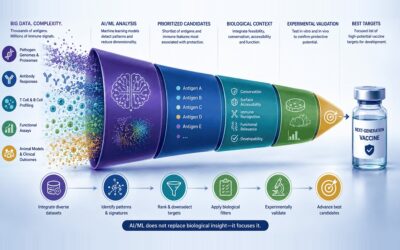
The narrower definition requires at least one of two things. The first is that an algorithm identified the target rather than conventional biology. The second is that the molecule itself was generated computationally rather than selected from a physical library. Programmes meeting both criteria remain scarce. Regulatory filings do not record the distinction, so no official register exists.
That absence matters for anyone assessing progress. Claims about firsts in this field depend entirely on the methodology of whoever is counting. Broader definitions that take in AI-assisted optimisation or AI-designed biologics produce longer lists and earlier firsts.
Phase III: a first late-stage test
Insilico Medicine began a Phase III trial of rentosertib on 7 July 2026. The drug is an oral inhibitor of TNIK, a kinase implicated in fibrotic signalling. It is being tested in idiopathic pulmonary fibrosis, a progressive lung disease with limited treatment options.
Both halves of the programme originated in software, according to Insilico. The company says its PandaOmics engine prioritised TNIK as a target, and that its Chemistry42 platform then generated and optimised the molecule. Insilico, which is listed in Hong Kong, describes the trial as a late-stage milestone for AI-discovered drugs generally.
The supporting Phase IIa data were published in Nature Medicine in June 2025. That study randomised 71 adults across 22 sites in China. The trial met its primary endpoint, which was the proportion of patients recording at least one treatment-emergent adverse event. On a secondary efficacy endpoint, patients on 60 mg once daily gained a mean 98.4 mL in forced vital capacity at 12 weeks, while the placebo group declined by 20.3 mL over the same period. Tolerability at the top dose was less clean. Seven patients discontinued because of liver injury or dysfunction, four of them while also taking nintedanib, and 12 of 18 patients completed the 60 mg regimen against 88 per cent of those on placebo.
The lead investigator was measured about what this established. Professor Zuojun Xu of Peking Union Medical College Hospital led the study. He noted that “the sample size in each patient group was relatively limited”. He said the findings would require validation in larger cohorts. The Phase III trial, registered as NCT07687459, is designed to supply it. It is enrolling 320 patients across 47 centres, all of them in China, which leaves open how the result will read to regulators in other markets.
What the clinical evidence actually shows
The broader record is more equivocal. A 2024 analysis published in Drug Discovery Today examined the clinical pipelines of AI-native biotechnology companies. It remains the most cited quantitative assessment of the question.
The authors found that AI-discovered molecules cleared Phase I at rates between 80 and 90 per cent. Historic industry averages sit between 40 and 65 per cent. On that measure, the technology performs well.
Phase II told a different story. Success rates for AI-discovered drugs were approximately 40 per cent, broadly in line with conventional norms. The authors concluded that algorithms are effective at generating molecules with drug-like properties. They have not yet demonstrated an ability to predict which biological targets will matter in patients. The Nature Medicine team made the same point. They noted that no AI-discovered drug had previously progressed through Phase III.
The distinction is important. Phase I largely tests tolerability, where molecular properties can be optimised computationally. Phase II tests the disease hypothesis itself. Most development failures occur at that second stage. AI-discovered drugs have yet to show an advantage there.
Record capital, narrowly distributed
Investment in AI-discovered drugs has not waited for the evidence to mature. Isomorphic Labs announced a Series B round of $2.1 billion on 12 May 2026. Thrive Capital led the financing. Alphabet, GV, MGX, Temasek, CapitalG and the UK Sovereign AI Fund also participated.
The London company was founded in 2021 out of Google DeepMind. It has not yet reported dosing a patient. Chief Executive Demis Hassabis described the round as a vote of confidence in an AI-first approach to drug design. The financing brought total capital raised to roughly $2.6 billion.
Isomorphic maintains research partnerships with Novartis, Eli Lilly and Johnson & Johnson. Those arrangements reflect a wider industry shift towards agentic AI in drug discovery. Large pharmaceutical companies have increasingly bought access to platforms rather than building them.
The scale of that single transaction distorts sector-level figures. BioPharma Dive recorded at least 68 biotechnology companies raising more than $9.1 billion in the first half of 2026. The figure covers companies backed by the 26 investors the publication tracks rather than the sector as a whole. It was the strongest opening half on that measure since the start of 2022. Isomorphic alone accounted for a substantial share of the total.
The distribution is equally instructive. Roughly 42 of those rounds went to companies that already had a candidate in human testing. Capital is concentrating on de-risked assets rather than early platform science. For a field whose central promise concerns discovery, that pattern is worth watching. Life Science Daily News examined the split in its review of biopharma VC funding in H1 2026.
Regulators move from principles to timetables
Regulatory frameworks have advanced unevenly. The US Food and Drug Administration published draft guidance in January 2025. It covers the use of AI to support regulatory decisions on drugs and biological products. The document sets out a risk-based framework for establishing the credibility of a model within a defined context of use. The guidance remains in draft form.
In January 2026 the FDA and the European Medicines Agency acted jointly. They issued ten guiding principles on good AI practice in drug development. The principles hold that AI should support rather than replace human regulatory judgement. They also require documentation sufficient for reviewers to evaluate model behaviour independently.
Europe’s device-side rules moved in the opposite direction. Regulation (EU) 2026/1744, the Digital Omnibus on AI, entered into force on 27 July 2026. It deferred full high-risk obligations under the AI Act. Standalone high-risk systems now face a deadline of 2 December 2027. AI embedded in regulated products, including medical devices, has until 2 August 2028.
Not every provision moved. Transparency duties under Article 50 applied from 2 August 2026 as originally scheduled. The prohibitions in force since February 2025 and the general-purpose model rules were untouched. Manufacturers who assumed a blanket delay have misread the text.
The UK positions itself as a testing ground
British regulators have taken a sandbox approach. The MHRA completed the second phase of its AI Airlock programme in May 2026. Seven innovators worked through three regulatory challenges alongside the agency. The MHRA has published reports covering the methodology, the individual case studies and an independent programme evaluation.
A parallel exercise is examining the framework itself. The National Commission into the Regulation of AI in Healthcare was announced in September 2025. It is chaired by Professor Alastair Denniston of the University of Birmingham. Professor Henrietta Hughes, the Patient Safety Commissioner for England, is Deputy Chair.
Its call for evidence drew 761 responses between December 2025 and February 2026. More than 80 per cent of every respondent group wanted some degree of change. In most groups the majority favoured significant reform rather than a complete overhaul. That figure ranged between 54 and 59 per cent. Patients and the public were the exception. Among that group, 35 per cent called for a complete overhaul. Denniston said the evidence would “directly influence the final recommendations we make”. Those recommendations are due in late summer 2026 and had not appeared at the time of writing.
The commission’s remit extends beyond classification. It covers liability allocation, post-market surveillance and lifecycle oversight of systems that change after approval. Those are the questions that conventional device regulation was never designed to answer.
What to watch across the rest of 2026
Three developments will shape how the year is assessed.
The first is whether Isomorphic Labs doses a patient before December. The company has already moved its timeline once, having originally targeted 2025.
The second is whether the FDA finalises its January 2025 draft guidance. Sponsors are currently designing credibility assessments against a document that carries no binding force.
The third is the publication of the National Commission’s recommendations, still awaited. That report will indicate whether Britain intends to diverge from the European approach or converge with it.
None of these will settle the underlying question for AI-discovered drugs. No AI-discovered drug has yet secured approval from a major regulator. Rentosertib is the first to reach the point at which that outcome becomes testable. Its Phase III readout, rather than any funding round or framework document, will deliver the field’s first real verdict.