
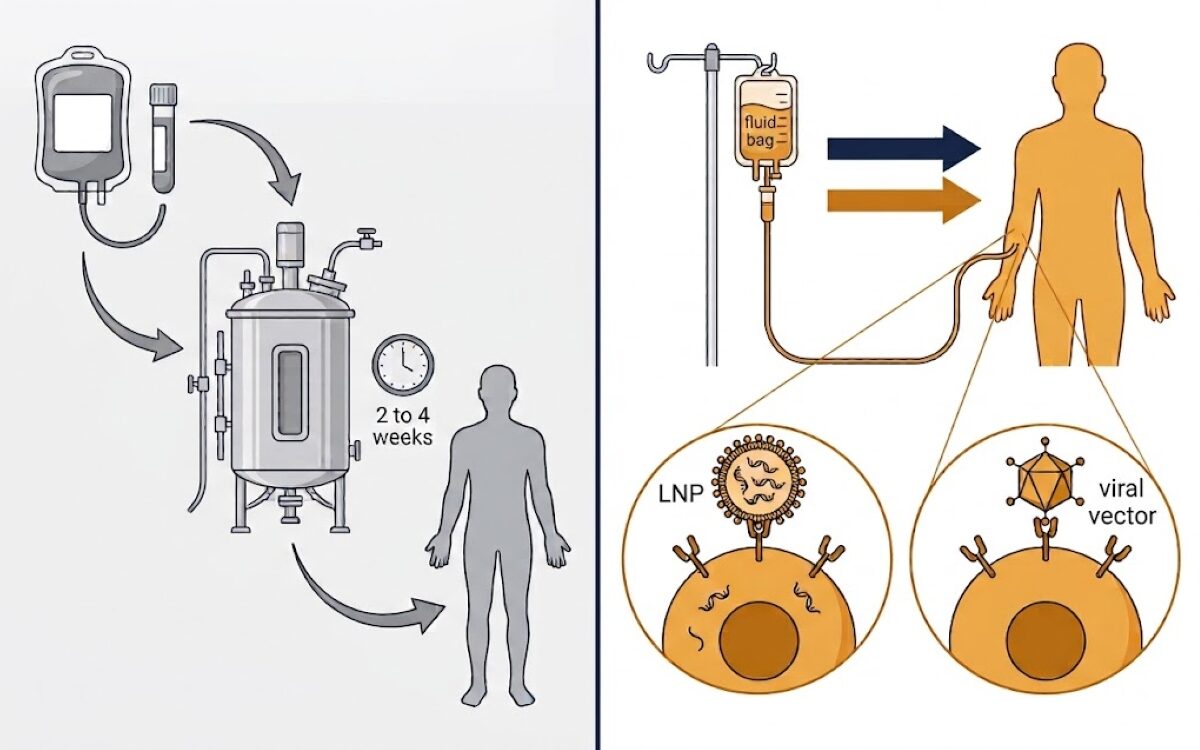
In vivo CAR-T therapy has travelled from laboratory concept to clinical reality faster than almost any modality in recent memory. Conventional cell therapy collects a patient’s T cells, engineers them in a specialist facility and returns them weeks later. The in vivo approach inverts that sequence. A single infusion delivers the genetic instructions directly into the bloodstream, and the body manufactures its own chimeric antigen receptor T cells. Within roughly eighteen months the field has attracted more than $10 billion in announced acquisitions, measured on headline deal values including contingent milestones. It has also produced its first substantial efficacy datasets and recorded its first serious safety warning.
Why the ex vivo model reached its limits
Seven CAR-T products had been approved by the United States Food and Drug Administration as of March 2026, and that remains the position today. Their impact in relapsed B-cell malignancies and multiple myeloma is not in dispute. The delivery model is another matter. Conventional autologous therapy requires leukapheresis, transport to a manufacturing site, genetic modification, cell expansion, release testing and reinfusion. That sequence typically consumes several weeks. Patients must also receive lymphodepleting chemotherapy beforehand, which limits eligibility to those well enough to tolerate it.
Infrastructure adds a further constraint. In England, CAR-T remains a directly commissioned specialised service. It is delivered through a small number of haematology and transplant units accredited to FACT-JACIE standards, a structure set out in NHS England’s service specification published in April 2026. Vein-to-vein time, centre capacity and cost have therefore shaped who actually receives these therapies, rather than clinical need alone.
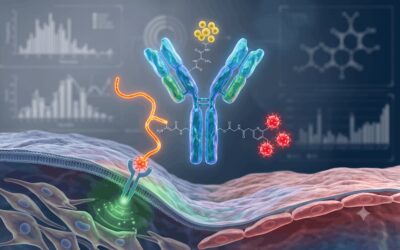
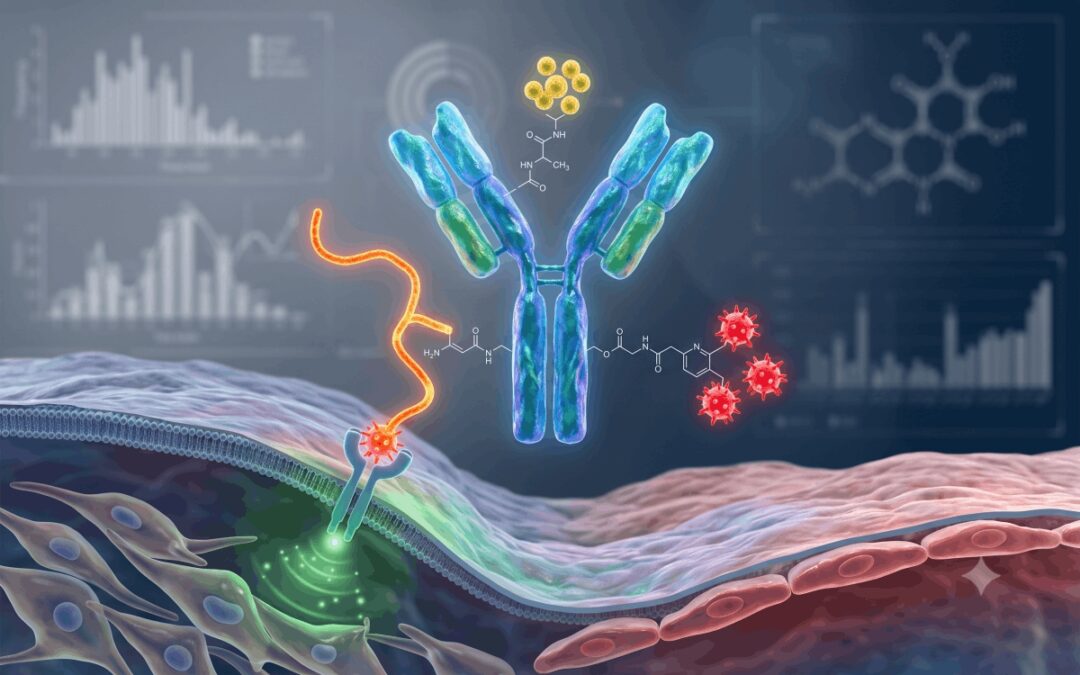
The in vivo route attempts to remove that chain entirely. A single intravenous infusion carries a targeting vector that binds a receptor on circulating T cells, commonly CD3, CD5, CD7 or CD8, and delivers a CAR-encoding payload. The patient’s own body performs the engineering step.
Two in vivo CAR-T platforms, two risk profiles
The field has split into two technological camps. The distinction matters clinically as much as commercially.
Lentiviral platforms integrate the CAR gene into the T cell genome, producing durable expression from a single dose. Kelonia Therapeutics, Umoja Biopharma, Interius BioTherapeutics and EsoBiotec all pursue variants of this approach. Integration raises the familiar gene therapy questions of insertional mutagenesis, and it mandates long-term patient follow-up.
Targeted lipid nanoparticles take the opposite route. They deliver messenger RNA encoding the CAR, producing transient, non-integrating expression that decays over days. Capstan Therapeutics is the leading example. The trade-off is straightforward. Tunable, repeatable dosing with no permanent genomic change comes at the cost of any guarantee of persistence.
Kelonia’s myeloma data set an early benchmark
Kelonia Therapeutics has reported the most substantial dataset in the field so far. Its candidate KLN-1010 uses an engineered lentiviral particle system, branded iGPS, to generate anti-BCMA CAR-T cells inside patients with relapsed and refractory multiple myeloma.
First-in-human results from the inMMyCAR study (NCT07075185) were presented in a late-breaking session at the American Society of Hematology annual meeting in December 2025. That readout covered the first four patients dosed. At the 2026 American Society of Clinical Oncology annual meeting on 31 May, Kelonia reported on 18 patients. According to the company, all evaluable patients achieved an objective response and MRD-negative bone marrow at one month. Among six patients with at least four months of follow-up, four reached a stringent complete response and two a very good partial response. All maintained MRD-negative marrows. The first patient treated remained in a deep, ongoing MRD-negative response beyond 10 months. Median time from consent to infusion was 13 days.
Kelonia described the safety profile as consistent with outpatient administration. Sixteen of the 18 patients developed cytokine release syndrome, all grade 1 or 2. There were two neurotoxicity events, one grade 1 and one grade 3, the latter resolving within three days. The study’s safety review committee subsequently approved outpatient infusion, a meaningful departure from current cell therapy practice.
Reporting the earlier ASH data, Professor Phoebe Joy Ho of the University of Sydney and Royal Prince Alfred Hospital said the trial had shown that “lymphodepletion is not required for in vivo CAR T-cell generation and expansion in the peripheral blood”. KLN-1010 holds FDA Fast Track designation.
A cautionary signal from ESO-T01
The counterweight arrived in March 2026. Nature Medicine published a phase 1 study of ESO-T01, the BCMA-directed candidate AstraZeneca obtained through its acquisition of Belgium’s EsoBiotec, announced in March 2025 for $425 million upfront and up to $575 million in milestones.
The single-arm trial (NCT06791681) ran at Tongji Hospital in Wuhan. It was an investigator-initiated study funded by Chinese national and provincial research grants, with EsoBiotec supplying the vector and technical input rather than sponsoring the trial. It enrolled five heavily pretreated men with a median of three prior lines of therapy. Each received one intravenous infusion of a nanobody-directed, immune-shielded lentiviral vector, without leukapheresis or lymphodepletion. Four of five achieved objective responses, including three stringent complete remissions. All four evaluable responders were MRD-negative at a sensitivity of 10−5 by day 60.
The safety picture was less encouraging. All five patients developed grade 3 or higher adverse events, although investigators recorded no dose-limiting toxicities. Cytokine release syndrome occurred in four patients, three of them grade 3, and was managed with corticosteroids, tocilizumab or supportive care. The most frequent toxicities were transient cytopenias and reversible liver enzyme elevations. One patient developed grade 1 neurotoxicity and died from spinal cord compression related to extramedullary disease.
The investigators described a biphasic pattern of immune toxicity, with one patient developing grade 3 cytokine release syndrome within two hours of infusion. Off-target transduction of non-T-cell lineages remained minimal, with CAR-positive non-T cells below 1% at peak expansion. Enrolment was stopped early in 2025 and no further patients were treated.
The two datasets should not be read as a direct comparison. The trials differ in vector design, dose, patient population and geography, and neither has been assessed against the other.
In vivo CAR-T therapy moves into autoimmune disease
Oncology is not the only destination. B-cell depletion using CD19-directed cell therapy has produced striking results in lupus and other autoimmune conditions. Ex vivo logistics, however, make it impractical for large patient populations.
Capstan Therapeutics is developing CPTX2309, a targeted lipid nanoparticle carrying anti-CD19 CAR mRNA to CD8-expressing T cells. The candidate entered a phase 1 healthy volunteer study in Australia in June 2025 and has since moved into phase 1 development in systemic lupus erythematosus and rheumatoid arthritis. Announcing that first trial, Capstan’s then chief medical officer Ramin Farzaneh-Far described the goal as an “immune reset through rapid and profound B cell depletion”, achieved without lymphodepletion or permanent genomic integration. AbbVie acquired Capstan in 2025 for up to $2.1 billion. Announcing the deal, Capstan Chief Executive Laura Shawver called the approach “a potential new treatment modality in medicine”.
Regulators are laying the groundwork in parallel. The FDA’s Center for Biologics Evaluation and Research listed a new draft guidance on CAR-T development for non-oncology indications on its 2026 agenda.
A dealmaking wave with few targets left
Capital has moved faster than the in vivo CAR-T data. Gilead’s Kite division acquired Interius BioTherapeutics for $350 million in cash, closing in October 2025 and establishing an in vivo centre of excellence in Philadelphia. Kite followed with a separate agreement with Pregene Biopharma worth up to $1.6 billion. Bristol Myers Squibb agreed in October 2025 to buy Orbital Therapeutics for $1.5 billion in cash, gaining OTX-201, a preclinical circular RNA candidate aimed at autoimmune disease. Eli Lilly, which had already acquired Orna Therapeutics, agreed in April 2026 to acquire Kelonia for $3.25 billion upfront and up to $7 billion including milestones. Lilly confirmed in its second-quarter results that both transactions completed during the quarter.
Interius brought a lentiviral candidate, INT2104, encoding a CD20-directed CAR and already in phase 1 for relapsed or refractory B-cell malignancies. The company spun out of research at the University of Pennsylvania.
The wave has not finished. Johnson & Johnson announced in July 2026 a collaboration with Sail Biomedicines, paying $785 million upfront including a $465 million equity investment, with a further $140 million tied to development milestones and an exclusive option to acquire the company for $2.58 billion in total.
Umoja Biopharma is now among the few clinical-stage independents remaining. Its CD19-directed candidate UB-VV111 was, according to the company, the first therapy of its kind to receive FDA clearance to begin clinical study, in 2024. It received Fast Track designation in September 2025 for relapsed or refractory large B-cell lymphoma and chronic lymphocytic leukaemia after two or more prior lines. AbbVie holds an exclusive option over Umoja’s CD19 programmes.
Regulatory and access questions
Enthusiasm has not softened the evidentiary bar. Writing in JAMA, FDA officials including then biologics director Vinay Prasad indicated that future approvals should generally rest on randomised evidence of superiority against a standard-of-care control. That marks a shift from the single-arm trials that supported all seven approved products, and it applies to in vivo candidates as much as to conventional ones. Prasad left the agency at the end of April 2026, and whether the position holds under new leadership at the Center for Biologics Evaluation and Research is not yet clear.
The United Kingdom is positioning itself as a location for the trials that follow. New clinical trial regulations from the MHRA and the Health Research Authority came into force on 28 April 2026, introducing risk-proportionate approval routes and a statutory pathway for protocol modifications. For a modality that dispenses with apheresis suites and manufacturing slots, faster study set-up is a material advantage.
The standard sits awkwardly with a field whose current datasets number in the dozens of patients. Durability is the central unknown. Persistence of the CAR-T cells generated inside the body, resistance through BCMA or CD19 antigen escape, and long-term vector safety will all take years to characterise properly. That caution sits against the wider read-out season captured in our coverage of the ASCO 2026 cancer trial results, where a run of practice-changing datasets arrived across several tumour types.
Access economics may prove equally decisive. If outpatient infusion without lymphodepletion becomes routine, these therapies could reach far beyond the accredited transplant centres that currently define the geography of cell therapy. That is the prize the acquirers are paying for. Whether the safety profile permits it remains the open question.