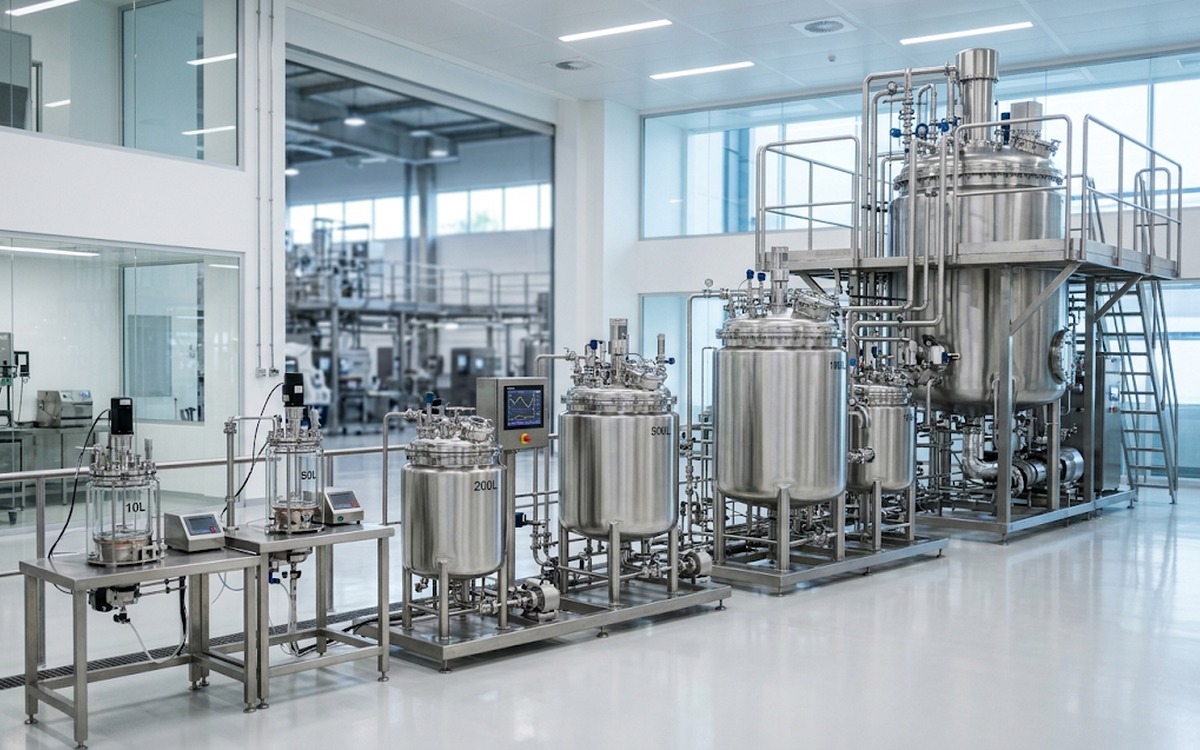
Scientific breakthroughs get attention for good reason. They are the moments when something that did not exist before suddenly becomes possible. But anyone who has spent time trying to commercialize biotechnology learns another lesson pretty quickly: proving that something can work is very different from proving that it can be manufactured reliably, repeatedly and at a scale the market can support. That gap is the central challenge of biomanufacturing scale-up.
A successful experiment might demonstrate that an organism can produce a desired protein, material or compound. Commercial manufacturing asks a much tougher set of questions. Can you do it again? Can you increase output without sacrificing quality? Can you control the process well enough that customers know what they are going to receive? That transition from scientific success to dependable production is one of the defining challenges in biomanufacturing.
I have spent more than two decades working with recombinant spider silk, and that experience has made one thing very clear to me. The breakthrough matters tremendously, but it is the beginning of the commercialization process, not the end.
A Breakthrough Creates The Opportunity
It is easy, especially from the outside, to look at a scientific breakthrough as the hardest part of developing a new biotechnology, and sometimes it is. Without the underlying science, there is nothing to scale. The ability to engineer an organism to produce something new is what creates the opportunity in the first place. But once that science works, the nature of the challenge begins to change.
A process that succeeds under carefully controlled laboratory conditions now has to perform across repeated production cycles. More material has to be produced. More variables enter the system. Quality has to remain within acceptable parameters, and inputs, equipment, people and procedures all have to work together. This is when relatively small issues can become much larger ones.
Something that has little effect on a laboratory experiment can have a meaningful impact when repeated thousands or millions of times. A minor change in an environmental condition, biological input or production step can influence yield or quality. Scale has a way of exposing everything you do not yet understand about a process.
Consistency Matters As Much As Output
One of the natural instincts in biomanufacturing scale-up is to focus on yield and ask how much the system can produce. That is obviously important. Commercial economics depend in part on producing enough material to satisfy demand at a cost the market can support. But yield by itself does not tell you whether you have a viable manufacturing process.
If one production cycle generates an exceptional result and the next three do not, the high number from that first cycle does not help very much. Commercial customers need predictability. They need confidence that the material produced next month will meet the same requirements as the material produced this month. That means consistency becomes just as important as increasing output.
With biological systems, achieving that consistency takes work because biology naturally contains variation. Genetics, environmental conditions, nutrition or feedstocks, disease, handling and timing can all influence production, depending on the system being used. The goal is not to eliminate every source of variation. It is to understand which variables matter most, how they affect the process and how tightly they need to be controlled. That knowledge develops over time, and every production cycle adds to it.
You Have To Understand The Entire System
My experience with recombinant spider silk has reinforced this broader lesson. Solving the scientific problem is only one part of the challenge. Moving from small-scale success to a repeatable production platform requires a much wider understanding of the biological and operational system.
With any living production platform, that can mean managing factors well beyond the underlying genetics, including nutrition or feedstocks, environmental conditions, disease management and quality control. The specific variables will differ from one technology to another, but the larger lesson is the same: commercialization requires understanding the entire system around the science.
A company may have world-class molecular biology, but if its production process is inconsistent, its supply chain is unreliable or its quality controls are inadequate, the underlying innovation will have a difficult time reaching the market. Biomanufacturing is rarely one technology. It is a collection of technologies, processes and disciplines that all have to work together.
Quality Cannot Be Added At The End
Quality control also changes as production grows. During early development, the basic question may be whether the process produced what researchers intended. Commercial manufacturing requires a much deeper understanding. What does acceptable output look like? How much variation can be tolerated? Which characteristics need to be measured during production rather than after it? At what point does a change indicate a genuine problem? Those questions have to be answered through data.
Just as importantly, quality cannot simply be checked after production is finished. By then, considerable time and resources may already have gone into a batch or production cycle. The better approach is to build quality into the process from the beginning.
That means identifying the points most likely to influence the final product and creating controls around them. It means knowing which variables matter most and monitoring them closely. It also means documenting results well enough to recognize trends before they become larger problems. The objective is not simply to catch failure. It is to make success repeatable.
Commercial Readiness Is Not One Milestone
There is a tendency to talk about commercialization as though there is a clear line between research and commercial production. In my experience, there rarely is. Commercial readiness develops gradually, through repeated refinement of the production process, quality systems and overall operations. Each cycle tends to reveal something new that can be improved. That may not sound as exciting as a single scientific breakthrough, but it is how difficult technologies become manufacturable.
The same principle applies to the operational side of the business. As production scales, processes have to become more standardized, teams need clear procedures, and the supporting infrastructure has to work reliably from one cycle to the next.
At smaller scale, experienced people can sometimes compensate for gaps through judgment and individual expertise. At commercial scale, that knowledge has to be built into the system itself.
Biomanufacturing Scale-Up Is A Learning Process
One of the most useful ways to think about biomanufacturing scale-up is as a process of learning. Every production cycle produces more than product. It also produces information about where variability enters the system, which improvements actually increase output, whether those changes create unintended problems elsewhere and which quality measurements are most useful. Over time, those lessons accumulate.
This is why successful biomanufacturing scale-up is rarely the result of one breakthrough. More often, it is the result of hundreds of improvements working together. Many of those improvements are small. They may never generate headlines or attract much attention outside the organization. But collectively, they are what transform a promising scientific platform into a dependable manufacturing operation.
That is also why scale-up rarely follows a straight line. Some changes improve yield but create problems somewhere else. Others simplify the process but reveal a new bottleneck downstream. Progress comes from understanding those tradeoffs and continuing to refine the system.
The organizations that do this well are not simply producing more. They are learning more about their process with every cycle.
From Scientific Success To Commercial Reality
Biotechnology continues to give us new ways to make medicines, materials, chemicals and other products that would have been difficult to imagine a generation ago. The science behind those advances deserves the excitement it receives. But as more biological technologies move beyond research, the next challenge is becoming just as important: learning how to manufacture them reliably.
That means improving yield while maintaining consistency, managing biological variability, building quality into the process from the start, and creating operations that can reliably reproduce the same result over time. The breakthrough makes a new technology possible. Reliable manufacturing is what makes it useful. Ultimately, that is what turns scientific innovation into commercial reality.
Author Bio