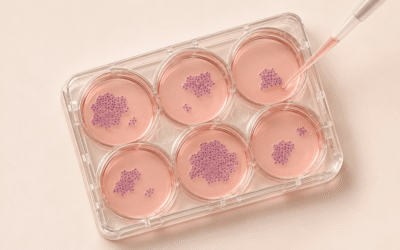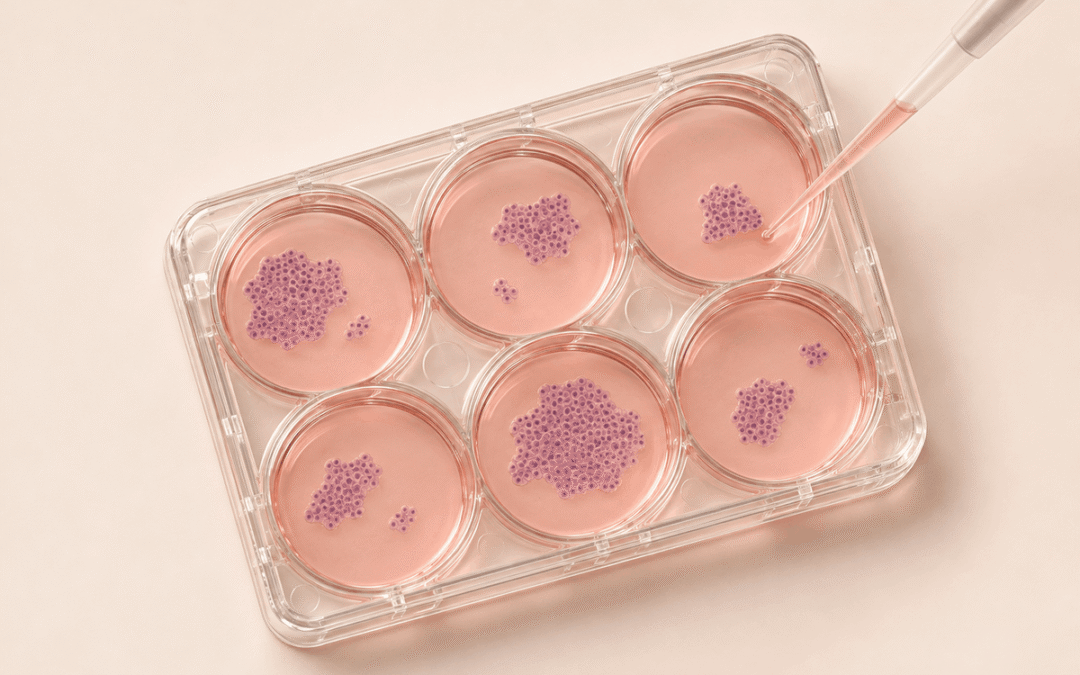
During a lab internship, I spent three months counting cells under a microscope. One slide at a time, one cell at a time. Today a trained model can do that counting in seconds, and that speed raises a question about the environmental cost of AI.
That is the promise of machine learning in life science. It reads genomes, predicts the shapes of proteins and helps design new medicines. But a quiet worry holds many researchers back: what is all this computing doing to the planet?
It is a fair question, and the honest answer is more interesting than either the hype or the fear.
First, the big picture
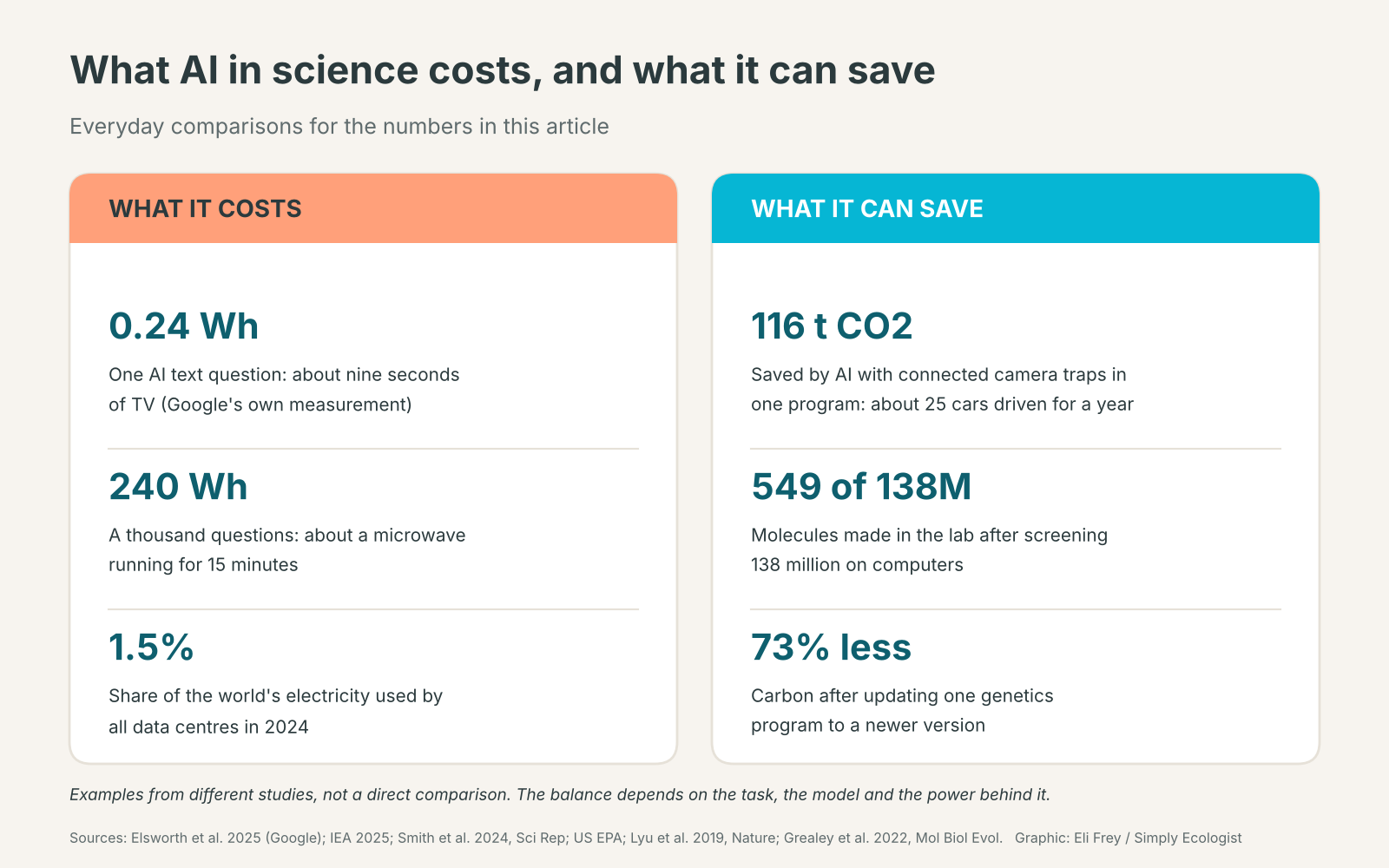
Data centres, the buildings full of computers that run the cloud and AI, used about 415 TWh of electricity in 2024, roughly 1.5% of the world’s total [1]. The International Energy Agency (IEA) expects that to more than double by 2030, to around 945 TWh, about as much electricity as all of Japan uses in a year, with AI as the main driver [1].
That growth is real. Yet the IEA concludes that fears of AI speeding up climate change appear overstated, because AI used to save energy elsewhere could cut more emissions than data centres add [1]. The honest twist: even those savings fall far short of what climate goals need [1]. AI is not the villain, and it is not the rescue.
For a lab, the better question is smaller: what does our own computing cost, and what does it save?
What one AI question really costs
In August 2025, Google reported that a median text prompt to its Gemini app used about 0.24 Wh of energy, 0.03 g of CO2e and 0.26 mL of water, roughly nine seconds of television and five drops of water [2]. Even a thousand such questions add up to about 240 Wh, roughly a 1,000-watt microwave running for 15 minutes.
These are company-reported figures, so read them carefully. They cover answering text prompts in Google’s own data centres, including idle machines and building overhead, but leave out model training, networks and your own device [2]. The water counts data centre cooling only. Nothing here covers images, video, long reasoning tasks or other companies’ models, and earlier outside estimates for one chat prompt ranged from about 0.3 Wh to nearly 7 Wh [2].
One question is small. For the environmental cost of AI, what you ask it to do matters far more.
Myth: all AI costs the same
An independent team from Hugging Face and Carnegie Mellon University tested 88 models on ten tasks [3]. Models that generate new text or images used orders of magnitude more energy than small models built for one job, even at the same size [3]. Sorting was cheap. Creating was expensive.
That is good news for biology, because so much of our work is sorting. Is this variant harmful? Will this molecule bind its target? Is this cell healthy? A small model trained for that one question often answers it for a fraction of the energy a chatbot would use.
Genomics: measure, update, reuse
Genomics ran on heavy computing long before chatbots. Using the free Green Algorithms calculator [4], researchers measured the carbon cost of everyday analyses, from genome-wide association studies to genome assembly and metagenomics [5]. Their findings read like a household energy audit:
- Updating one popular genetics program to a newer version cut the footprint of a large analysis by 73% [5].
- Faster processors or more cores finished jobs sooner, but could raise total emissions [5].
- Reserving more memory than a job needed added to its footprint, like heating rooms nobody uses [5].
- Moving the same work to a more efficient data centre cut emissions by about a third [5].
Reuse saves even more. AlphaMissense, a model published in Science in 2023, scored all 71 million possible DNA changes that swap one amino acid in a human protein for another [6]. It labelled 89% of them as likely harmful or likely benign, while human experts had confirmed only about 0.1% [6]. A clinical lab facing an unfamiliar variant can look up a shared score instead of computing it again. These are predictions, not diagnoses, but they show where to look first.
Drug discovery: fewer flasks, fewer failures
Wet labs are energy-hungry places. Research labs use 3 to 10 times more energy per square metre than offices [7], with fume hoods, freezers and climate control running around the clock. When computing replaces an experiment, it usually replaces something far more costly than itself.
Computers began changing this even before modern AI. In a 2019 Nature study, scientists screened more than 138 million virtual molecules against a brain receptor called D4 [8]. They made and tested only 549 in the lab, and about one in four bound the receptor [8]. AI now supplies target structures too: the free AlphaFold database holds predicted protein structures for over 214 million sequences, so teams can download a structure instead of predicting it again [9].
Early clinical results are promising. An analysis of AI-discovered drugs found that 80 to 90% passed Phase I safety trials, against a historical 40 to 65% [10]. In Phase II, about 40% succeeded, similar to the industry average [10]. The honest caveat: the sample is small and the analysis comes from BCG consultants, so these numbers will shift as more AI-designed drugs reach trials.
Every failed trial and every batch of compounds made for nothing carries its own footprint: chemicals, shipping, energy and years of people’s work. Avoiding even part of that can repay the computing many times over.
A lesson from the field
I learned this lesson outdoors. Camera traps are motion-triggered cameras that photograph animals when no one is watching, and in remote areas someone has to drive out again and again to swap memory cards. I have used camera trap AI such as MegaDetector on my own survey images.
A 2024 study in Scientific Reports measured this in an Australian feral cat eradication programme [11]. AI identification alone saved about US$0.27 million. Paired with cameras that sent photos over the mobile network, savings rose to US$2.15 million and about 116 tonnes of carbon emissions [11], roughly what 25 typical cars emit in a year of driving [14].
The twist: most of the carbon saving came not from the AI reading photos, but from trips nobody had to drive. Drug discovery works the same way. The biggest savings come from the experiments, shipments and trials that never have to happen.
Six ways labs can keep AI’s footprint small
- Measure it. Estimate jobs with Green Algorithms [4] or CodeCarbon, and report the footprint with your methods, as the GREENER principles suggest [12].
- Pick the smallest model that works. Use task-specific models for classification and prediction, and save large generative models for work that needs them [3].
- Keep software current and right sized. Update your tools and request only the memory and cores a job needs [5].
- Choose where and when. Efficient data centres and cleaner grids lower emissions [5], and jobs that can wait can run when the grid is cleaner [13].
- Reuse and share. Start from public structures, variant scores and pretrained models, and publish your own [6, 9].
- Count the savings. When AI prevents a failed experiment, a compound synthesis or a field trip, put it on the scale [8, 11].
The real answer
So, is AI bad for the planet? The environmental cost of AI depends on the task, the model, the hardware and the power behind it. One text question is small, generating content costs far more than classifying it, and well-designed AI can give back more than it takes when it changes the workflow around it.
For life science, the goal is not to fear AI. It is to use it the way a good biologist uses a precious sample: on purpose, measured, and never wasted.
Author Bio