
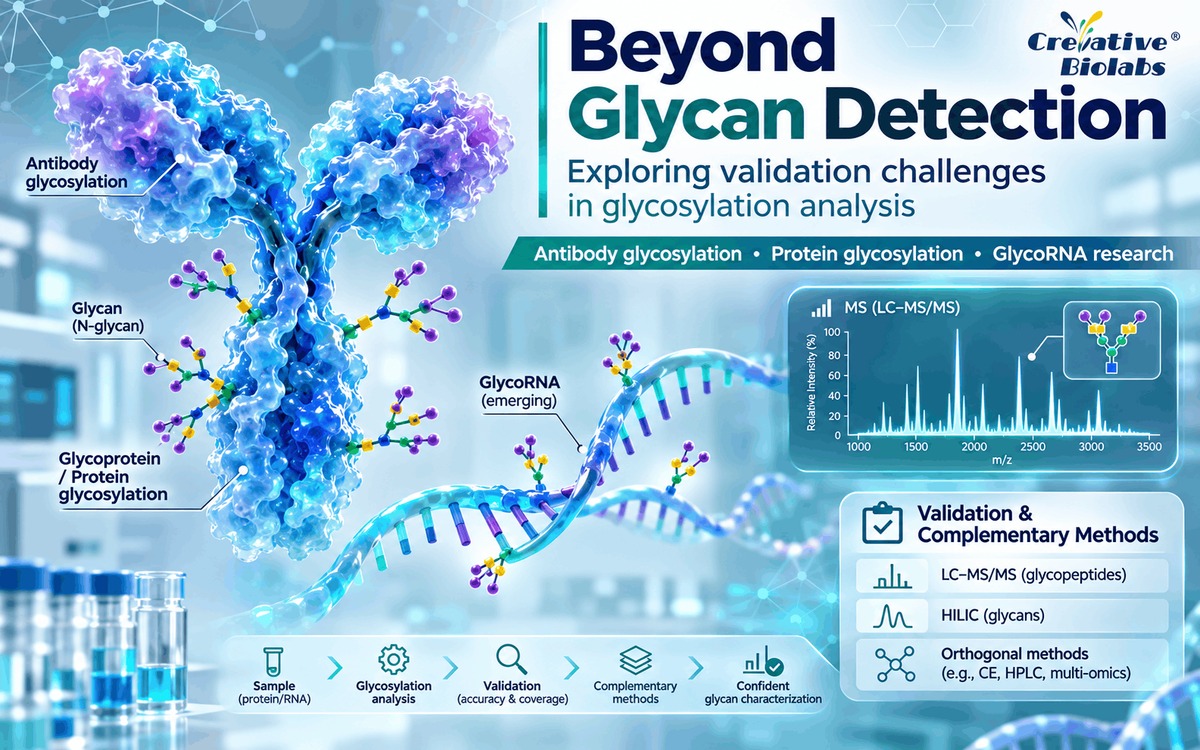
As glycobiology expands beyond established glycoprotein characterization to less extensively understood glycoconjugates, interpreting experimental signals in glycosylation analysis becomes increasingly complex. Detecting a glycan-associated signal may be only the first step; identifying its molecular source, describing its structure, and assessing its biological relevance require different forms of evidence.
Creative Biolabs highlights these distinctions across antibody glycosylation analysis, protein glycosylation analysis, and exploratory glycoRNA research. An appropriate workflow starts with the research objective and sample characteristics, then selects complementary methods and controls that can support the intended conclusion.
Why Glycan Characterization Requires More Than One Measurement
Glycosylation creates molecular heterogeneity through differences in glycan composition, branching, linkage, and attachment sites. These variations may affect protein properties, but their significance depends on the molecule, biological context, and decision being made.
Mass spectrometry-based methods offer complementary views of glycan structure. Released-glycan profiling can describe glycan compositions and relative distributions across a sample, while glycopeptide analysis can add site-specific information. Additional separation, fragmentation, or targeted approaches may be needed to evaluate site occupancy or resolve structural isomers [1].
For research teams comparing candidates or production batches, the aim is not to run every available assay. It is to match analytical depth to the specific uncertainty that the results must address.
Antibody Glycosylation: Connecting Glycoforms with Functional Evidence
Antibody glycosylation illustrates why structural profiles and functional outcomes should not be treated as interchangeable.
Fc-associated glycans can influence interactions with immune effector receptors. For certain Fc-active IgG antibodies, reduced core fucosylation has been associated with stronger FcγRIIIa binding and increased antibody-dependent cellular cytotoxicity (ADCC).
In a 2021 Biotechnology and Bioengineering study, Zimmermann and colleagues used 5-Thio-L-Fucose to alter glycosylation during expression of therapeutic proteins in CHO cell systems. The effect varied by clone and protein; in a rituximab model, changes in fucosylation were accompanied by increased FcγRIIIa binding and ADCC reporter-assay responses [2].
These findings support a context-dependent structure-function relationship, not a universal prediction that a particular glycoform distribution will produce the same outcome for every antibody.
Creative Biolabs’ antibody glycosylation analysis service supports the characterization of antibody glycan profiles and glycosylation sites, including Fc and applicable Fab regions. Relevant outputs may include released-glycan distributions and site-specific glycopeptide information, selected to suit the study objective.
For antibody development projects, glycan profiling can reveal structural differences between candidates or production batches, while receptor-binding or other functionally relevant assays may be needed to determine whether those differences have meaningful biological consequences. The appropriate functional readout depends on the antibody mechanism; ADCC is not a necessary endpoint for every format, including Fc-silent designs.
Protein Glycosylation: Matching Analytical Depth to Research Objectives
Beyond antibodies, protein glycosylation matters in the study of receptors, enzymes, secreted proteins, and other biologically important molecules. N-linked and O-linked glycans can contribute to folding, stability, and molecular recognition, but the relevant analytical questions vary across protein classes and sample matrices.
Released-glycan analysis may be appropriate for comparing overall glycan distributions. When a study asks which sites carry particular glycans, or how occupancy and local heterogeneity differ, site-specific glycoproteomic methods may be more informative [1].
Through its protein glycosylation analysis service, Creative Biolabs provides project-specific support for N- and O-glycosylation characterization, including glycan profiling and modification-site analysis where appropriate.
A fit-for-purpose strategy helps researchers select measurements that answer their hypotheses, whether the priority is glycoform comparison, site-level characterization, or an investigation of possible structure-function relationships.
GlycoRNA Profiling: An Emerging Field with Important Validation Challenges
Reports of glycoRNAs have broadened interest in RNA-associated glycoconjugates, including candidates examined in cell-surface biology and molecular interactions. The field is developing, and the strength of evidence for a particular glycan-RNA relationship depends on the methods used in each study.
Published work describes glycan labeling, affinity enrichment, imaging, and mass spectrometry-based approaches to investigate these candidates. Reviews discuss both evidence for glycoRNA molecular species and hypotheses about their biological roles [3,4].
Interpreting an isolated signal still requires careful controls. In a 2025 Experimental & Molecular Medicine study, Kegel and colleagues identified glycoproteins, including LAMP1, that co-purified with small-RNA preparations. In their experimental workflow, some glycan-bearing material resisted RNase A/T1 treatment but was degraded by proteinase K under denaturing conditions, demonstrating that co-purifying proteins could contribute to detected signals [5].
This observation does not negate all other glycoRNA findings. Rather, it shows why results obtained with a particular isolation method should not be taken as definitive evidence of a direct covalent glycan-RNA linkage without appropriate molecular identification.
For glycoRNA investigations, three evidence levels should be considered separately: detection asks whether a glycan-associated signal is present; molecular identification asks what species carries the signal and whether a direct glycan-RNA linkage has been established; and functional validation asks whether the identified candidate contributes to a defined cellular process. Co-enrichment or co-localization alone does not establish covalent attachment, just as a correlated cellular response does not establish a mechanism. Where molecular identity remains uncertain, conclusions should describe the observed analytical association rather than a confirmed RNA modification.
For exploratory studies, Creative Biolabs also describes a glycoRNA profiling service that can be discussed in conjunction with enrichment, molecular characterization, and controls for RNA integrity, residual proteins, and sample-processing effects. The strength of any structural claim depends on the evidence obtained.
Orthogonal methods can strengthen interpretation, particularly when a study proposes a previously unconfirmed RNA-linked modification. Controls should be chosen to address the vulnerabilities of the actual purification and detection workflow.
From GlycoRNA Detection to Functional Investigation
Identifying a candidate molecular species and establishing what it does in a biological system are separate research objectives.
Functional studies may ask whether changes in a candidate glycoRNA-associated signal accompany a measurable cellular response. Such designs should also account for alternative explanations involving other RNA species, residual glycoproteins, and broader cellular perturbations.
Depending on the study model, endpoints might include cell-surface interactions, cellular adhesion, or other predefined responses. Independent measurements, appropriate negative and positive controls, and replication are important for distinguishing association from a supported mechanistic interpretation.
Creative Biolabs’ glycoRNA functional analysis service describes project-specific approaches involving the selection of suitable biological models, candidate detection or characterization, and functional readouts such as adhesion-related or cell-surface interaction assays when relevant. Study planning can incorporate controls for uncertain molecular identification and potential contributions from co-purifying components; assay feasibility depends on sample type and research objectives.
GlycoRNA-associated biomarkers and diagnostic uses remain investigational and would require further analytical, biological, and clinical validation.
Four Practical Questions for Glycosylation Research
Four questions can help research teams select an evidence strategy before committing samples and resources:
- What is the research objective? Glycan composition, modification site, molecular identity, and biological function require distinct forms of evidence.
- What could distort the signal? Consider co-purifying proteins, labeling efficiency, enzyme-treatment conditions, and sample handling.
- How can findings be cross-checked? Orthogonal methods, suitable controls, and replication can test competing explanations.
- What decision will the results inform? Define relevant endpoints and follow-up experiments before starting.
Explore Creative Biolabs’ Glycosylation Research Services
Creative Biolabs supports established antibody glycosylation analysis and protein glycosylation analysis through tailored analytical services, while offering exploratory support for emerging glycoRNA research. The appropriate evidence strategy depends on whether the question concerns glycan distribution, molecular identity, or biological function.
Researchers can discuss sample types, structural characterization goals, analytical limitations, controls, and the level of validation needed with Creative Biolabs’ technical team to identify feasible, project-specific research approaches.
Author Bio
Dr. Emily R. Coleman is a senior scientist at Creative Biolabs with a background in immunology, oncology research, and translational biotherapeutic development. Her work focuses on translating complex biological mechanisms into practical experimental strategies for next generation therapeutic discovery, with particular expertise in tumor immunology and antibody engineering.
At Creative Biolabs, she provides scientific insight across multiple R&D domains, including antibody discovery and development, gene and cell therapy research, and translational assay design. She is particularly focused on improving the connection between mechanistic biology and predictive preclinical models to support more effective therapeutic development across immune related disease areas.
About Creative Biolabs
Creative Biolabs provides customized biotechnology research services to pharmaceutical, biotechnology, and academic teams, including antibody and protein glycosylation characterization and exploratory glycoRNA research support.
Creative Biolabs’ products and services are intended for research use only and are not for diagnostic or therapeutic use.