

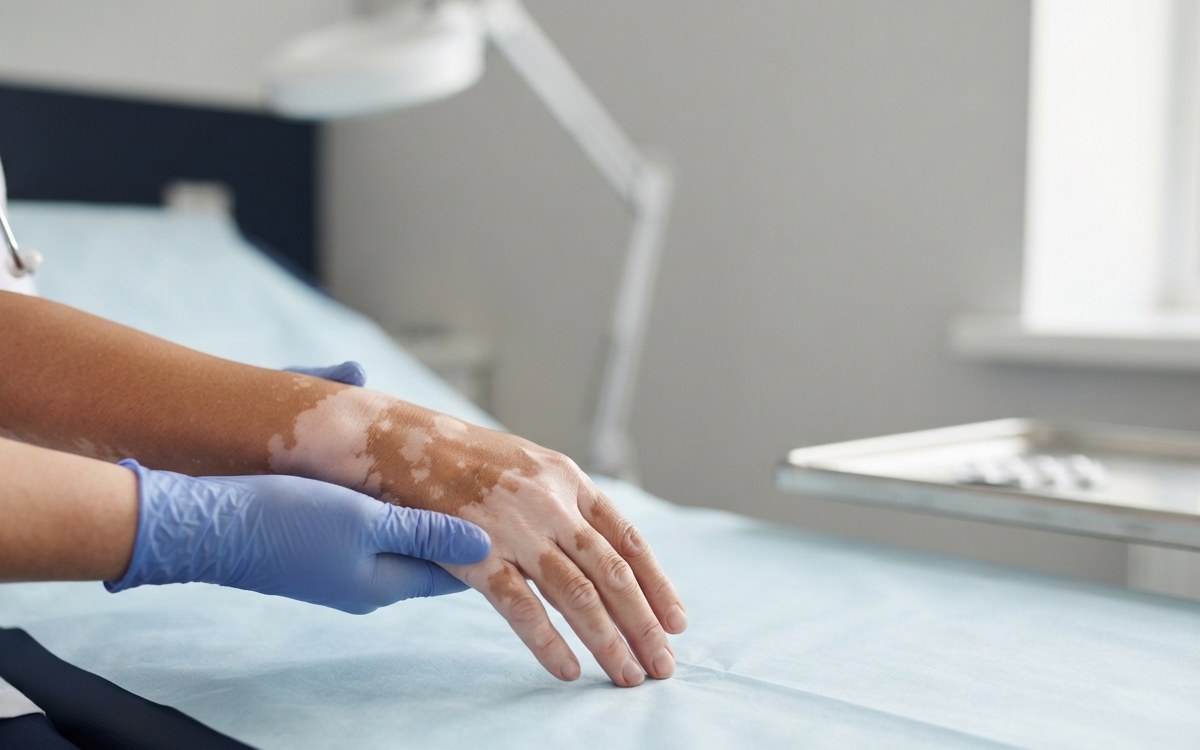
Rinvoq vitiligo treatment is now approved in the US for people aged 12 and over with non-segmental vitiligo. AbbVie announced the decision on 23 November 2026. The approved dose of upadacitinib is 15 mg, taken once daily as a tablet. The European Union approved the same use in July 2026. In the UK, however, the medicine’s product information did not list vitiligo when checked on 25 November 2026.
The answer for US patients therefore depends on age, vitiligo type and what other medicines they take. It also depends on how prescribers weigh a boxed warning that applies across the drug class.
Is Rinvoq approved for vitiligo?
Yes, in the US and the EU. In AbbVie’s approval announcement, the company called Rinvoq “the first and only FDA-approved systemic therapy for NSV in the U.S.” A search on 25 November 2026 found no separate FDA press announcement. The updated US prescribing information, revised in November 2026, carries the new indication in section 1.4.
Roopal Thakkar is AbbVie’s executive vice president, research and development, and chief scientific officer. In the company’s announcement, he spoke of “providing the first FDA-approved systemic treatment option for this immune-mediated disease.” AbbVie announced on 3 February 2026 that it had filed applications with the FDA and the European Medicines Agency.
Who can get Rinvoq vitiligo treatment in the US?
The Rinvoq vitiligo label wording is specific. The relevant text is section 1.4 of the US prescribing information. It covers “adults and pediatric patients 12 years of age and older with nonsegmental vitiligo.” It sets no requirement to try other treatments first. The Viti-Up trials enrolled a narrower group, according to AJMC. Patients needed failed topical therapy, actively progressing disease or a T-VASI of 10 or higher. The recommended dose for adults and adolescents is 15 mg once daily.
The label does, however, carry a limitation of use. Rinvoq is not recommended in combination with other JAK inhibitors or biologic immunomodulators. The same applies to use with other immunosuppressants. Patients on those therapies would therefore fall outside the recommended use.
Prescribers must also weigh the boxed warning. It covers serious infections, mortality, malignancies, major adverse cardiovascular events and thrombosis. The November 2026 label also lists an update to the boxed warning among its recent major changes.
What do the Viti-Up trials show?
The Rinvoq vitiligo approval rests on Viti-Up-1 and Viti-Up-2, two replicate Phase 3 studies (NCT06118411). They randomised 614 adults and adolescents 2:1 to upadacitinib 15 mg or placebo. Results were published in The Lancet in August 2026, with Thierry Passeron as first author. AbbVie funded the studies.
Both studies used two co-primary endpoints at week 48. F-VASI 75 means at least a 75 per cent reduction from baseline in the facial vitiligo score. T-VASI 50 means at least a 50 per cent reduction in the total body score.
In Viti-Up-1, 25.2 per cent of upadacitinib patients reached F-VASI 75, against 5.9 per cent on placebo. In Viti-Up-2, the figures were 23.4 and 6.9 per cent. For T-VASI 50, the rates were 19.4 versus 5.9 per cent in Viti-Up-1. They were 21.5 versus 5.9 per cent in Viti-Up-2. AbbVie reported a multiplicity-controlled p value of 0.001 or lower for F-VASI 75 in both studies.
Those results also show the limits of the effect. Roughly three in four treated patients did not reach F-VASI 75 by week 48. Pharmacy Times also reported no statistically significant difference from placebo on T-VASI 75, a stricter whole-body measure, at week 48.
Longer follow-up looks stronger, with caveats. Among patients who stayed on treatment, F-VASI 75 rates reached 55.1 and 47.4 per cent at week 76. AbbVie described these observed-case figures as descriptive. They cover only continuing patients, not the full randomised population.
Safety findings from the 48-week period
In the Rinvoq vitiligo trials, overall adverse events were more frequent on treatment. AJMC, reporting the Lancet paper, gave rates of 81 versus 60 per cent in Viti-Up-1. The Viti-Up-2 figures were 70 versus 62 per cent. Upper respiratory tract infection, acne, nasopharyngitis and headache were among the most common events. Herpes zoster affected about 2 per cent or fewer of upadacitinib patients in each study.
Serious events were less common. In Study 1, serious treatment-emergent adverse events affected 3.9 per cent on upadacitinib and 4 per cent on placebo. In Study 2, the rates were 2 and 1 per cent. AbbVie’s October 2025 topline release reported no adjudicated major adverse cardiovascular events or venous thromboembolism.
The same release recorded one malignancy on upadacitinib in Study 1, a genital neoplasm. Each placebo group also had one malignancy. There were no deaths on upadacitinib, and one death occurred in the Study 2 placebo group.
How does Rinvoq compare with Opzelura cream?
Rinvoq is not the first vitiligo medicine in its drug class. The FDA approved Incyte’s Opzelura (ruxolitinib) cream, also a JAK inhibitor, in July 2022. Incyte called Opzelura “the first and only FDA-approved treatment for repigmentation in patients with vitiligo.” It is applied twice daily to affected areas of up to 10 per cent of body surface area.
The main difference is the route. Opzelura is applied to the skin, while Rinvoq is a tablet that acts systemically. A tablet is not limited by treated body surface area. In contrast, it brings the class boxed warning into treatment decisions for a skin condition.
A search on 25 November 2026 found no head-to-head trial of the two medicines. Their pivotal trials also differed in design, so their response rates should not be compared directly.
Where does Rinvoq vitiligo access stand in the UK and EU?
The European Commission approved the Rinvoq vitiligo indication, AbbVie announced on 29 July 2026. That followed a positive CHMP opinion adopted on 25 June 2026. The EU wording is narrower than the US label. It covers adults and adolescents 12 and older “who are candidates for systemic therapy.”
In the UK, the picture is less advanced. The Rinvoq 15 mg summary of product characteristics on emc, last updated on 22 June 2026, lists no vitiligo indication. That was the position when checked on 25 November 2026. A search the same day found no announced MHRA decision on the indication.
The UK product information also restricts use in three groups. For them, it says upadacitinib “should only be used if no suitable treatment alternatives are available.” These are patients aged 65 and over, those with cardiovascular risk factors and those with malignancy risk factors. Current or past long-time smokers are named as an example of cardiovascular risk.
There is one UK regulatory marker. The MHRA has agreed a paediatric investigation plan for upadacitinib in non-segmental vitiligo, held by AbbVie Ltd. A modification decision dated 5 December 2025 covers ages 6 to under 18, with completion set for 31 August 2029.
For NHS patients, the reference point remains the cream. In NICE guidance TA1140, published in March 2026, ruxolitinib cream is an option for non-segmental vitiligo with facial involvement. It applies to people 12 and over when topical first-line treatments have not worked or are not suitable. A search on 25 November 2026 found no NICE appraisal of upadacitinib for vitiligo.
What would settle the open questions?
Several questions remain unanswered for now. A search on 25 November 2026 found no public AbbVie statement on a UK filing for the vitiligo indication. An MHRA decision and a NICE appraisal would settle UK access.
In the US, the next markers are payer coverage decisions and prescribing patterns under the boxed warning. Longer-term safety data from continuing patients will also matter. AbbVie’s October 2026 release described long-term safety as consistent with the known profile and gave no figures.
The decision adds to a run of JAK-class approvals in immune-mediated disease, including the August 2026 brepocitinib dermatomyositis approval. Other recent outcomes are listed in the FDA drug approval decisions tracker.