

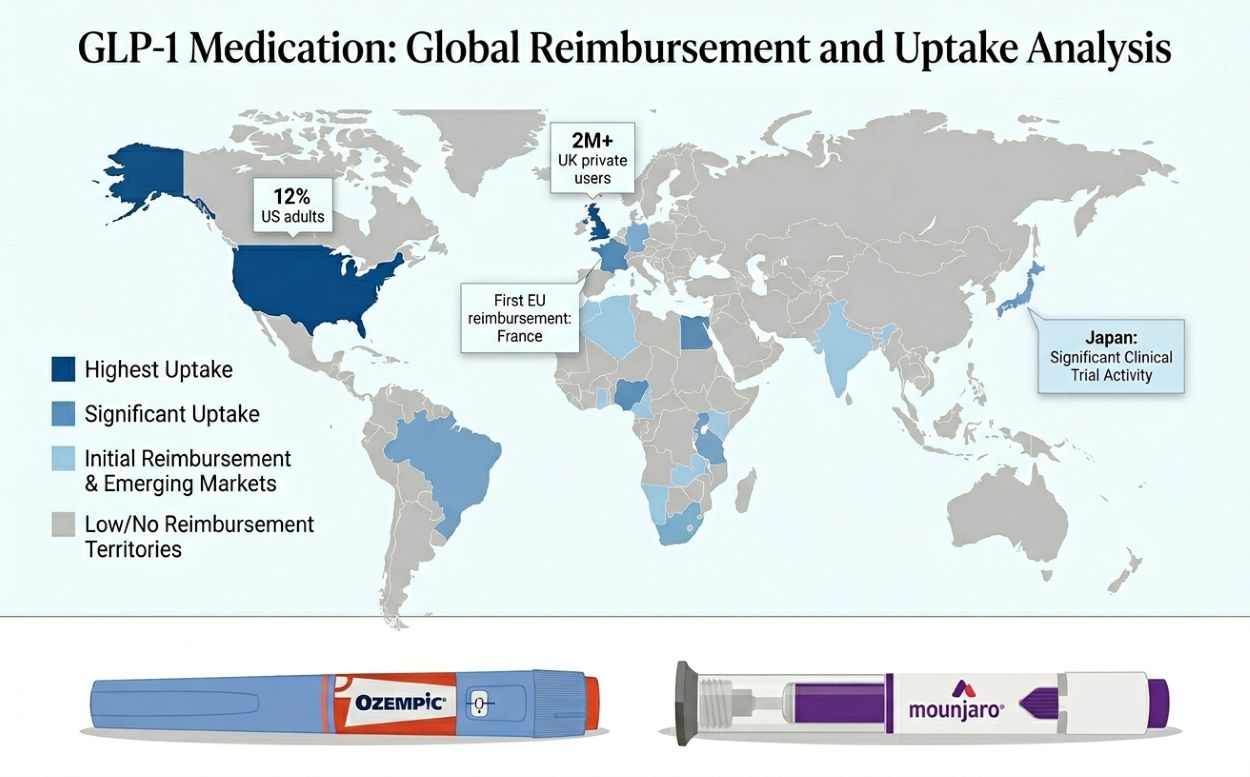
The global market for glucagon-like peptide-1 (GLP-1) receptor agonists has entered a new phase. What began as a breakthrough in type 2 diabetes management has become one of the defining pharmaceutical stories of the decade. In 2025, the GLP-1 receptor agonist market was valued at $66.4 billion and is projected to grow to $82 billion in 2026. GLP-1 uptake by country, however, is anything but uniform. Reimbursement policies, pricing pressures, supply chain dynamics, and cultural attitudes to obesity are producing starkly different patterns of access across the world’s major markets.
Ozempic (semaglutide, Novo Nordisk) and Mounjaro (tirzepatide, Eli Lilly) sit at the heart of that story. Together with their obesity-labelled counterparts Wegovy and Zepbound, they generated combined revenues of approximately $69.5 billion in 2025. The pipeline of next-generation treatments is advancing rapidly: Novo Nordisk’s CagriSema, a fixed-dose combination of semaglutide and the amylin analogue cagrilintide, has an FDA decision expected in late 2026 and could further accelerate the market. Yet in some countries these medicines are freely prescribed, generously reimbursed, and actively promoted as chronic disease treatments. In others, they remain the preserve of patients able to pay several hundred dollars a month out of pocket. Understanding where GLP-1 uptake is booming, where it is stalling, and why, offers important insight into how the obesity treatment revolution is reshaping global healthcare systems.
The United States: The Undisputed GLP-1 Leader
No country comes close to the United States in volume or intensity of GLP-1 uptake. In mid to late 2025, around 12.4% of US adults reported taking a GLP-1 medicine specifically for weight loss, up from 5.8% in February 2024, according to Gallup survey data of more than 15,000 adults. Separate estimates suggest around 10 million Americans were on GLP-1 treatment in 2025, with JP Morgan projecting 25 million by 2030.
Tirzepatide (Mounjaro and Zepbound) has outpaced expectations in the US market. According to the Evaluate consultancy’s 2026 Preview report, Mounjaro and Zepbound are projected to collectively generate more than $45 billion in global sales in 2026, overtaking Merck’s Keytruda to become the world’s best-selling drug. Ozempic and Wegovy are expected to bring in a combined $34.8 billion over the same period. The US market is also witnessing a pivotal affordability shift. A GLP-1 Medicare Bridge programme launching on 1 July 2026 aims to set a net price of $245 per 30-day supply for participating manufacturers, representing a significant step toward broader access. Despite high demand, Americans still pay two to four times more for these drugs than patients in Europe, with significant out-of-pocket costs remaining a barrier for many without insurance coverage.
The United Kingdom: Europe’s Largest Anti-Obesity Medicines Market
The United Kingdom has emerged as the largest anti-obesity medication market in Europe, driven almost entirely by private spending. A 2026 UCL study published in BMC Medicine found that around 1.6 million adults in England, Wales, and Scotland used a GLP-1 weight-loss drug in the year to early 2025. IQVIA prescription data put ongoing users at approximately 1.5 million in March 2025 alone, rising to over 2 million paying privately by July 2025.
What makes the UK story distinctive is the dominance of Mounjaro. According to the UCL study, four out of every five people taking a GLP-1 medicine for weight loss in the UK were on tirzepatide. That figure reflects both the drug’s superior efficacy data and aggressive commercial uptake through private channels, at a time when NHS access has been severely rationed. As of July 2025, IQVIA estimated more than 2 million UK adults were paying out of pocket for anti-obesity medications, against approximately 220,000 receiving them through the NHS: a ratio of around nine to one.
NHS access began in specialist weight management services from June 2025 for the highest-need patients, with tirzepatide prescribing incorporated into the GP Quality and Outcomes Framework from April 2026. A phased rollout is expected to extend eligibility progressively through June 2026 and March 2027. The private market was shaken in September 2025 when Eli Lilly implemented a UK-wide list price increase of up to 170% for privately purchased Mounjaro, a move that coincided with broader US administration pressure on pharmaceutical companies to raise prices in international markets. IQVIA estimates the UK will be a market of over £2 billion for GLP-1 treatments by the end of 2025, irrespective of that price shock.
France: The EU’s Reimbursement Pioneer
Across the Channel, a landmark policy decision has redrawn Europe’s GLP-1 landscape. On 28 May 2026, France’s Health Ministry confirmed that Wegovy and Mounjaro would be covered by the French national health insurance system from 15 June 2026, making France the first country in the European Union to reimburse GLP-1 receptor agonists for obesity. The drugs are reimbursed at 65%, bringing the monthly cost to patients to approximately €105, against a negotiated pharmacy price of around €300 per month.
The decision followed an 18-month process involving the Haute Autorité de Santé (HAS), price negotiations with the Comité Économique des Produits de Santé (CEPS), and ministerial confirmation. Eligibility is restricted to adults with a BMI of at least 35 kg/m² and at least one weight-related comorbidity, or a BMI of 40 or above, who have not achieved meaningful weight loss through nutritional management, and who are under specialist supervision with a lifestyle programme. France’s minister of health, Stéphanie Rist, said the annual public cost at full rollout would be “around one hundred million euros”. As of January 2026, more than 70,000 patients were already being treated with Mounjaro in France without reimbursement, illustrating the scale of suppressed demand now set to be released.
France’s decision carries significance beyond its own borders. As one health policy analysis described it, three institutions: clinical assessment, economic negotiation, and ministerial confirmation, aligned across 18 months to produce permanent structural reimbursement of the most commercially significant drug class of the decade. Whether other EU member states follow France will be one of the defining access questions in pharmaceutical policy over the next two years.
Germany: Coverage for Diabetes, Not Obesity
Germany presents a contrasting picture. Under the gesetzliche Krankenversicherung (GKV) public insurance system, GLP-1 medicines including Ozempic are covered when prescribed for type 2 diabetes. For obesity as a standalone indication, however, patients must generally fund treatment themselves, with only a limited exception for those with obesity and serious cardiovascular risk. Wegovy is generally available only through private practitioners, and the GKV does not reimburse it for weight management. That said, Germany remains deeply engaged with GLP-1 research, accounting for 12.4% of all global GLP-1 clinical trial activity in 2025, according to GlobalData’s trials database.
India, China, and Brazil: The Generic Inflection Point
India represents one of the most significant emerging frontiers for GLP-1 uptake. Eli Lilly launched Mounjaro in India in March 2025, followed by Novo Nordisk’s Wegovy in June 2025. At a monthly cost of approximately INR 14,000 to INR 17,500 (around $168 to $210), the drugs remain out of reach for most of the country’s population, even as India accounts for nearly 101 million people living with diabetes. The more transformative development is the imminent patent expiry of semaglutide in India in 2026. According to IQVIA, this creates an unusually short branded exclusivity window: generic manufacturers are positioned to flood the market with lower-cost alternatives, potentially extending GLP-1 treatment to a far broader patient population. India’s GLP-1 market was valued at $150.8 million in 2025 and is projected to reach $1 billion by 2033.
A similar patent expiry dynamic is playing out in China, Brazil, Canada, and Turkey. Semaglutide’s patents are expiring in these countries from 2026 onwards, covering nations that together represent 40% of the world’s population and around 33% of adults living with obesity globally. Morgan Stanley Research has forecast that China and Brazil could see rapid expansion in GLP-1 uptake as generic competition reduces prices substantially. Canada’s Health Canada had approved two generic versions of Ozempic and was reviewing submissions for seven further products by mid-2026.
A Two-Speed World
The pattern emerging from GLP-1 uptake data in 2026 is one of structural divergence. According to analysis by ING, GLP-1 uptake in the EU and UK combined remains around 2% of the adult population, compared with approximately 12% in the United States. That gap reflects not just different levels of consumer demand but fundamentally different health system architectures, pricing frameworks, and attitudes toward obesity as a disease requiring treatment rather than willpower.
In the United States, uptake is driven by broad commercial availability, expanding insurance coverage, and strong consumer demand, tempered by persistent affordability gaps. In the United Kingdom, a large private market has developed ahead of NHS access, with rationing shaping who gets treated on public funding. In France, public reimbursement is beginning to regularise access for the most severely affected patients. In Germany and across much of continental Europe, obesity remains largely self-funded.
Japan presents a further variation on the access theme. Despite accounting for 12.6% of global GLP-1 clinical trial activity in 2025, placing it third globally behind the US and China, prescribing rates for obesity indications remain comparatively low. Japan’s national health insurance system has covered Wegovy for weight management since February 2024, but under stringent eligibility criteria and prescribing restrictions that have kept actual patient numbers limited. Cultural attitudes toward obesity as a condition requiring pharmacological intervention also remain more conservative than in Western markets. High research engagement has not yet translated into broad patient access, making Japan a market to watch rather than a market already lets have a bolder moving. In India, China, and Brazil, the market is about to be transformed not by branded launches but by generic competition unlocked by patent expiry.
GLP-1 uptake by country will continue to diverge along these lines for the foreseeable future, shaped by the interplay of healthcare financing, regulatory sequencing, and the pace at which national health systems formally recognise obesity as a chronic disease requiring structured, long-term pharmacological management. The geography of access is changing. But it is changing unevenly, and without deliberate policy intervention, the GLP-1 revolution risks becoming one of the starkest examples in modern medicine of a breakthrough that transformed outcomes for those who could afford it, and passed everyone else by.