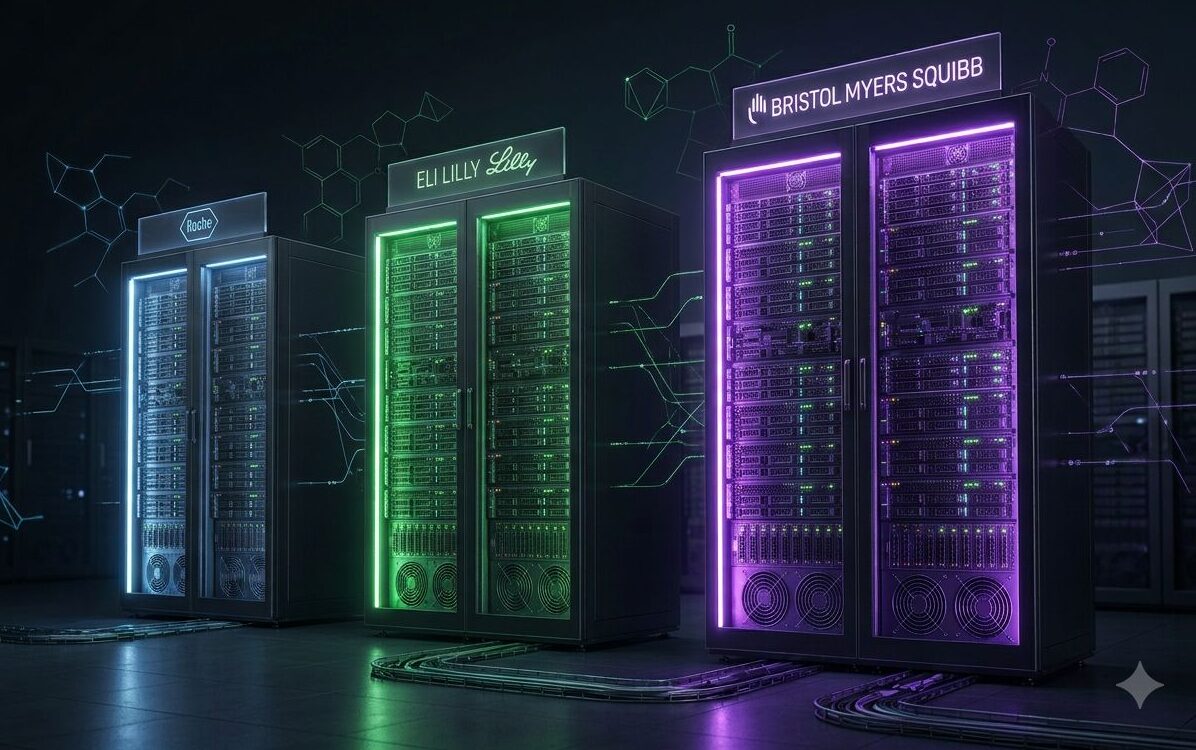
Bristol Myers Squibb announced on 20 July 2026 that it will deploy an NVIDIA DGX SuperPOD built on eight DGX Vera Rubin NVL72 systems, a move the company says will give it the most powerful and energy efficient single-owned NVIDIA infrastructure in the life sciences industry. The announcement makes BMS the third major drugmaker in nine months to lay claim to the same title, following Eli Lilly in October 2025 and Roche in March 2026, raising questions about whether the sector is witnessing a genuine computational arms race or a cycle of marketing superlatives.
Three Companies, One Title, Nine Months
The pattern began on 28 October 2025, when Eli Lilly announced at NVIDIA GTC in Washington, D.C. that it was building what it described as the most powerful supercomputer owned and operated by a pharmaceutical company. The system, later branded LillyPod, was built on NVIDIA’s DGX SuperPOD architecture with 1,016 Blackwell Ultra GPUs. It went live at Lilly’s Indianapolis headquarters in February 2026, delivering more than 9,000 petaflops of AI performance.
Less than five months later, Roche moved to reclaim the crown. On 16 March 2026, the Swiss pharmaceutical group announced its own “AI factory” in partnership with NVIDIA, comprising more than 3,500 high-performance GPUs across on-premises sites in the United States and Europe and cloud infrastructure. Roche described it as the largest announced hybrid-cloud AI factory in the pharmaceutical industry, explicitly positioning itself as having overtaken Lilly’s benchmark.
Now BMS has entered the race with what it characterises as the next generation entirely: eight rack scale DGX Vera Rubin NVL72 systems, each combining NVIDIA Vera CPUs and Rubin GPUs. BMS says it will be the first life sciences company to acquire a DGX SuperPOD based on the Vera Rubin architecture, which NVIDIA introduced earlier this year as the successor to its Blackwell generation. The company claims the new system delivers up to ten times greater performance per megawatt than its predecessor.
Inside the Pharma AI Supercomputer BMS Is Building
The investment extends a collaboration that began nearly three years ago, when BMS first deployed a smaller NVIDIA DGX SuperPOD to support research and development. That original system, which Erin Davis, vice president of research business insights and technology at BMS, has informally dubbed the “SuperDuperPOD” in its expanded form, is now operating at capacity.
“We’re saturated,” Davis told the NVIDIA blog. “We’re in production with some very large scale predictions around large molecules. We’re building our own foundational models, and that takes a lot of GPUs.”
The new Vera Rubin cluster will be combined with the existing SuperPOD in a unified computing environment accessible from every BMS research site globally. Rather than restricting access to a small cohort of computational specialists, BMS intends to open the platform to its entire scientific workforce.
“Instead of equipping a small group of researchers with access to the supercomputer, we’re opening it up to literally every scientist,” Davis said. “No one has to wait, and no one is told they have a limit.”
The Vera Rubin system will serve as the computational backbone for BMS’s next generation foundation models, trained on decades of proprietary data, while also drawing on domain specific capabilities from BioNeMo, NVIDIA’s platform for biological AI. The system will power agentic workflows that allow researchers to evaluate hypotheses at a scale that was unachievable just a few years ago.
Early Returns on AI Investment
BMS’s existing AI infrastructure has already begun to change how the company discovers and develops medicines. AI agents that automate target identification and validation are saving scientists weeks of manual work, freeing time for higher value scientific decisions. The company has used AI to expand its library of CELMoD compounds, molecules engineered to selectively degrade cancer causing proteins, opening the door to new targets across a wider range of diseases including blood cancers.
Robert Plenge, Executive Vice President and Chief Research Officer at BMS, told Artificial Intelligence News that AI tools have already reduced the time needed to produce medicines for clinical testing by 20 to 30 per cent, with the figure potentially climbing to 50 per cent over the coming years. He cited an experimental sickle cell disease treatment currently in early clinical development as one example of AI supported research, stating that the treatment probably would not have been discovered without the company’s AI tools. These figures have not been independently verified, and it remains too early to assess whether the efficiency gains in preclinical timelines will translate into faster regulatory approvals or patient access.
“Drug discovery is a sequence of decisions made under uncertainty, and better decisions come from better evidence, faster,” Plenge said in the BMS press release. “The goal isn’t speed for its own sake; it’s raising the probability that each programme we advance is the right one.”
The Predict First Methodology
Central to BMS’s approach is a methodology the company calls “Predict First,” where AI generated predictions inform experimental design before work begins at the laboratory bench. According to BMS, this approach now informs the design of every small molecule programme and the majority of its large molecule programmes.
Payal Sheth, Senior Vice President of Therapeutic Discovery Sciences at BMS, described the shift in practical terms on the NVIDIA blog.
“We use predictions as a way to prioritise synthesis of molecules with multi parameter optimisation,” she said, “to weed out molecules that wouldn’t necessarily meet the property landscape we’re working towards.”
The result, Sheth explained, is that laboratory experiments are increasingly aligned with progressing only those molecules that have the highest probability of success. Before BMS’s expanded AI infrastructure, Plenge noted, the company might evaluate ten potential candidates for a given target. With the new system, that number is expected to reach dozens, substantially broadening the search space without a proportional increase in bench time.
Hybrid Intelligence and the Agentic Future
BMS frames its vision as “hybrid intelligence,” a model of scientific work where AI co scientists and human researchers operate in close coordination. AI systems handle the execution of complex, data intensive tasks, while scientists focus on direction, interpretation, and the decisions that require deep human expertise. The model is not unique to BMS; Lilly and Roche have described similar ambitions, and the language of human-AI collaboration has become standard across the sector’s AI announcements. What distinguishes each company’s approach will ultimately be the results it delivers, not the terminology.
Sheth described how this creates a cumulative learning loop that did not exist earlier in her career. “Every project was treated differently, and there were discrete sets of learnings that did not compound into any kind of intelligence framework within discovery,” she said. “There’s a cumulative learning loop today in drug discovery that did not exist when I first started my career.”
Agentic AI workflows are a critical component of this architecture. Unlike individual AI tools that perform isolated tasks, agentic systems can operate across organisational silos, drawing on data from multiple programmes simultaneously. “Agents don’t care,” Davis said. “They go all across. And that is a huge game changer because now we can learn from decisions across the silos and across programmes.”
An Arms Race with Real Stakes
The rapid succession of superlative claims, from Lilly to Roche to BMS, each separated by just a few months, reflects a broader shift in how pharmaceutical companies view computational infrastructure. The pharma AI supercomputer has moved from a novelty to a strategic necessity. Where AI was once a research experiment confined to specialist teams, it is now being positioned as core infrastructure, comparable to a company’s clinical pipeline or manufacturing network.
Each company has carefully qualified its claim to the title. Lilly called its system the most powerful “owned and operated” by a pharmaceutical company. Roche described the “largest announced hybrid-cloud AI factory” in the sector. BMS now claims the most powerful “single owned” NVIDIA infrastructure in life sciences. The subtle differences in framing suggest that, while the underlying investments are substantial, the marketing dimension should not be ignored.
What is harder to dispute is the scale of commitment. Lilly has pledged up to $1 billion over five years through its NVIDIA co innovation lab. Roche has deployed more than 3,500 GPUs across multiple continents. BMS is deploying NVIDIA’s newest architecture before any other life sciences company. Financial terms of the BMS deal were not disclosed.
Greg Meyers, Chief Digital and Technology Officer at BMS, framed the investment in operational terms in the company’s press release.
“BMS has made a deliberate bet on AI, and we are beginning to see it pay off in our pipeline and operations,” he said. “Expanding our compute capabilities with NVIDIA gives our researchers and teams across the business the scale they need to keep BMS at the leading edge of what AI can do for drug discovery and development.”
For an industry where bringing a single drug to market still typically takes more than a decade and costs billions, the pharma AI supercomputer race signals a deeper conviction: that computational scale is no longer optional, but existential. The question is no longer whether AI infrastructure matters, but whether any major drugmaker can afford to be without it.