

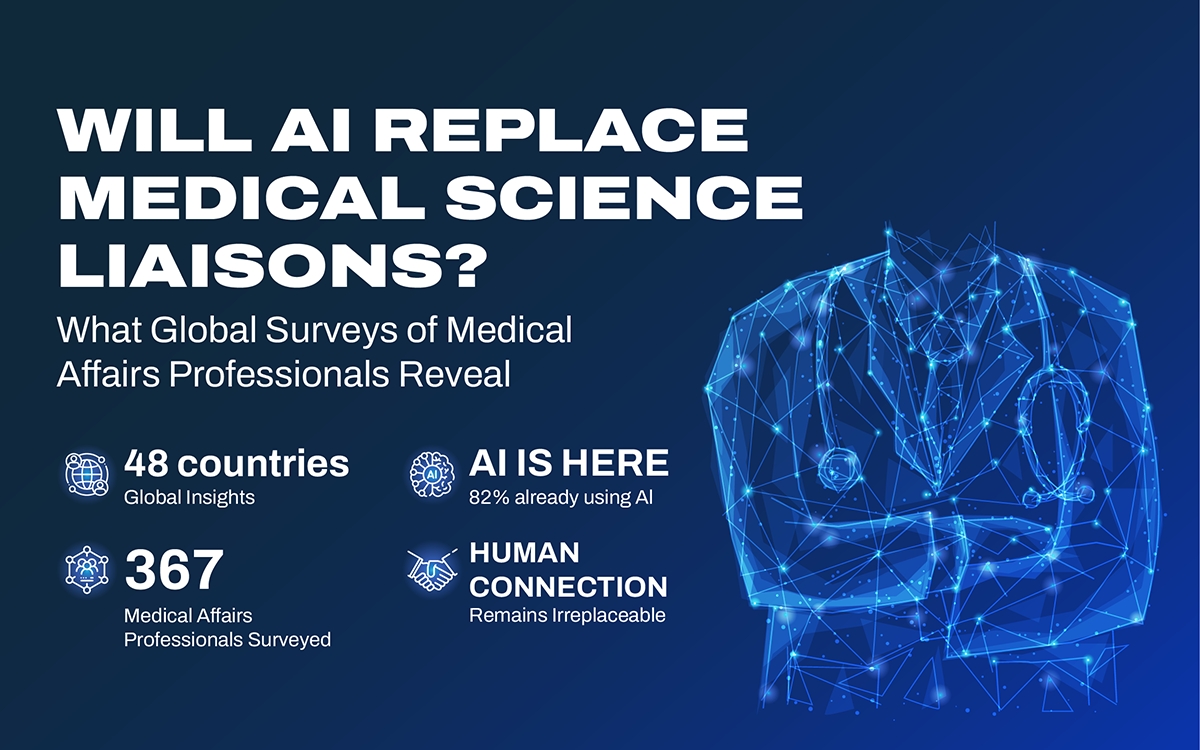
What Global Surveys of Medical Affairs Professionals Reveal
Artificial intelligence (AI) is rapidly transforming the pharmaceutical industry, prompting many Medical Affairs professionals to ask whether some roles may eventually become obsolete. Headlines regularly predict workforce disruption, while new AI tools appear almost weekly, promising greater efficiency, automation, and productivity.
As a result, an important question continues to emerge across the pharmaceutical industry: Will AI replace Medical Science Liaisons (MSLs)?
The answer may be more nuanced than many expect.
Recent findings from the first global surveys examining AI adoption and perceptions within Medical Affairs, conducted by the Medical Science Liaison Society, suggest that while AI is likely to significantly change how MSLs work, it is far less likely to replace the role itself. The study surveyed 367 Medical Affairs professionals from 48 countries and found widespread AI adoption, strong expectations for future impact, and a growing recognition that some aspects of Medical Affairs are more susceptible to automation than others. 1
Most importantly, the findings suggest that the future of Medical Affairs may not be a choice between humans and AI. Instead, it is increasingly becoming a question of how organizations can effectively combine the strengths of both.
AI Adoption in Medical Affairs Has Already Arrived
For many organizations, AI is no longer a future initiative. It is already being incorporated into daily activities. The survey results revealed that 82% of Medical Affairs professionals reported MSLs use (or would use) AI for literature reviews, data analysis, presentation preparation, real-time information retrieval during KOL engagements, and other tasks. 1 In addition, 74% reported AI will have a significant impact on Medical Affairs in the near future. 1
These findings demonstrate that AI adoption is not limited to early adopters or technology enthusiasts. Across the pharmaceutical, biotechnology, medical device, and diagnostic companies, MSLs are actively utilizing AI to improve efficiency, reduce administrative burden, and support scientific activities.
These are all activities that traditionally require substantial amounts of time and resources. By reducing the time required to perform routine tasks, AI has the potential to allow MSLs to focus more attention on strategic activities and KOL engagement.
However, increased efficiency should not be confused with role replacement.
The survey suggests that Medical Affairs professionals clearly distinguish between tasks that can be automated and those that require uniquely human capabilities.
Which Medical Affairs Roles Are Most Vulnerable?
Findings from another global survey explored perceptions regarding which Medical Affairs roles are most likely to be significantly reduced as AI capabilities continue to advance (Table 1). 2
When respondents were asked which role in Medical Affairs would most likely experience substantial reductions over the next few years, the results were striking.
Table 1. As a Result of AI Advancements, Which Role in Medical Affairs Will Most Likely Be Significantly Reduced Over the Next Few Years?
| Role | Percentage of Respondents |
| Medical Information | 72% |
| No Roles Significantly Reduced | 20% |
| MSLs/Medical Advisors | 6% |
| Leadership Roles (Director/VPs) | 2% |
N = 806
The overwhelming majority of respondents identified Medical Information as the function most susceptible to AI-driven workforce reductions.
This finding is not surprising. Medical Information teams frequently manage activities involving information retrieval, literature searches, content generation, and responses to structured inquiries. These are areas where AI technologies already demonstrate considerable capabilities.
Notably, one in five respondents believed that no Medical Affairs roles would be significantly reduced as a result of AI. This suggests that many professionals view AI as a tool that will augment existing teams rather than eliminate positions outright. By contrast, only 6% of respondents identified MSLs and Medical Advisors as the roles most likely to be significantly reduced, while just 2% pointed to Medical Affairs leadership positions such as Directors and Vice Presidents.
This distinction highlights a critical difference between information management and scientific engagement. AI excels at processing information. It can retrieve, summarize, organize, and generate content at speeds unimaginable just a few years ago. Yet the MSL role involves more than information engagement.
MSLs develop long-term scientific relationships with KOLs and other health care professionals (HCPs), navigate complex clinical discussions, gather insights, identify unmet needs, build trust, and provide context that extends beyond what is written in a publication or contained within a database. These responsibilities rely heavily on human interaction and professional judgment. The survey findings suggest that Medical Affairs professionals recognize this distinction.
Is AI a Threat to Typical MSL Activities?
In the previously mentioned global survey on AI adoption and perceptions, while respondents generally did not believe AI would replace the MSL role, it also explored whether AI could threaten specific activities commonly performed by MSLs. 1
Table 2. Do You Perceive AI as a Threat to Any of the Typical Activities of the MSL Role?
| Response | Percentage of Respondents |
| Yes | 11% |
| No | 58% |
| I am not sure | 31% |
The results reveal a notable level of confidence in the MSL role’s resilience. A majority of respondents (58%) reported that they do not perceive AI as a threat to typical MSL activities. However, uncertainty remains significant. Nearly one-third of respondents (31%) indicated they were unsure whether AI could threaten aspects of the role, reflecting the rapidly evolving nature of AI technologies and the difficulty of predicting future capabilities. Only 11% viewed AI as a direct threat to typical MSL activities.
These findings reinforce the broader survey results, suggesting that Medical Affairs professionals see a distinction between automating tasks and replacing the scientific engagement, relationship-building, and strategic insight generation that characterize successful MSLs.
The Human Capabilities That Continue to Matter
As AI capabilities expand, an important question emerges: What aspects of the MSL role remain difficult to automate?
The answer appears to center on the very characteristics that have historically defined successful MSLs. Scientific exchange is not simply the transfer of information from one individual to another. It is an interactive process involving active listening, interpretation, context, credibility, and trust.
An experienced MSL can identify concerns that are not explicitly stated, recognize emerging trends within clinical practice, understand local healthcare challenges, and facilitate discussions that uncover valuable insights. These interactions often depend on emotional intelligence, communication skills, and relationship-building abilities.
KOLs and other HCPs engage with MSLs because they value more than just access to scientific information. They value access to a trusted scientific colleague who can interpret evidence, discuss clinical implications, and provide meaningful context. While AI can assist with information delivery, it cannot easily replicate the trust that develops through repeated professional interactions over time. This may explain why survey respondents viewed the MSL role as substantially less vulnerable to automation than other Medical Affairs functions.
Will AI Reduce Medical Affairs Leadership Roles?
Role impact remains one of the most frequently discussed topics surrounding AI adoption. Many organizations are exploring how AI may influence staffing needs, productivity expectations, and resource allocation. A third global survey specifically evaluated perceptions regarding the future of Medical Affairs leadership roles. 3
Table 3. Will the Number of Medical Affairs Leadership Roles (e.g., Directors, VPs) Be Significantly Reduced in the Next Few Years as a Result of AI?
| Response | Percentage of Respondents |
| YES, MAJOR reduction in numbers | 16% |
| YES, MINOR reduction in numbers | 39% |
| NO, Numbers remain the same | 45% |
N = 520
While more than half of respondents anticipated some level of reduction in Medical Affairs leadership roles, only 16% expected major decreases in the number of leadership roles. The largest proportion of respondents (45%) believed leadership numbers would remain unchanged despite increasing AI adoption.
These findings suggest that many professionals view AI primarily as a force multiplier rather than a replacement technology, even at senior levels of the organization. Organizations may use AI to improve efficiency and productivity while continuing to rely on experienced leaders to provide strategic direction, oversee complex decision-making, manage stakeholders, and guide organizational change. This perspective aligns with how many organizations have historically adopted new technologies. Automation often changes how work is performed rather than eliminating the need for human expertise altogether.
Most Expect AI to Have a Significant Future Impact
In the global AI adoption and perceptions survey, although respondents generally did not view AI as a direct threat to MSL activities, they overwhelmingly anticipated that AI would meaningfully influence Medical Affairs and the MSL function. 1
Table 4. How Would You Assess the Potential Future Impact of AI in Medical Affairs and the MSL Function?
| Response | Percentage of Respondents |
| Highly impactful | 27% |
| Impactful | 47% |
| Somewhat impactful | 21% |
| Limited impact | 4% |
| No impact | 1% |
The findings indicate that AI will shape the future of Medical Affairs. Nearly three-quarters of respondents (74%) described AI as either highly impactful or impactful, while an additional 21% considered it somewhat impactful. Only 5% believed AI would have limited or no impact.
These results suggest that Medical Affairs professionals do not expect AI to replace MSLs, but they do expect it to fundamentally influence how MSLs operate. The challenge for organizations will be adapting activities, training programs, expectations, and responsibilities to capitalize on AI’s strengths while preserving the human elements that remain central to scientific engagement.
However, the survey findings suggest that the impact of AI on Medical Affairs will be driven less by role replacement and more by the evolution of the role. This is particularly relevant for MSLs, whose responsibilities extend beyond information delivery and into areas where human judgment, scientific dialogue, and relationship-building remain essential.
The MSL of the Future
The survey findings should not be interpreted as evidence that the MSL role will remain unchanged. In fact, the opposite is likely true. MSLs may experience significant changes in how they prepare for engagements, analyze data, identify trends, communicate scientific information, and document activities. Future MSLs will likely spend less time performing repetitive administrative tasks and more time focusing on strategic scientific engagement.
As AI becomes increasingly integrated into Medical Affairs workflows, new competencies may emerge as essential.
Ironically, the widespread availability of AI may increase the value of skills that are uniquely human, including Emotional Intelligence. As scientific information becomes easier to access, the ability to interpret and present that information, provide context, and build trusted professional relationships may become even more important.
Evolution, Not Extinction
The question facing Medical Affairs leaders is no longer whether AI will impact the profession.
That transformation is already underway.
The more important question is which capabilities will become increasingly valuable as AI becomes commonplace.
The findings from these global surveys highlight that relying solely on scientific knowledge is not enough. 4 As information becomes increasingly accessible as a result of AI, the uniquely human capabilities that have always been critical to the success of the MSL role, including building trusted relationships, interpreting context, exercising judgment, gathering actionable insights, mentoring, and facilitating value-added scientific exchange, may become even more valuable. 5 Recent research has also demonstrated the continued importance of mentorship, professional guidance, and meaningful interpersonal interactions in shaping career awareness and professional development, highlighting areas where human engagement remains difficult to replicate through technology alone. 6
As a result, AI may not diminish the importance of MSLs. Counterintuitively, AI may elevate the importance of the uniquely human capabilities that define the profession.
The future of Medical Affairs is unlikely to be human versus AI. It is far more likely to be human plus AI.
Author Bio
Samuel Dyer, MD, PhD, CEO of the Medical Science Liaison Society, is a global leader in the Medical Science Liaison (MSL) profession and has over 26 years of international experience. During his career, he has managed MSL teams and operations in over 60 countries. While leading the MSL Society, he has trained MSL teams at over 80 companies in more than 20 countries. He has authored multiple peer-reviewed publications and global surveys on the MSL profession. Dr. Dyer is a multi-award-winning author of two books on the MSL profession and an Amazon #1 Best-Seller.