Amylin analogues have become one of the most active areas of obesity drug development. Novo Nordisk, Eli Lilly, Roche, Pfizer, AbbVie and AstraZeneca all hold clinical programmes built on the hormone amylin. The most advanced obesity candidate in the class, Novo Nordisk’s CagriSema, awaits a US regulatory decision anticipated by late 2026. Behind it sit monotherapy candidates that compete less on peak weight loss and more on tolerability. This explainer sets out how amylin analogues work, what the data show and where the competition is heading.
How amylin analogues work
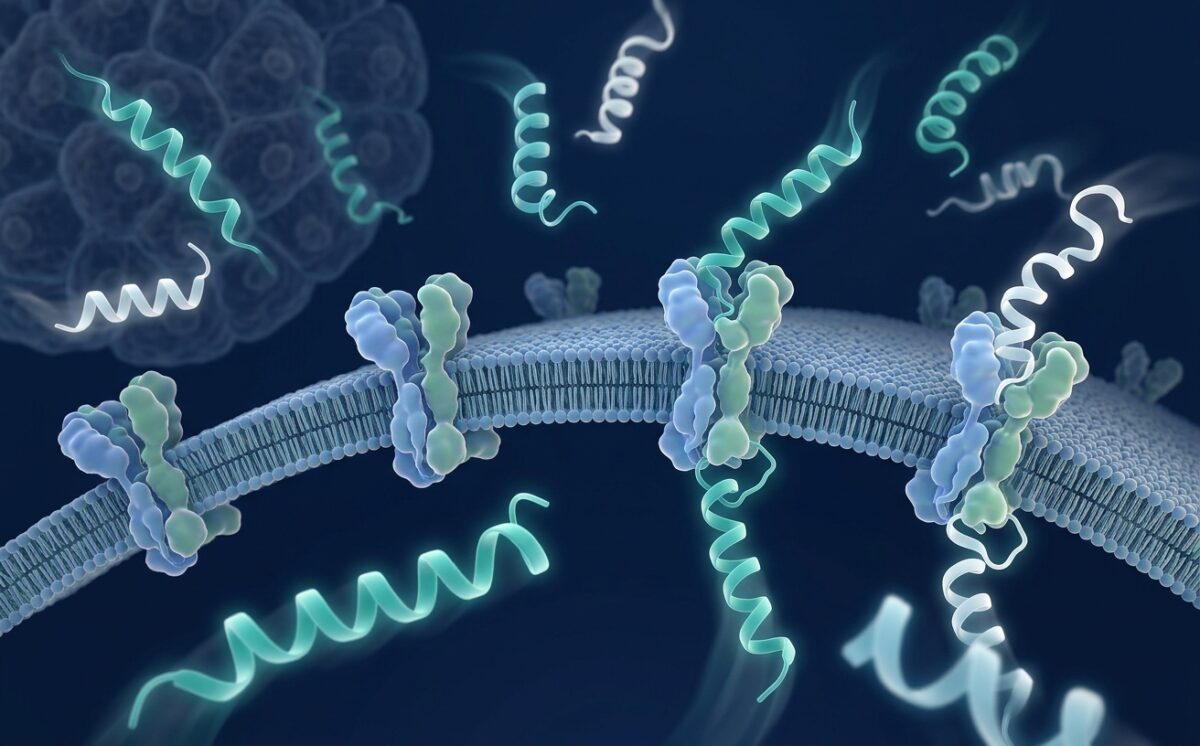
Amylin analogues are synthetic, longer-lasting versions of amylin designed for use as medicines. Amylin is a peptide hormone that pancreatic beta cells release alongside insulin after a meal. It slows gastric emptying, suppresses glucagon secretion and helps signal the end of a meal through the brain. Those actions sit outside the incretin pathway that GLP-1 drugs exploit. A 2026 review in Peptides reported that the effects of amylin analogues are additive to those of GLP-1 receptor agonists.
The first approved amylin analogue was pramlintide, used as an adjunct to insulin therapy. The review’s authors are Clifford Bailey of Aston University and Peter Flatt and J Michael Conlon of Ulster University. They note that pramlintide found only limited application. The authors describe a second generation of long-acting analogues that do not aggregate. Their design drew on a clearer understanding of how amylin and calcitonin receptor complexes are built.
Combining pathways is not a new idea in this field. The same logic underpins the dual and triple agonists that pair GLP-1 with GIP or glucagon activity.
Selective versus broader receptor activity
Developers have taken different positions on receptor selectivity. Lilly describes eloralintide as a selective amylin receptor agonist. Novo Nordisk describes cagrilintide as a dual-acting analogue that activates both amylin and calcitonin receptors. Kenneth Custer, president of Lilly Cardiometabolic Health, set out Lilly’s position in the company’s announcement. “We believe that molecule specificity is important in this class,” he said. No head-to-head trial has yet tested whether selectivity changes outcomes for patients.
CagriSema puts amylin analogues in obesity before the FDA
Novo Nordisk filed CagriSema with the US Food and Drug Administration (FDA) on 18 December 2025. The product combines cagrilintide 2.4 mg with semaglutide 2.4 mg in a single weekly injection. The new drug application rests on the REDEFINE 1 and REDEFINE 2 phase 3 trials.
Both pivotal trials tested CagriSema against placebo over 68 weeks. REDEFINE 1 enrolled 3,417 adults without diabetes, and REDEFINE 2 enrolled 1,206 with type 2 diabetes. Mean weight change was minus 20.4% and minus 13.7% respectively, against minus 3.0% and minus 3.4% with placebo. Novo Nordisk’s headline 22.7% figure for REDEFINE 1 assumes all participants stayed on treatment. Gastrointestinal adverse events affected 79.6% of the CagriSema group in REDEFINE 1, against 39.9% on placebo.
Novo Nordisk has said an FDA decision is anticipated by late 2026. LSDN found no published FDA action on the application as at 23 September 2026. Neither the FDA nor Novo Nordisk had confirmed a target action date when LSDN reviewed the CagriSema application in July.
The REDEFINE 4 setback
In February 2026, REDEFINE 4 compared CagriSema head-to-head with tirzepatide 15 mg in 809 people with obesity. CagriSema missed its primary endpoint of non-inferiority on weight loss at 84 weeks. Weight fell 23.0% against 25.5% if all participants adhered, or 20.2% against 23.6% on the treatment-regimen estimand. LSDN’s analysis of whether CagriSema can beat tirzepatide covers the trial in detail.
Chief executive Mike Doustdar defended the product in remarks to analysts. “To say it’s obsolete is quite belittling a fantastic drug, in all honesty,” he said, as reported by CNBC. A second head-to-head, REIMAGINE 4 in type 2 diabetes, showed non-inferiority on weight loss but not on HbA1c.
On 21 September 2026, Novo Nordisk reported topline results from REIMAGINE 5 and REDEFINE 9 at its Capital Markets Day. In REIMAGINE 5, CagriSema 1.0 mg/1.0 mg beat tirzepatide 5 mg on weight loss at week 60. The figures were 12.4% against 9.1% on the efficacy estimand. Its HbA1c reduction of 1.71% was non-inferior to 1.67% with tirzepatide. The comparator was tirzepatide 5 mg, not the 15 mg dose used in REDEFINE 4.
In REDEFINE 9, the same low dose produced 21.0% weight loss against 2.0% with placebo at week 68. That trial met its primary superiority endpoint.
Novo Nordisk expects REDEFINE 11 to report in the first quarter of 2027, according to Capital Markets Day remarks. A higher-dose CagriSema phase 3 trial is planned to start in the second half of 2026.
Monotherapy amylin analogues and the tolerability case
CagriSema pairs amylin with GLP-1. The next wave tests amylin analogues on their own. Their case rests less on maximum weight loss than on how well patients tolerate treatment. Novo Nordisk has said it plans to launch cagrilintide as a standalone product, in remarks at its Capital Markets Day.
Lilly’s phase 2 trial of eloralintide enrolled 263 adults with obesity or overweight and without type 2 diabetes. At 48 weeks, mean weight reductions ranged from 9.5% to 20.1% across treatment arms, against 0.4% with placebo. Those figures use the efficacy estimand and were not adjusted for multiplicity. The Lancet published the results in November 2025.
The most common adverse events were mild to moderate gastrointestinal symptoms and fatigue. Lilly said these were more frequent at higher doses and less frequent with slower dose escalation. Lead author Dr Liana Billings of Endeavor Health was quoted in Lilly’s announcement. She said the data “suggest eloralintide could offer a promising tolerability profile”.
Lilly’s second quarter 2026 materials list four phase 3 ENLIGHTEN trials. ENLIGHTEN-1 plans to enrol 1,980 people with obesity or overweight and without type 2 diabetes. ENLIGHTEN-2 covers 1,035 people with type 2 diabetes, while ENLIGHTEN-3 targets 800 people with obstructive sleep apnoea. ENLIGHTEN-6, with 900 planned participants, involves people already treated with an incretin.
Zealand Pharma and Roche are co-developing petrelintide under a 2025 collaboration. The phase 2 ZUPREME-1 trial enrolled 493 people with overweight or obesity. It met its primary endpoint of weight change at week 28. Petrelintide produced up to 10.7% mean weight reduction at week 42, a secondary endpoint. Placebo recorded 1.7% on the efficacy estimand.
Treatment discontinuation due to adverse events was 4.8% in the maximally effective arm, compared with 4.9% on placebo. That arm recorded no vomiting. Zealand also reported that female participants lost considerably more weight than male participants.
Adam Steensberg, Zealand’s chief executive, made the tolerability case in the company’s announcement. The key to improved health outcomes “is a treatment patients can stay on”, he said. Zealand and Roche expect to start phase 3 trials in the second half of 2026. Topline data from ZUPREME-2, in people with type 2 diabetes, are expected in the same period.
These results come from separate trials with different durations and populations. Eloralintide was measured at 48 weeks and petrelintide at 42 weeks, so the figures cannot be compared directly.
Single molecules and monthly dosing
Novo Nordisk is also developing zenagamtide, previously known as amycretin, one of the late-stage obesity drugs LSDN is tracking. It is a single peptide that activates both GLP-1 and amylin receptors. In a 36-week phase 2 trial in type 2 diabetes, weight fell by up to 14.6% at the highest dose. That was a key supportive secondary endpoint, against 2.1% with placebo.
Novo Nordisk plans a phase 3 programme in type 2 diabetes from the second half of 2026. In obesity, its AMAZE phase 3 programme is already under way, according to its first quarter 2026 report.
Pfizer entered the field through its acquisition of Metsera, completed in November 2025 after a bidding contest with Novo Nordisk. Pfizer’s May 2026 pipeline lists MET-233i, now PF-08653945, in phase 2. It is being studied alone and alongside berobenatide, a GLP-1 receptor agonist in development for monthly dosing.
In a phase 1 study reported in June 2025, MET-233i produced up to 8.4% placebo-subtracted weight loss at day 36. Metsera reported a 19-day observed half-life, which it said supports once-monthly dosing. AbbVie’s ABBV-295 and AstraZeneca’s AZD6234 are also in clinical development, according to a 2026 review of the class.
What amylin analogues could mean for UK patients
No amylin analogue for obesity holds a UK marketing authorisation. As at 23 September 2026, LSDN had found no confirmed CagriSema filing in the UK or the EU.
Any UK launch would enter a system that already rations access to the incumbent class. NICE guidance on tirzepatide set a phased NHS rollout. Around 220,000 people are expected to benefit in the first three years. NHS England had asked for the full rollout to run over 12 years. NICE will re-evaluate the remaining period using evidence from those first three years.
In LSDN’s reading, that constraint shapes the question an amylin sponsor would face in England. Tolerability affects how long patients stay on treatment, and persistence feeds into cost-effectiveness. No appraisal has yet tested that argument for amylin analogues, and NICE has taken no position on any amylin analogue.
UK researchers have helped build the evidence base. Professor Melanie Davies of the University of Leicester led REDEFINE 2. The 2026 Peptides review came from Aston and Ulster universities.
The battleground ahead
The next 18 months will test several claims at once. The FDA decision on CagriSema, anticipated by late 2026, will show how regulators read the first combination. ZUPREME-2 topline data and the start of petrelintide phase 3 fall in the same window. REDEFINE 11 follows in the first quarter of 2027, while ENLIGHTEN primary completions are listed from January 2028.
The central question is whether amylin analogues compete as stand-alone drugs, as partners for incretins, or both. In LSDN’s reading, and without head-to-head data, efficacy so far favours combinations while tolerability favours some monotherapies. How prescribers and payers weigh those trade-offs may decide which strategy prevails.