
Exploring the Role of Astrocytes in MND With Translatable Human Cell Models

Jul 24, 2026 | Biotech

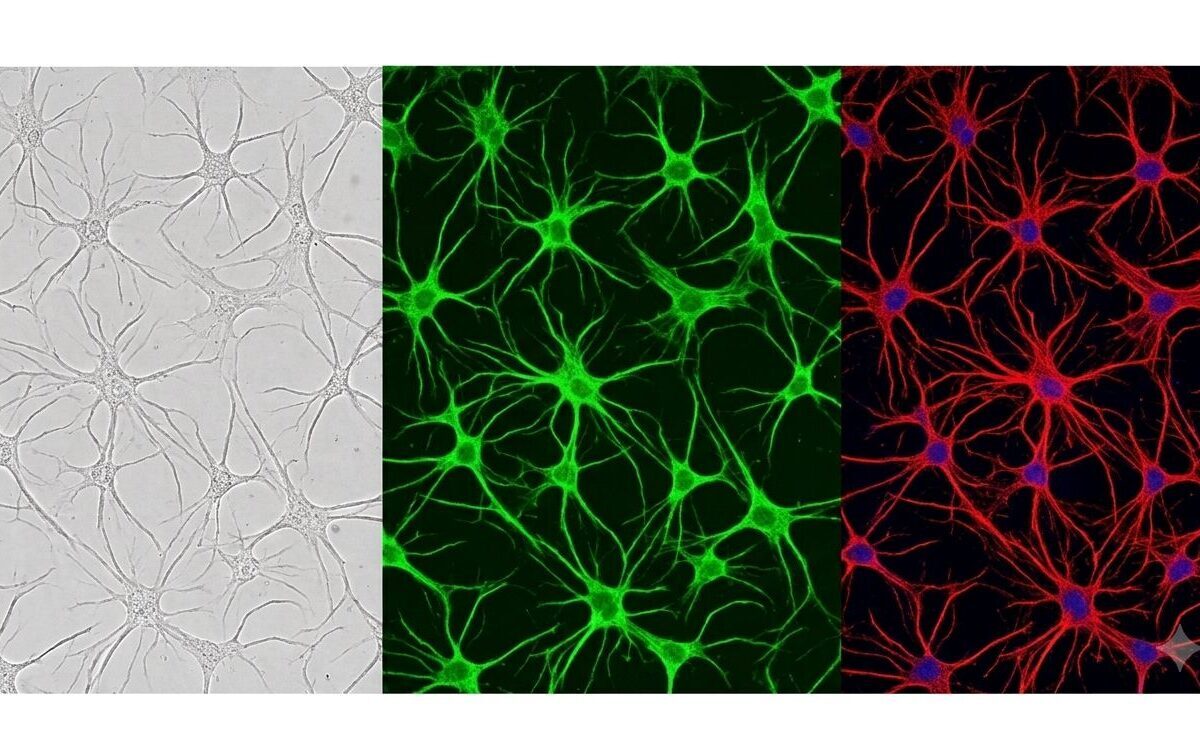
Image Source: LifeArc - A 4x magnified brightfield microscopy image (left), astrocytes dyed green with a fluorescent calcium dye (middle) and an image of the nucleus of the cells fluorescently dyed blue and the cell bodies red (right).
Written by: Viktoria Brachmaier
On behalf of: LifeArc, University of Sheffield

Motor Neuron Disease (MND) is characterised by the progressive loss of motor neurons. Despite years of research into the disease, effective treatments remain extremely limited and half of patients pass away within two years of diagnosis.

To date there is no cure for MND and only a few therapies exist that neither reverse nor stop disease progression but merely slow it. For example, riluzole, one of the most widely used MND therapies, extends survival by only a few months for many patients. This reflects a broader challenge across neuroscience research, where treatments that appear promising in laboratory studies frequently fail in clinical trials.

Since its first description in 1869, significant progress has been made in our understanding of genetic and biological mechanisms of MND. However, turning this knowledge into effective treatments is still proving difficult.

High rates of failure in clinical trials can be a result of a huge diversity of disease between individuals as well as the fact that lab models fail to capture and mimic this complexity of the human brain and spinal cord and the disease. These challenges highlight the need for multidisciplinary approaches, greater investment and out-of-the-box solutions along the research pipeline to successfully translate discoveries into therapies.

Better models for better treatment development

To develop better treatments, we need models that more closely reflect what happens in humans. Many of the models currently used to study MND fall into three main groups: animal models, labgrown cells, and computer models. While each has strengths, all come with important limitations.

Animal models, such as worms, flies, fish, and mice, help scientists study the disease in living organisms. However, these animals do not develop MND in the same way humans do, which means findings often do not translate well to patients. This is one reason why many treatments that look promising in the lab later fail in clinical trials.

Lab-based models, where cells are grown in dishes, make it easier to test drugs directly. However, these systems are much simpler than real human tissue and cannot fully reproduce the complex interactions between different cell types that drive disease progression.

Newer approaches using human stem cells allow scientists to generate patient-derived nerve cells in the lab. These models are more relevant to patients and can better reflect how the disease develops in people. Human stem cell systems are increasingly being viewed as an important route towards building more predictive, scalable, and clinically relevant models for neurodegenerative disease research.

The ‘stars’ of motor neuron disease

For decades, MND research has focused predominantly on motor neurons themselves. However, growing evidence suggests that other cell types within the brain and spinal cord may also play a critical role in driving disease progression. Among these are astrocytes, named after the Greek words for “star” and “cell” because of their distinctive shape, which are the most abundant cell subtype in the central nervous system (feature image).

Despite the label of being ‘helper’ cells, more recent research shows that they are anything but passive bystanders. Astrocytes are involved in almost every aspect of nerve cell functions, and they maintain their environment and regulate chemical signals between neurons and their energy use. Because of these broad responsibilities, dysfunction in astrocytes can have major consequences for the nervous system.

In MND, astrocytes appear to lose their protective functions and instead contribute to neuronal damage by adopting inflammatory and toxic states. Researchers still do not fully understand whether these changes are a cause or consequence of disease progression, creating an ongoing “chicken-and-egg” debate within the field. However, increasing attention is being directed towards astrocytes as potential drivers of neurodegeneration rather than passive bystanders.

The appearance of astrocytes in research papers has only picked up in the last 20 years and is still not comparable to the spotlight that neurons receive in this space. Scientists are still working to understand the diversity of astrocyte subtypes, how these cells change throughout disease progression, and whether they could serve as effective therapeutic targets. This emerging shift in focus has opened new opportunities to rethink how MND is modelled and studied.

Building human-relevant astrocyte models

My research focuses on developing human-relevant disease models that better capture the role of astrocytes in MND. By combining genetic studies of brain tissue from people who had MND, with cutting-edge lab models generated from human stem cells, this approach will allow better identification and confirmation of specific ways astrocytes contribute to the disease. The ultimate goal is to create disease models that closely mimic real-life conditions, allowing researchers to test potential treatments aimed at restoring normal astrocyte function.

These models could also improve how new therapies for neurodegenerative diseases are developed. By recreating key disease-associated cellular interactions in the laboratory, researchers may be able to identify new treatment targets in systems that more accurately reflect patient biology, improving confidence that findings will translate into clinical benefit.

Improved disease models may also help address one of the central challenges in neurodegenerative drug development: the high failure rate of clinical trials. Systems that better reflect human disease biology could enable earlier identification of ineffective therapies while accelerating the progression of more promising candidates into clinical testing.

Collaboration at the interface of academia and translation

This project is being carried  out through an Industrial Fellowship supported by the Royal Commission for the Exhibition of 1851, a long‑standing organisation established to advance science and innovation by supporting early‑career researchers working at the interface of academia and industry. The research brings together the Sheffield Institute for Translational Neuroscience (SITraN), a world‑leading centre focused on understanding and treating neurological diseases such as MND, and LifeArc, a medical research charity dedicated to turning scientific discoveries into life‑changing treatments for patients.

By combining patient‑focused neuroscience research with industrial expertise in drug discovery and translation, this collaboration aims to bridge the gap between understanding disease biology and delivering practical treatments. The project represents an important step forward for people living with MND, offering hope for meaningful progress against this devastating condition.


Author Bio



    Viktoria Brachmaier is a scientist at LifeArc, a non-profit organisation focused on first-stage drug discovery and diagnostics. She is a Royal Commission of 1851 Industrial Fellow, completing the Fellowship at LifeArc in collaboration with the University of Sheffield. She is passionate about supporting the next generation of scientists, demonstrated through her work running children’s science parties and supporting students at LifeArc.
    References: Avior, Y., Sagi, I. and Benvenisty, N. (2016) ‘Pluripotent stem cells in disease modelling and drug discovery’, Nature Reviews Molecular Cell Biology, 17(3), pp. 170–182. Available at: https://doi.org/10.1038/nrm.2015.27. Clerc, P., Lipnick, S. and Willett, C. (2016) ‘A look into the future of ALS research’, Drug Discovery Today, 21(6), pp. 939–949. Available at: https://doi.org/10.1016/j.drudis.2016.02.002. De Cock, L., Bercier, V. and Van Den Bosch, L. (2024) ‘Chapter Twelve - New developments in pre-clinical models of ALS to guide translation’, in P.J. Shaw and J. Kirby (eds) International Review of Neurobiology. Academic Press (Motor Neurone Disease), pp. 477–524. Available at: https://doi.org/10.1016/bs.irn.2024.04.008. Guidance on the use of riluzole (Rilutek) for the treatment of motor neurone disease | NICE (2001). NICE. Available at: https://www.nice.org.uk/guidance/ta20/resources/ta20-motor-neurone-disease-riluzole-guidance-html (Accessed: 30 April 2026). Halpern, M., Brennand, K.J. and Gregory, J. (2019) ‘Examining the relationship between astrocyte dysfunction and neurodegeneration in ALS using hiPSCs’, Neurobiology of disease, 132, p. 104562. Available at: https://doi.org/10.1016/j.nbd.2019.104562. Leeds Motor Neurone Disease (MND) Care Centre (2024) Leeds Teaching Hospitals NHS Trust. Available at: https://www.leedsth.nhs.uk/services/leeds-motor-neurone-disease-mnd-care-centre/ (Accessed: 4 December 2024). Ludolph, A.C. et al. (2010) ‘Guidelines for preclinical animal research in ALS/MND: A consensus meeting’, Amyotrophic Lateral Sclerosis, 11(1–2), pp. 38–45. Available at: https://doi.org/10.3109/17482960903545334. Pandya, V.A. and Patani, R. (2024) ‘The role of glial cells in amyotrophic lateral sclerosis’, International Review of Neurobiology. Elsevier, pp. 381–450. Available at: https://doi.org/10.1016/bs.irn.2024.04.005. Petrov, D. et al. (2017) ‘ALS Clinical Trials Review: 20 Years of Failure. Are We Any Closer to Registering a New Treatment?’, Frontiers in Aging Neuroscience, 9, p. 68. Available at: https://doi.org/10.3389/fnagi.2017.00068. Shaw, P.J. (2005) ‘Molecular and cellular pathways of neurodegeneration in motor neurone disease’, Journal of Neurology, Neurosurgery & Psychiatry, 76(8), pp. 1046–1057. Available at: https://doi.org/10.1136/jnnp.2004.048652. Stoklund Dittlau, K. and Van Den Bosch, L. (2023) ‘Why should we care about astrocytes in a motor neuron disease?’, Frontiers in Molecular Medicine, 3, p. 1047540. Available at: https://doi.org/10.3389/fmmed.2023.1047540. Talbot, K. (2002) ‘Motor neurone disease’, Postgraduate Medical Journal, 78(923), pp. 513–519. Available at: https://doi.org/10.1136/pmj.78.923.513. Talbot, K. et al. (2023) ‘Guiding principles for drug discovery and development in amyotrophic lateral sclerosis’. Available at: https://www.myname5doddie.co.uk/Guiding%20principles%20for%20drug%20discovery%20and%20development%20in%20amyotrophic%20lateral%20sclerosis.pdf. Vaz, S.H. et al. (2021) ‘Astrocytes in Amyotrophic Lateral Sclerosis’, in T. Araki (ed.) Amyotrophic Lateral Sclerosis. Brisbane (AU): Exon Publications. Available at: http://www.ncbi.nlm.nih.gov/books/NBK573422/ (Accessed: 1 December 2024). Vincent, A.M. et al. (2008) ‘Strategic approaches to developing drug treatments for ALS’, Drug Discovery Today, 13(1), pp. 67–72. Available at: https://doi.org/10.1016/j.drudis.2007.10.011. Yamanaka, K. (2023) ‘Neuroinflammation in neurodegenerative disease’, Nagoya Journal of Medical Science, 85(1), pp. 30–32. Available at: https://doi.org/10.18999/nagjms.85.1.30. Yamanaka, K. and Komine, O. (2018) ‘The multi-dimensional roles of astrocytes in ALS’, Neuroscience Research, 126, pp. 31–38. Available at: https://doi.org/10.1016/j.neures.2017.09.011. Zhang, Y. et al. (2014) ‘An RNA-sequencing transcriptome and splicing database of glia, neurons, and vascular cells of the cerebral cortex’, The Journal of Neuroscience: The Official Journal of the Society for Neuroscience, 34(36), pp. 11929–11947. Available at: https://doi.org/10.1523/JNEUROSCI.1860-14.2014. Zushin, P.-J.H., Mukherjee, S. and Wu, J.C. (2023) ‘FDA Modernization Act 2.0: transitioning beyond animal models with human cells, organoids, and AI/ML-based approaches’, The Journal of Clinical Investigation, 133(21), p. e175824. Available at: https://doi.org/10.1172/JCI175824.  
    All content is published for informational purposes only and does not constitute medical, legal, or investment advice. For more information, see our Terms and Conditions

    Articles that may be of interest

    NAMs and Animal Testing: Separating Progress From Hype

    NAMs and Animal Testing: Separating Progress From Hype

    If you followed the headlines over the past two years, you could be forgiven for thinking animal testing in drug development is already on its way out. In December 2022, the FDA Modernization Act 2.0 removed the blanket legal requirement for animal studies to support...

    read more
    Are Animal Models Limiting Progress in Product Development?

    Are Animal Models Limiting Progress in Product Development?

    While animal models have played a central role in safety assessment and biological research for decades, advances in cellular biology, computational modelling, and micro physiological systems are prompting scientists to explore new ways of generating human-relevant...

    read more

    Articles that may be of interest

    NAMs and Animal Testing: Separating Progress From Hype

    NAMs and Animal Testing: Separating Progress From Hype

    If you followed the headlines over the past two years, you could be forgiven for thinking animal testing in drug development is already on its way out. In December 2022, the FDA Modernization Act 2.0 removed the blanket legal requirement for animal studies to support...

    read more
    Are Animal Models Limiting Progress in Product Development?

    Are Animal Models Limiting Progress in Product Development?

    While animal models have played a central role in safety assessment and biological research for decades, advances in cellular biology, computational modelling, and micro physiological systems are prompting scientists to explore new ways of generating human-relevant...

    read more