Autoimmune CAR-T safety has moved to the centre of the cell therapy agenda. Novartis has halted eight clinical studies of its experimental CD19 CAR-T therapy rapcabtagene autoleucel. The company acted after three fatal cases of a severe inflammatory reaction. Bristol Myers Squibb then paused enrolment in its own autoimmune cell therapy programme. Two of the largest sponsors in the field stepped back within days of each other. The sector now faces a question about platform design rather than a single asset.
What Novartis Halted and Why
Rapcabtagene autoleucel, known as rap-cel or YTB323, targets CD19 on B cells. Novartis has been testing it well beyond oncology. The halted studies span autoimmune rheumatology and neurology.
Four are Phase 2 trials. They cover systemic lupus erythematosus and lupus nephritis, diffuse cutaneous systemic sclerosis, ANCA-associated vasculitis, and idiopathic inflammatory myopathies. The remainder are Phase 1/2 studies. These cover rheumatoid arthritis and Sjögren’s disease, generalised myasthenia gravis, relapsing multiple sclerosis, and non-active progressive multiple sclerosis.
Reports of eight studies and nine indications are both correct. Rheumatoid arthritis and Sjögren’s disease are enrolled under a single protocol. The lupus study is registered as a Phase 2 trial sponsored by Novartis Pharmaceuticals.
Screening, randomisation and dosing stopped across all of them, according to Fierce Biotech. Novartis implemented the halt on 24 August 2026. The company confirmed the trigger in a statement. The halt follows “three serious immune effector cell-associated hemophagocytic syndrome (IEC-HS) events”, Novartis said. A company spokesperson separately described the reaction as a known safety risk in CAR-T therapies.
Why IEC-HS Matters
IEC-HS is a hyperinflammatory syndrome that resembles haemophagocytic lymphohistiocytosis. It follows rapid T cell expansion after infusion. Presenting features include high ferritin, cytopenias and organ dysfunction. Clinicians recognise it as rare and potentially fatal. The American Society for Transplantation and Cellular Therapy set out a formal definition in 2023.
The syndrome is well described in haematological cancer. Its risk calculus changes in autoimmune disease. Lupus and myositis patients are not facing imminent death from their condition. A fatal toxicity therefore carries a different weight in the benefit-risk assessment.
Novartis has left its oncology programme for the same asset running. Studies in chronic lymphocytic leukaemia, diffuse large B-cell lymphoma and acute lymphoblastic leukaemia continue. That split is the clearest available evidence of the company’s reasoning. It signals a judgement tied to the patient population, not to the construct itself.
Bristol Myers Squibb Pauses Zola-Cel Enrolment
Bristol Myers Squibb paused enrolment across its autoimmune trials of zolacabtagene autoleucel, or zola-cel. The asset is also known as BMS-986353. Routine safety surveillance flagged what the company called transient and reversible inflammatory events.
The company framed the decision as precautionary. It acted “out of an abundance of caution”, it said. The company implemented “a voluntary pause to review clinical data across our zola-cel program”. Bristol Myers Squibb added that it retains confidence in the therapy, BioPharma Dive reported. It aims to resume testing as quickly as possible. The signal was not entirely new. Results published in February detailed one case of IEC-HS in a Phase 1 zola-cel study. A company spokesperson said the safety profile remains consistent with what is known for CAR-T therapies.
The registry position shows the breadth of the programme. Breakfree-1 is a Phase 1 study across four autoimmune diseases. Breakfree-2 is a Phase 1 study in multiple sclerosis and myasthenia gravis. Both are listed as recruiting. Breakfree-SLE, a Phase 2 study in lupus and lupus nephritis, is listed as active and not recruiting. A Phase 3 systemic sclerosis study is registered but not yet recruiting. A further study in autoimmune cytopenia is awaiting start.
Neither company has reported a regulatory clinical hold. Both pauses are sponsor-initiated. Novartis has said it is engaged with regulators as the review proceeds. That distinction matters commercially. A voluntary pause can be lifted on the sponsor’s own timetable.
Autoimmune CAR-T Safety and the Manufacturing Question
The two assets share more than a target. Both are made using shortened, next-generation manufacturing processes. Novartis uses its T-Charge platform. Bristol Myers Squibb uses NEX-T.
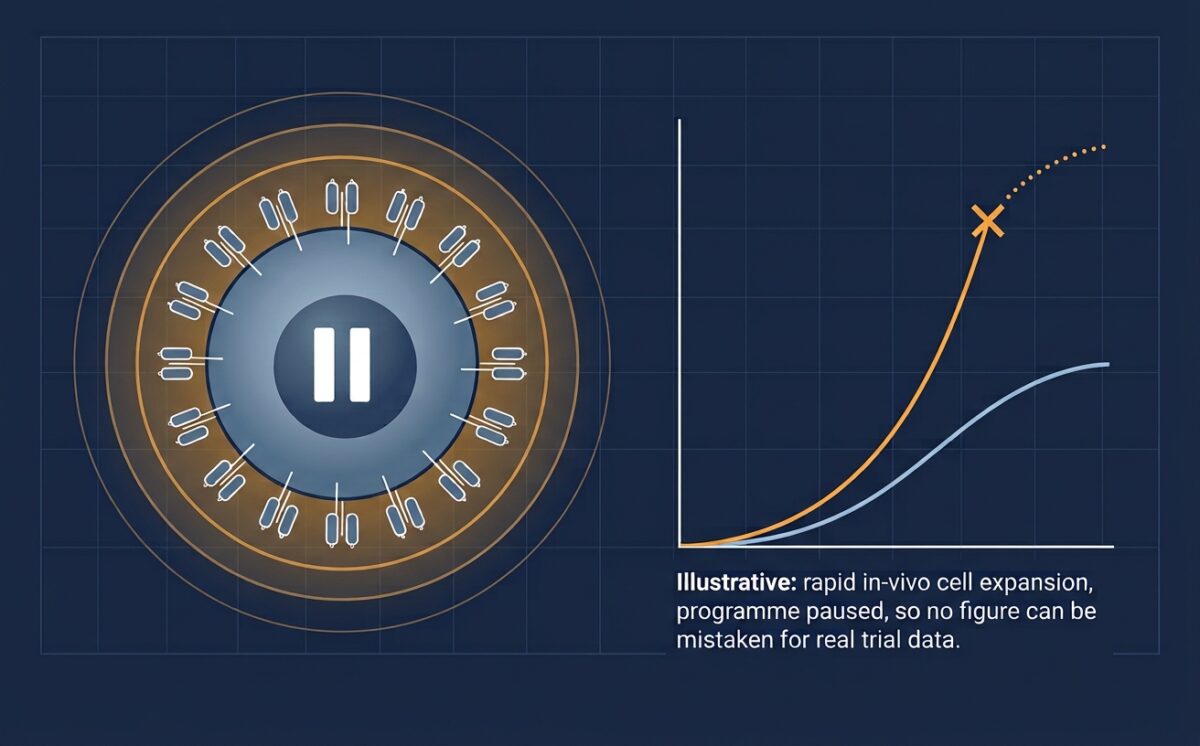
T-Charge cuts manufacturing to under two days. Novartis has described the design openly since 2021. Expansion of the CAR-T cells happens mainly inside the patient rather than in culture. The process is intended to preserve T cell stemness and reduce exhaustion.
That design choice delivers more proliferative potential. It may also deliver more inflammation. William Blair analyst Sami Corwin has pointed to the rapid manufacturing platforms as a possible driver. On that reading, faster processing produces greater cell expansion and the reported toxicities. Corwin cautioned that other factors could also be involved. The hypothesis is not proven.
For sponsors, the implication is uncomfortable. Manufacturing speed has been treated largely as a cost, capacity and vein-to-vein-time advantage. It is now also a candidate safety variable. Readers new to the modality can find the underlying mechanism explained in our guide to CAR-T therapy.
What the Pauses Mean for the UK Sector
Britain has a direct stake in autoimmune cell therapy. Autolus Therapeutics, headquartered in London, is running obecabtagene autoleucel, or obe-cel, in the same disease area. The asset is already approved in adult relapsed or refractory B-cell acute lymphoblastic leukaemia. The UK and EU authorisations are conditional and were granted in 2025.
Obe-cel uses a fast off-rate CD19 binding domain. The design is intended to limit excessive immune activation. Pivotal FELIX data in leukaemia were published in the New England Journal of Medicine in 2024.
In lupus, Autolus reported early Phase 1 CARLYSLE data at the American Society of Hematology meeting in December 2025. Nine patients had been dosed. At that timepoint the company reported only Grade 1 cytokine release syndrome and no ICANS. It also reported one transient Grade 3 liver toxicity in the higher dose cohort. Hypertension was recorded in five patients at the lower dose.
The company did not report on HLH or macrophage activation syndrome in that update. The approved obe-cel label does carry an HLH and MAS warning in the leukaemia setting. Those numbers are small and early. No valid cross-trial comparison can be drawn against the Novartis or Bristol Myers Squibb datasets. Patient populations, dosing regimens and follow-up duration all differ. The point is narrower. Different constructs and different manufacturing routes may carry different inflammatory risk.
Autolus published its second quarter results on 11 August 2026. A further CARLYSLE data update is due at the American College of Rheumatology meeting in the fourth quarter. Its pivotal Phase 2 LUMINA study in refractory lupus nephritis is enrolling across five countries. Data are expected in 2028. That timeline now sits in a changed competitive landscape.
Registry Records, Regulators and What Happens Next
One practical detail deserves attention from trial operations teams. As at 1 September 2026, several of the affected Novartis studies still showed a recruiting status on ClinicalTrials.gov. The lupus, systemic sclerosis, vasculitis, and rheumatoid arthritis and Sjögren’s records were among them. The myositis study was already listed as active and not recruiting. The most recent record updates predate the pause.
Registry lag is normal. It is also a reminder that sites and referring clinicians cannot rely on registry status alone. Sponsor communications remain the operative source during a fast-moving safety review.
Three questions will shape the next quarter. First, whether the IEC-HS cases cluster by indication, dose or prior therapy. Second, whether regulators in the United States, the European Union or Britain impose formal restrictions. Third, whether the field concludes that rapid manufacturing needs different monitoring protocols.
Contract manufacturers and treatment centres face a more immediate task. Inflammatory monitoring windows may need to lengthen. Referral pathways built around a short vein-to-vein time may need revisiting. Site staffing models assume a predictable toxicity window after infusion. That assumption is now under review in the autoimmune setting. Rheumatology and neurology units running these studies rarely carry haematology-grade critical care cover.
Autoimmune CAR-T has been among the most heavily funded stories in biotech. The promise is a drug-free remission after a single infusion. Early lupus data from several groups have supported that thesis. That promise is not withdrawn by these pauses. The margin for error in non-malignant disease has simply narrowed.
Investors and partners should expect slower enrolment across the sector. Protocol amendments and enhanced inflammatory monitoring are the likely near-term outcome. Companies with differentiated constructs will look to make that case loudly. The immediate market reaction was muted. Novartis shares rose around 4 per cent on Tuesday, with attention on its remibrutinib Phase III result.