The GLP-1 era has given clinicians something they have wanted for decades: medications that produce weight loss approaching what was once possible only with surgery. Semaglutide and tirzepatide routinely deliver reductions of 15% to 20% of body weight in trials, and that number, rather than body composition, now drives most of the conversation among patients, prescribers, payers and investors.
But body weight is a single number describing a complicated change. Two patients who each lose 20 kilograms can end up with very different bodies, very different strength and very different long-term risk, depending on what those 20 kilograms were made of. As a surgeon who prescribes these medications and also operates on patients after they have lost the weight, I see that difference every week. I would argue that body composition deserves a more central place in how we study, prescribe and monitor these therapies.
What the trials actually measured
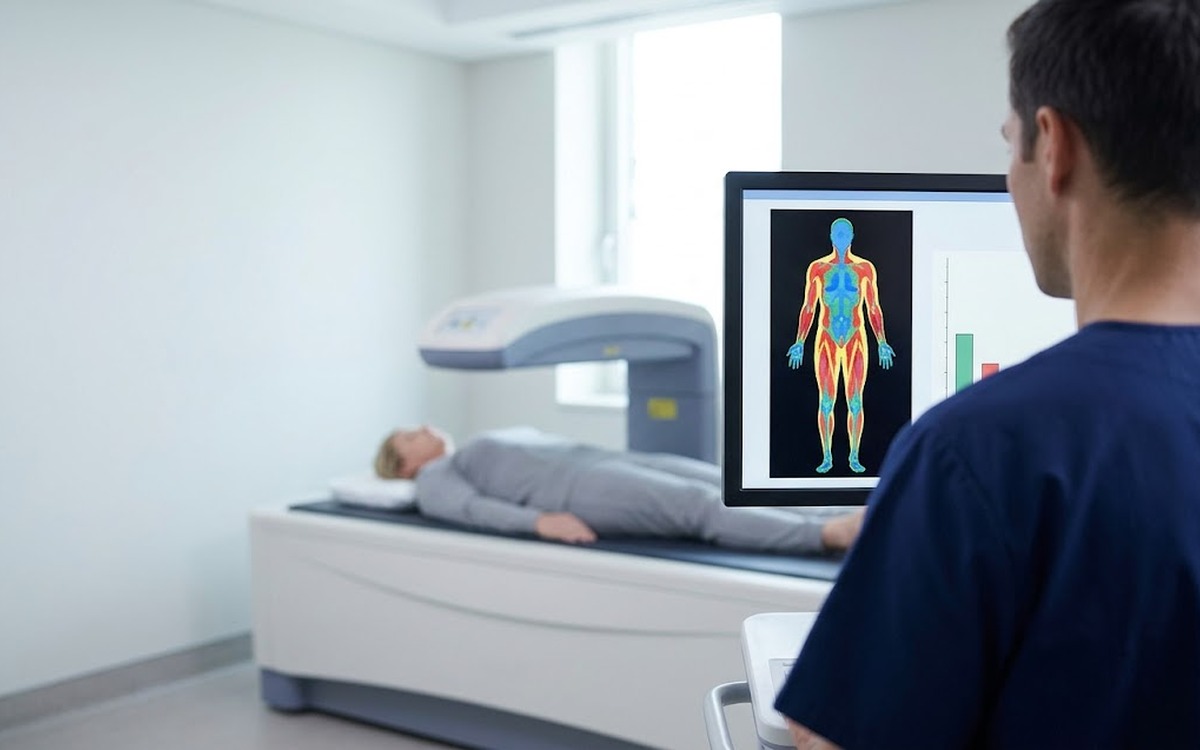
The pivotal trials did look at body composition. Both the STEP 1 trial of semaglutide and the SURMOUNT-1 trial of tirzepatide included substudies that measured fat and lean mass with dual-energy X-ray absorptiometry (DXA).
In the SURMOUNT-1 DXA substudy of 160 participants, those taking tirzepatide lost 21.3% of body weight over 72 weeks, including 33.9% of their fat mass and 10.9% of their lean mass. Roughly 75% of the weight lost was fat and 25% was lean mass, a proportion that held across most subgroups [2]. In the STEP 1 DXA substudy, lean mass accounted for a larger share, close to 40% of the weight lost with semaglutide [1]. A 2024 review of GLP-1-based therapies found even wider variation across studies, from roughly 15% or less to as much as 40% to 60% of total weight lost [3].
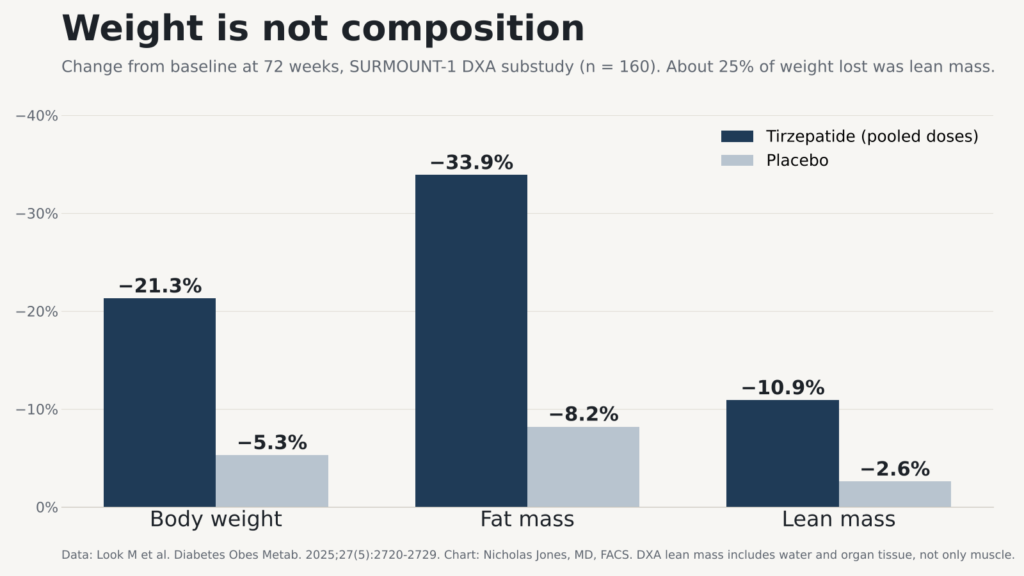
SURMOUNT-1 DXA substudy: change from baseline at 72 weeks with tirzepatide and placebo. Chart by Nicholas Jones, MD, FACS.
Two caveats matter. First, DXA lean mass is not the same as skeletal muscle. It includes water, organ tissue and the water content of fat tissue, so a fall in DXA lean mass overstates the loss of muscle itself. MRI-based studies suggest that the muscle changes seen with these drugs may be largely adaptive and proportionate to the weight lost, with some improvement in muscle quality as fat infiltration falls [3]. Second, these were substudies. Body composition was a secondary or exploratory measure, not a primary endpoint, and it is rarely measured in routine clinical care.
That is the gap I want to highlight. The issue is not that nobody has measured body composition. It is that weight remains the endpoint we treat as the outcome, while composition and function are treated as details.
Why the composition question matters
For a healthy 35-year-old with plenty of muscle reserve, losing some lean tissue along with a large amount of fat may carry little risk. The calculation changes for older adults, for patients who already have low muscle mass, and for people whose livelihoods depend on physical strength. Conte, Hall and Klein have argued that the clinical relevance of weight-loss-induced muscle loss is still uncertain, but that it deserves attention in populations already at risk of sarcopenia and functional decline [4]. Neeland and colleagues likewise flag older age and disease severity as factors that may affect who is an appropriate candidate [3].
Weight can also be regained after these medications are stopped. If a patient loses a meaningful amount of lean tissue on the way down and regains mostly fat on the way back up, the net result after a cycle of treatment and discontinuation could be a body that weighs the same but is weaker. That scenario has not been well characterized, and it is exactly the kind of question that composition and function data could answer.
What I see in my own practice
The observations in this section come from my own patients, not from published studies, and should be read as clinical experience rather than evidence.
I now regularly meet patients in their forties and fifties who have reached their goal weight on a GLP-1 medication and are surprised, and sometimes disappointed, by how their bodies look and feel. They are lighter, but many describe themselves as looking deflated. They have less muscle definition than they expected, and some feel physically weaker than they did before treatment. Rapid weight loss also reveals significant skin laxity, particularly in the abdomen, arms, thighs and breasts, and it changes body shape in ways a scale cannot capture.
Many of these patients were never told to track protein intake or to start resistance training when they began treatment. In my experience, those who did tend to arrive with better tissue quality and are often better candidates when they seek body contouring surgery.
How this compares with post-bariatric patients
Plastic surgeons have long experience with massive weight loss after bariatric surgery, and that experience offers useful context. A meta-analysis of 59 studies found that patients lost more than 8 kilograms of lean body mass in the first year after bariatric surgery, with about 55% of that loss occurring in the first three months [5]. Lean mass loss during rapid weight reduction is therefore not new or unique to GLP-1 medications.
What differs is the care pathway around it. Bariatric programs typically build in dietitian follow-up, protein targets and supplementation from day one. GLP-1 medications are often prescribed with far less structure. A 2025 joint advisory from four obesity and nutrition societies noted that evidence-based nutritional and behavioral therapy is not yet widely used alongside these drugs, and it called for baseline assessment of muscle strength, function and body composition, along with resistance training and adequate protein during treatment [6].
What clinicians should measure
Based on the published guidance and my own experience, I would suggest a few practical steps for any clinician prescribing GLP-1-based therapy, particularly for older or physically vulnerable patients:
1. Record a baseline body composition measurement where it is available, using DXA or a validated bioimpedance device, and repeat it at intervals during treatment rather than relying on weight alone.
2. Add a simple functional measure such as grip strength, a timed chair-stand test or gait speed. These are inexpensive and say more about a patient’s future than the scale does.
3. Ask about protein intake and resistance training at every visit, and refer to a registered dietitian when intake is falling short.
4. Watch the rate of weight loss. Very rapid loss in an older patient is a reason to look more closely at composition and function.
5. Plan for discontinuation, since what happens to lean mass during weight regain is still poorly understood.
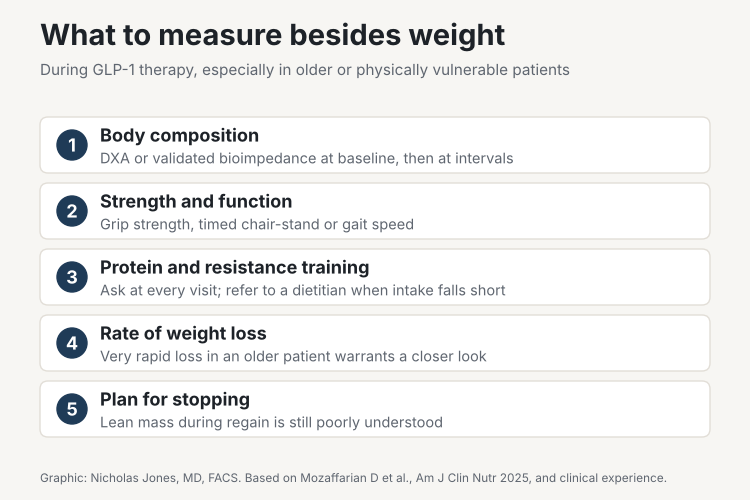
Suggested measures alongside weight during GLP-1 therapy. Graphic by Nicholas Jones, MD, FACS.
What this means for future research
For the life sciences community, the opportunity is to treat body composition and physical function as outcomes that matter in their own right. That could mean including composition and strength as key secondary endpoints in obesity trials, reporting skeletal muscle measures from MRI alongside DXA lean mass, and following participants through discontinuation and regain. Several therapies intended to preserve or build muscle in combination with GLP-1-based treatment are already in development [3], and they will need endpoints that capture function, not just mass.
The success of these medications is real. The next step is making sure we measure the right thing. Weight tells us how much a patient has lost. Composition and function tell us what the patient has left.
Author Bio