Collagen bioinks have to satisfy two very different demands. They need to behave predictably during printing, and once the printing stops they must also provide an environment in which cells can organise and begin behaving like tissue. However, it’s typically the second part of that equation that is changing how researchers judge success in 3D bioprinting.
A perfectly printed construct is not necessarily a successful tissue construct, and that distinction matters. Much of the early development of bioinks focused on what happened inside and immediately after the printer: could the material be extruded consistently, retain its intended geometry and support viable cells in the process? These remain essential requirements. But regenerative medicine ultimately asks more of a bioink than good print fidelity. The material left behind becomes part of the cellular environment. For collagen, that is where its value becomes particularly interesting.
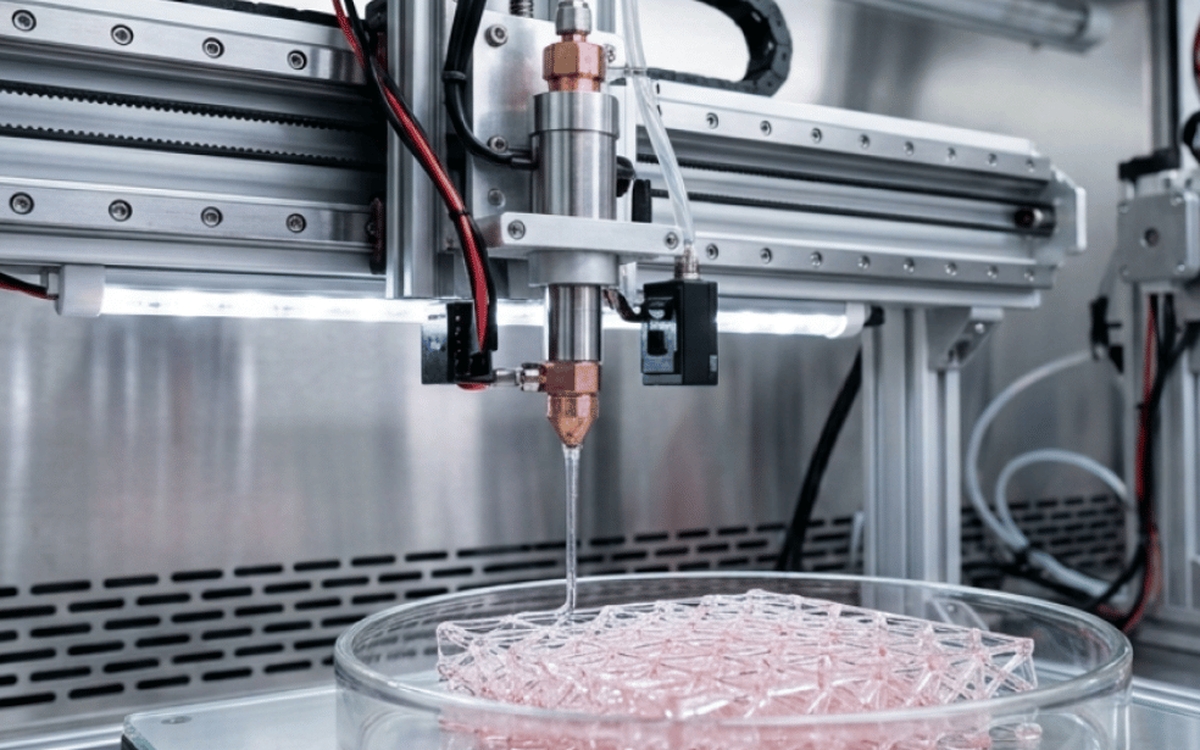
Printability is often only half the problem. Extrusion-based bioprinting places competing demands on a bioink: the material needs to flow through a nozzle without exposing cells to excessive stress, then recover enough structure to maintain the printed geometry. This makes rheological behaviour central to bioink development.
But optimising for the printer alone can create another problem, since a material engineered primarily for stiffness or rapid crosslinking might produce a serviceable construct but one that does not provide the proper conditions that cells need afterwards.
Collagen makes this trade-off particularly apparent. At low concentrations, collagen can lack the mechanical stability needed to maintain complex printed structures. Increasing concentration can improve shape fidelity, but changing the density and mechanics of the surrounding matrix also changes the environment experienced by cells. The question becomes not simply whether collagen can be made more printable, but how far its printing behaviour can be controlled without engineering away the biology that made it useful in the first place.
How Collagen Changes the Equation
As a major component of the extracellular matrix (ECM), collagen is more than a convenient carrier for cells, providing a fibrillar environment that cells can recognise and attach to, and then appropriately remodel.
This means the relationship between cells and a collagen bioink continues long after extrusion. Cells exert forces on the surrounding matrix and respond to its physical properties. Over time, they can reorganise the collagen network while depositing their own ECM.
Even the cells themselves can affect how a collagen bioink prints. Research using collagen loaded with chondrocytes has shown that cell density can alter the material’s rheological properties and, under some conditions, improve its printability. The cells are therefore not simply passengers being carried through a nozzle. They are part of the material system from the outset.[1]
That interaction makes collagen harder to reduce to a simple set of printing parameters. It also helps explain why it remains so relevant to tissue engineering. But a printed construct is only a snapshot. For regenerative medicine, the more important question is what happens over the following hours, days, weeks, and beyond.
Cells need to survive printing, but survival alone is a low bar: they must still interact with the matrix and (depending on the intended tissue) spread, proliferate, or differentiate within it. The construct itself may also need to change as newly deposited ECM gradually replaces or remodels the original bioink.
This shifts the definition of print fidelity. Holding an exact shape immediately after extrusion may be useful, but a living tissue construct is not supposed to remain biologically static. Recent collagen bioink research increasingly reflects this tension: improving gelation and mechanical integrity remains important, but these properties have to be balanced against cell adhesion and the ability of the material to reproduce aspects of native ECM.[2] A bioink could succeed as a printing material, but still fall short as a tissue environment.
What Should the Next Generation of Collagen Bioinks Be Judged On?
The real challenge for the next generation of collagen bioinks is therefore to have better control over what happens both during and after printing, which will require that researchers think beyond the geometry of the initial construct. Reproducible extrusion still matters, as does sufficient structural stability. But these characteristics need to coexist with an environment that allows cells to interact with the matrix in biologically meaningful ways.
This is a standard that will be more demanding, but it is also one that better reflects the goal of 3D bioprinting, which is not simply to manufacture structures that resemble tissue but to create conditions in which tissue can develop. Collagen’s future as a bioink may ultimately depend on how successfully those two requirements can be reconciled. And the best-performing material will not necessarily be the one that produces the most precise construct on day zero, but what that construct becomes next.
Author Bio